The Impact of Running Surface Material: Comparing Impact on Asphalt, Track, and Trail
Many runners train on the same surface every day without ever considering how surface material affects the body. In fact, from asphalt roads to running tracks to mountain trails, different surfaces have markedly different effects on joint impact, muscle engagement, and injury risk.
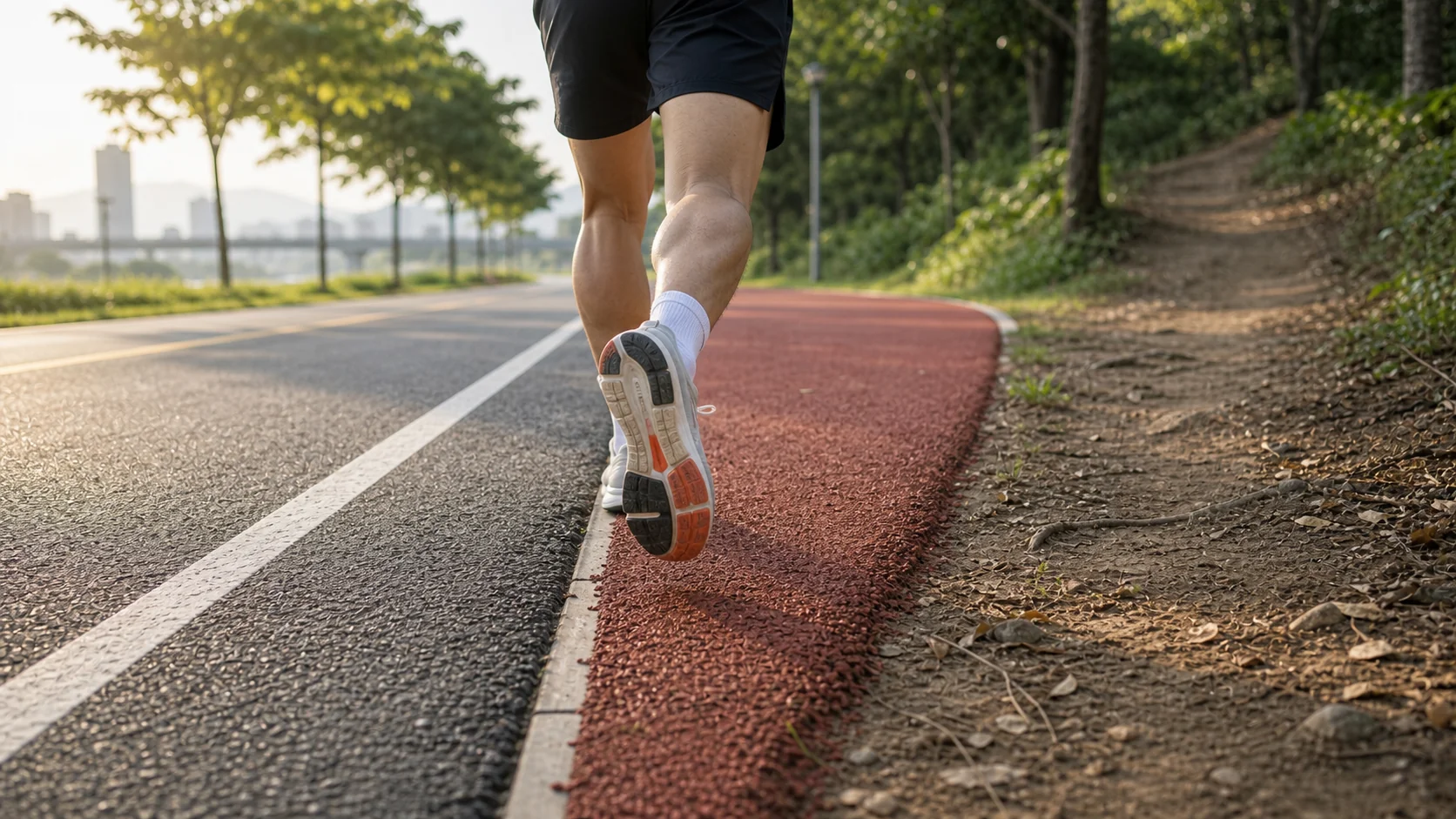
The Basic Science of Ground Impact
Every time your foot lands, the ground’s Ground Reaction Force (GRF) is roughly 2-3 times body weight during running. At a cadence of 180 steps per minute, each foot lands 90 times per minute, meaning you absorb roughly 150-200 impacts per kilometer.
These impacts are absorbed through the following structures:
- Ankle and arch (primary cushioning)
- Knee joint (main absorber)
- Hip joint (dispersing impact)
- Spine (final buffer)
Asphalt Roads
Characteristics
| Metric | Value/Description |
|---|---|
| Hardness | High |
| Impact absorption | Low |
| Ground Reaction Force (GRF) | Highest (approx. 2.5-3.0x body weight) |
| Friction coefficient | Moderate |
Advantages
- Most accessible, can run virtually anywhere
- Flat surface, stable pacing
- Suitable for accurately calculating training mileage
Disadvantages
- Highest impact, highest risk of cumulative injury
- Long-term training easily leads to tibial stress fractures and plantar fasciitis
Usage Recommendations
Asphalt is suitable for speed training and race simulation, but shouldn’t serve as the primary daily training surface. If you run over 60% of your weekly mileage on asphalt, injury risk rises significantly.
Rubber Running Track (Standard 400m Track)
Characteristics
| Metric | Value/Description |
|---|---|
| Hardness | Moderate-low |
| Impact absorption | Moderate-high |
| Ground Reaction Force (GRF) | approx. 2.0-2.5x body weight |
| Friction coefficient | High |
Advantages
- Rubber material provides noticeable cushioning effect
- Standard 400m length makes timed training convenient
- Suitable for track-style interval training
Disadvantages
- Lateral stress on the knee from curves: the track’s fixed direction (counterclockwise) means the left knee and left ankle bear more lateral pressure. Long-term track-only training increases left-side injury risk relative to the right side.
- Speed on curves matters: the faster you go, the greater the centrifugal force, and the higher the joint stress on the curve
Usage Recommendations
The track is suitable for interval speed training (such as 400m repeats), but it’s recommended to periodically alternate direction (switching between clockwise and counterclockwise) to balance left/right side loading.
Mountain Dirt Trail
Characteristics
| Metric | Value/Description |
|---|---|
| Hardness | Low-moderate (depends on soil) |
| Impact absorption | High |
| Ground Reaction Force (GRF) | approx. 1.8-2.2x body weight |
| Terrain variability | High (unpredictable) |
Advantages
- Lowest joint impact
- Terrain variation activates more stabilizing muscle groups (ankle, hip stabilizers)
- Strong psychological relaxation and enjoyment
- Uphill/downhill training builds more strength
Disadvantages
- High ankle sprain risk: irregular ground demands higher lateral ankle stability
- Imprecise speed training: terrain variation makes pacing unstable
- Requires trail running shoes: regular road shoes lack sufficient grip on dirt/gravel surfaces
Recommended Training Combination Across Three Surfaces
| Weekly Training Mileage | Recommended Surface Allocation |
|---|---|
| Asphalt | 30-40% (speed and pace training) |
| Track | 20-30% (interval and speed training) |
| Trail/off-road | 30-40% (recovery runs and long runs) |
The Special Case of Grass
Natural grass has the lowest impact of all surfaces, but due to its uneven surface, ankle sprain and instability risk is relatively higher.
Recommended uses:
- Post-race recovery runs
- Barefoot running training (improves plantar sensation)
Conclusion
The best training strategy is surface diversification. Each surface has its own unique benefits, and by alternating between them, you can:
- Reduce cumulative injuries caused by any single surface
- Train a more comprehensive range of muscle groups and neural control
- Keep both body and mind feeling fresh
Next time you’re designing a training plan, consider factoring in “surface diversity.”
Related Reading
- The Science of Sports Venues and Surfaces: How Track, Turf, and Asphalt Affect Your Performance and Injury Risk
- Runner’s Landing Mechanics: Technical Training and Measurement Methods to Reduce Ground Impact Force
- Ground Reaction Force at Foot Strike: A Quantitative Study of Load Distribution — Heel vs. Forefoot Strike
- Biomechanical Analysis of Road Running: How Ground Reaction Force Determines Your Running Efficiency
RAMP FTP Test 直播 究竟能撐到幾瓦 訓練台 Gravat Zwift
6 年前
一日北高常見問題大集合 | 攻略 | 路線 | 訓練 | 補給 | 自行車 單車 | 一日雙城 | 雙塔 | TWB北高360 | 屁股痛
6 年前
Vision Metron RS 37碳幅條輪組 (非SL)官網沒有的 低調開箱 / 這重量太銷魂了 / 公路車 / CT Yeh
6 個月前
Zwift 元宇宙單車世界 如何與全世界同步騎車運動
6 年前
公路車 BB培林大升級! / 備戰海鷗繞圈賽 Canyon Aerod & TIME 一起改 / MIT大廠 CEMA對鎖式陶瓷培林BB & 導輪 / 公路車 / CT Yeh
2 年前
靠單車減肥35公斤 心得分享與整理
7 年前
爬陡坡被爆胎的車友跑步超車 #cycling #里佳部落
9 個月前
大禹嶺 到 武嶺牌樓 全程前後實況錄影 | 北進武嶺 | 東進武嶺 | KOM | 訓練台 | 坡度分析 | Taiwan KOM Last 10 km HARD | 公路車
6 年前