Fast Bike Tire Change Techniques: How to Swap a Tire in Under 1 Minute During a Race
In road cycling races, a flat tire costs more than just the time it takes to fix it — it also brings a mental hit and the difficulty of fighting your way back into the pack. However, a well-drilled tire change can be completed in 60-90 seconds. Professional riders have recorded tire changes in under 40 seconds.
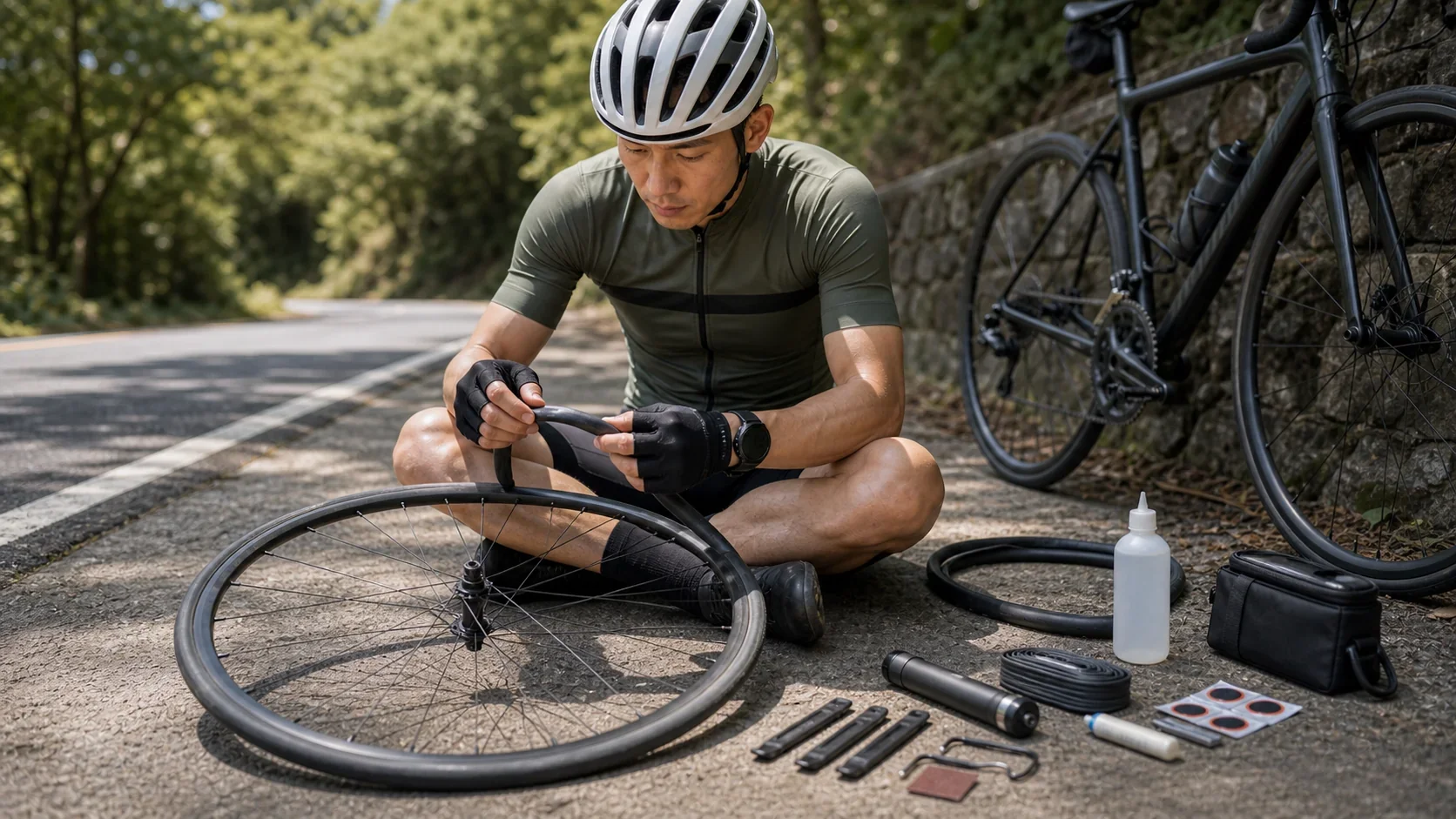
What Determines Tire-Change Speed
Tire-change time depends on:
- Tool readiness: Whether your spare tube and inflation tool are within easy reach
- Motor skill mastery: Whether you’ve practiced the motions repeatedly
- Wheel system: Quick-release vs. thru-axle, front wheel vs. rear wheel
- Tire type: Clincher with inner tube (standard change) vs. tubeless (plug or tube insert)
Tool Setup for a Fast Tire Change
CO2 Inflator vs. Portable Pump
CO2 inflator (strongly recommended for racing):
| Comparison | CO2 Inflator | Pump |
|---|---|---|
| Inflation time | 3-5 seconds | 3-5 minutes |
| Size/weight | Compact | Heavier |
| Uses | 1-2 (single-use) | Unlimited |
| Price | NT$150-200/cartridge | NT$500-2000 |
A single 16g CO2 cartridge can inflate a 700×25c tire to 100 PSI in under 5 seconds, making it an essential tool for race-day tire changes.
How to Carry Your Spare Tube
Options for quick access:
- Strapped under the saddle: Secured with a rubber band, ideal for racing (minimal aerodynamic impact)
- Rear saddle bag: More capacity, but slower to access
- Top-tube/frame triangle bag (BTA bag): Fast access, slight aero penalty
Race recommendation: Fold the spare tube into an S-shape and cinch it tight under the saddle rails with a rubber band. Paired with a CO2 cartridge, the whole bundle is only about 3-4cm thick.
Front Wheel Tire-Change Steps (Target: 60 Seconds)
Preparation (before the clock starts): Have your spare tube and CO2 cartridge already in hand or somewhere easy to grab.
Seconds 1-5: Stop + open the front quick-release
- Pull over to the side
- Open the front quick-release (standard skewer)
- Remove the wheel
Seconds 6-15: Remove one side of the tire + take out the old tube
- Remove one side of the tire by hand or with a tire lever
- Pull out the old inner tube
Seconds 16-20: Inspect the tire + install the new tube
- Run your fingers quickly along the inside of the tire (checking for anything sharp)
- Insert the new tube’s valve into the rim hole
Seconds 21-35: Reseat the tire + inflate with CO2
- Work the tire back onto the rim around the circumference (push the last section on with your thumbs)
- Attach the CO2 inflator head and press to inflate
Seconds 36-50: Reinstall the wheel + lock it
- Put the wheel back into the fork
- Close and lock the quick-release
- Confirm the disc brake/caliper is correctly seated
Seconds 51-60: Final check
- Give the tire a quick squeeze to confirm it’s properly inflated
- Roll out
Rear Wheel Tire Change (30-60 Seconds Longer Than the Front)
The rear wheel is harder because of the drivetrain (cassette and chain):
Technique:
- Before removing the rear wheel, shift the chain onto the smallest cog (hardest gear)
- When removing the wheel, let the chain hang naturally outside the smallest cog
- When reinstalling, slot the wheel back in next to the smallest cog the same way
This prevents the chain from tangling during installation and saves 15-30 seconds.
Training Plan
Practice tire changes once a week (15 minutes after work):
| Week | Target Time | Training Focus |
|---|---|---|
| Weeks 1-2 | No timing, get familiar with the motions | Do each step slowly and correctly |
| Weeks 3-4 | Under 5 minutes | Pick up the pace without mistakes |
| Weeks 5-6 | Under 3 minutes | Smooth and continuous |
| Weeks 7-8 | Under 90 seconds | Close to race speed |
| From month 2 | 60 seconds | Race-level speed |
How to practice against the clock:
- Prepare an old inner tube you can sacrifice (puncture it deliberately so you actually need to replace it)
- Set a timer on your phone
- Log your time each attempt and analyze where you’re losing time
Common Mistakes to Avoid When Changing a Tire
- Pressing the CO2 inflator before it’s properly seated: The CO2 leaks out and wastes the whole cartridge
- Forgetting to remove the sharp object still in the tire: The new tube goes flat immediately
- Not fully locking the rear quick-release: The rear wheel can come loose while riding — extremely dangerous
- Reinstalling the rear wheel with the chain in the wrong position: You’ll have to take it back off and readjust
Tire-changing skill is a fundamental part of being a cyclist. Every time you practice, you get one step closer to calmly fixing a flat during a race and fighting your way back into the pack.
Related Reading
- Emergency Flat Tire Response: A 10-Minute Guide to Changing Your Inner Tube on the Road
- Bike Flat Tire First Aid: The Complete SOP for Roadside Tube Changes and Patching
- Bike Tire Replacement in Practice: The Complete Process from Puncture to Patch to Full Tire Change
- Handling Mechanical Failures Mid-Race: The 5-Minute Golden Recovery Process for a Flat Tire
單車胎壓觀察到的有趣現象,SRAM Quarq TyreWiz 2.0 無內胎胎壓計 / 裝了有哪些幫助? / Tubeless / 公路車 / CT Yeh
1 年前
碟煞公路車 優缺點?換車一年半實際經驗分享 / 公路車 / CT Yeh
2 年前
碟煞公路車 銑面器 !? 原來銑完差這麼多! 降低蹭碟機率! | TIME 公路車 保養小記錄 | CT Yeh
3 年前
詳測) 小米 電動打氣筒 公路車胎要充多久? 值得買嗎? 米家充氣寶 小心燙手!
7 年前
公路車 BB培林大升級! / 備戰海鷗繞圈賽 Canyon Aerod & TIME 一起改 / MIT大廠 CEMA對鎖式陶瓷培林BB & 導輪 / 公路車 / CT Yeh
2 年前
#公路車 #Fitting 靠人工智慧APP 幫你調整單車
6 年前
Live) 備戰2019彰化經典百K 賽前攻略 (已完賽請看新影片
7 年前
#公路車 #西進武嶺 配速配瓦實驗 坡度分析 四小時內攻略 建大盃 NeverStop #西進武嶺攻略
6 年前