Before long climbing events like Wuling, Dongjin, or the KOM Challenge, almost every amateur cyclist in Taiwan runs into the same problem: limited time, slow recovery, and a desire to boost FTP quickly. Threshold training is too painful, and Zone 2 feels too slow — this is where “Sweet Spot” becomes the most underrated yet highest-efficiency piece of the puzzle.
Sweet Spot was first systematized by Frank Overton (FasCat Coaching) in the mid-2000s, and later quantified further by Coggan and Hunter Allen in Training and Racing with a Power Meter. Its core value is that it trades intensity slightly below threshold for adaptation benefits noticeably higher than Tempo — while requiring 30-50% less recovery time than Threshold work, making it ideal for working professionals who can only train 6-10 hours a week.
What Is Sweet Spot?
Sweet Spot refers to the 88%-94% of FTP range (some coaches define it more loosely as 84-97%). Using Coggan’s 7-zone model, it spans the fuzzy territory from the upper edge of Zone 3 (Tempo) to the lower edge of Zone 4 (Threshold).
| Intensity Zone | Power (% FTP) | Heart Rate (% LTHR) | RPE | Primary Adaptation |
|---|---|---|---|---|
| Zone 2 Endurance | 56-75% | 69-83% | 2-3 | Aerobic base, fat metabolism |
| Zone 3 Tempo | 76-87% | 84-94% | 3-4 | Muscular endurance |
| Sweet Spot | 88-94% | 92-97% | 5-6 | FTP, lactate threshold, muscular endurance |
| Zone 4 Threshold | 95-105% | 95-105% | 7-8 | FTP-raising |
| Zone 5 VO2max | 106-120% | >106% | 9 | Maximal oxygen uptake |
Why Is Sweet Spot Called the “Best Value” Zone?
A study published by Seiler in 2010 in Sportscience showed that intensities roughly 10% below threshold can stimulate mitochondrial biogenesis and capillary density at a lower perceived effort (RPE), without causing the 48-72 hours of deep fatigue typical of VO2max intervals. Internal data from FasCat Coaching also shows that amateur riders who did Sweet Spot work 3 times a week for 6 consecutive weeks saw an average FTP increase of 5-8%.
Its three main advantages are:
- High training stress per unit time (TSS/hour): One hour of Sweet Spot yields roughly 85-90 TSS, about 20% more than Tempo (70)
- Fast recovery: You can train again within 24 hours, unlike VO2 intervals that can wipe out your form for a whole week
- Longer cumulative duration: A single session can sustain 40-60 minutes of total volume, delivering far more stimulus time than Threshold work
Sample Sweet Spot Workouts
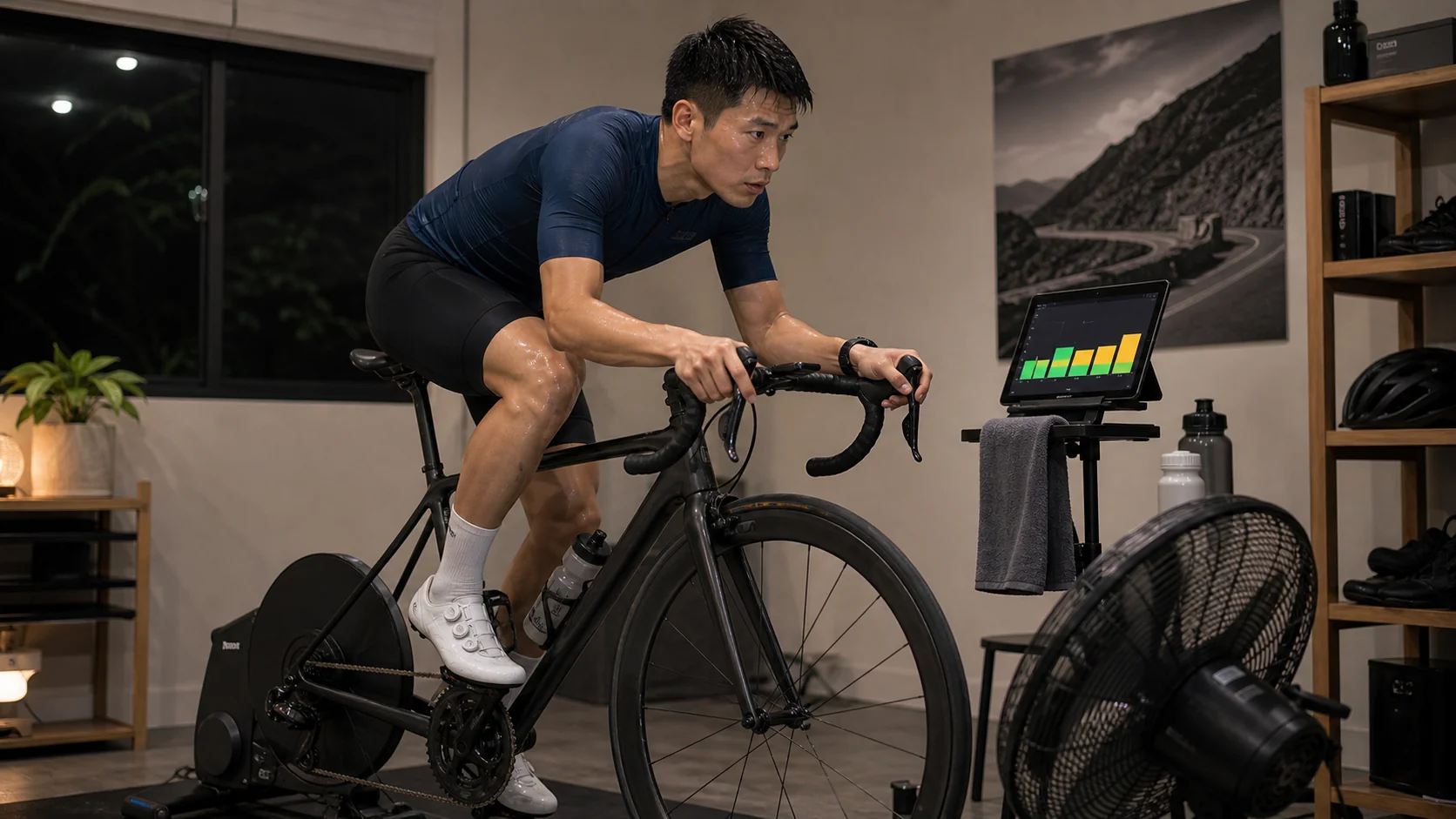
Below are three common Sweet Spot workouts of increasing difficulty. All can be done on Zwift, an indoor trainer, or outdoors (for outdoor riding, choose a climb of 8-15% gradient sustained for at least 6 minutes, such as Yangmingshan’s Yangde Boulevard, the Dongpu section of the New Central Cross-Island Highway, or Xiping Highway).
Beginner (1 hour)
- 15-minute warm-up (Zone 1-2)
- Main set: 3 x 10 minutes @ 90% FTP, with 5 minutes Zone 1 recovery between intervals
- 10-minute cool-down
- Total duration: 60 minutes, approx. 65 TSS
Advanced (1.5 hours)
- 15-minute warm-up
- Main set: 2 x 20 minutes @ 92% FTP, with 8 minutes recovery between intervals
- 10-minute cool-down
- Total duration: 90 minutes, approx. 95 TSS
Over-Under Workout
- 15-minute warm-up
- Main set: 3 x (15 minutes alternating 2 minutes @ 88% / 1 minute @ 95%)
- 5 minutes recovery between sets
- Total duration: 90 minutes, approx. 105 TSS
Weekly Periodization: How to Fit It Into Your Training Week
For an amateur rider training 8-10 hours per week, here is a suggested layout:
| Day | Content | Duration |
|---|---|---|
| Mon | Rest or easy recovery | 0-45 min |
| Tue | Sweet Spot (beginner / advanced) | 60-90 min |
| Wed | Zone 2 aerobic | 60-90 min |
| Thu | Sweet Spot Over-Under | 75-90 min |
| Fri | Rest or Z1 commute | 30 min |
| Sat | Long Zone 2 ride + 1-2 SST blocks | 2.5-4 hours |
| Sun | Easy Z2 or rest | 60-90 min |
Practical Tips for Taiwanese Riders
- Choose the right road: In the north, try Yangde Boulevard, Fengguizui, or Hsinchu’s Hengshan Sanfen Mountain; in central Taiwan, try Provincial Highway 89 (the Renzhiguan section heading west to Wuling); in the south, try Liugui to Baolai-Tengzhi. A gradient of 5-8% sustained for over 10 km is ideal.
- Choose the right time: In summer, ride before 6:00 AM or after 6:00 PM to avoid heart-rate drift caused by temperatures above 35°C. If your heart rate runs 10 bpm higher than usual, drop down an intensity level.
- Keep your cadence up: Sweet Spot work requires a cadence of 80-95 rpm. Too low, and it turns into pure strength training, shifting the adaptation in the wrong direction.
- Pair with a power meter: Without a power meter, heart rate can serve as a backup, targeting 92-97% of LTHR — but be aware that heat and dehydration can drive heart rate artificially high.
Common Pitfalls
- Riding too much, too often: Sweet Spot is not a cure-all. After 8 consecutive weeks, you must schedule a 1-week deload, or you risk chronic overtraining.
- Drifting into Threshold: It’s tempting to push harder when the road feels good, ending up at 95-100% FTP — which doubles your recovery time.
- Skipping the warm-up: In winter, a 20-minute outdoor warm-up is recommended. Jumping straight into SST without one causes your heart rate to lag behind and your actual power output to appear inflated.
Conclusion
Sweet Spot isn’t flashy, and it doesn’t deliver the dramatic, rapid gains of VO2max intervals — but what it offers is steady progress you can repeat every week and accumulate every year. For Taiwanese amateur riders chasing a sub-4-hour Wuling climb, a KOM Challenge finish, or a PR on Provincial Highway 7A, it’s the most practical and repeatable shortcut to a higher FTP. Over the next 6-8 weeks, work SST into your trainer sessions and weekend long rides — the numbers will speak for themselves.
Related Reading
單車AI教練!全新 ChatGPT4o 幫你分析訓練成果!排武嶺課表,分析騎車姿勢! 太神了! / 公路車 / CT Yeh / feat. 緯緯
2 年前
西進武嶺 8000名單車友數據分析 PART1 | 從新手到高手數量/瓦數/推力比/FTP推力比/功率計使用率 大解析 | 公路車 | CTYeh
5 年前
西進武嶺 免費訓練分析服務 Intervals | 練不夠還是練過頭?你哪一種類型選手?AI模型告訴你! | 備戰神器 | 公路車 訓練 | CT Yeh
4 年前
FTL 與 SYB 車隊專訪 西進武嶺 實用攻略分享! 2小時 如何練?!你不知道的眉角!新手準備武嶺必看 EP1 | 實力派女車友 | 精華版 | 公路車 | CTYeh
4 年前
西進武嶺配速器 3.0更新 / NEW 免功率FTP估算! / 大數據xAI體能模型 / 如何模擬人止關前集團效應 / 配速儲存功能 / AI全台自行車賽事行事曆 / 公路車 / CT Yeh
1 年前
CT趣訪 西進武嶺 2小時組 EP2 全村的希望 蔣緯緯! 訓練菜單&技巧公開 |公路車 |CT Yeh
4 年前
RAMP FTP Test 直播 究竟能撐到幾瓦 訓練台 Gravat Zwift
6 年前
#公路車 #西進武嶺 配速配瓦實驗 坡度分析 四小時內攻略 建大盃 NeverStop #西進武嶺攻略
6 年前