Plyometrics and Reactive Strength Ladder: A Safe Progression Blueprint for Endurance Athletes, from Landing Shock Absorption to Rebound
What Is Reactive Strength and Why Endurance Athletes Should Train It
Reactive strength refers to the ability of the muscle-tendon system to produce force immediately after being rapidly lengthened (the stretch-shortening cycle, SSC). Every running step is an SSC: on landing, the tendon is lengthened and stores elastic energy; on push-off, it is released. Runners with efficient SSC have shorter ground contact times and better running economy. Plyometric training is the specific stimulus for this system.
But plyometrics are also the most commonly “skipped-level” misused training—jumping straight into depth jumps, knees caving inward on landing, and excessive impact volume, which instead creates injuries. The correct path is a strict ladder.
Five-Level Progression Ladder (Advance Only After Meeting Each Level’s Criteria)
| Level | Theme | Representative Exercise | Passing Criteria |
|---|---|---|---|
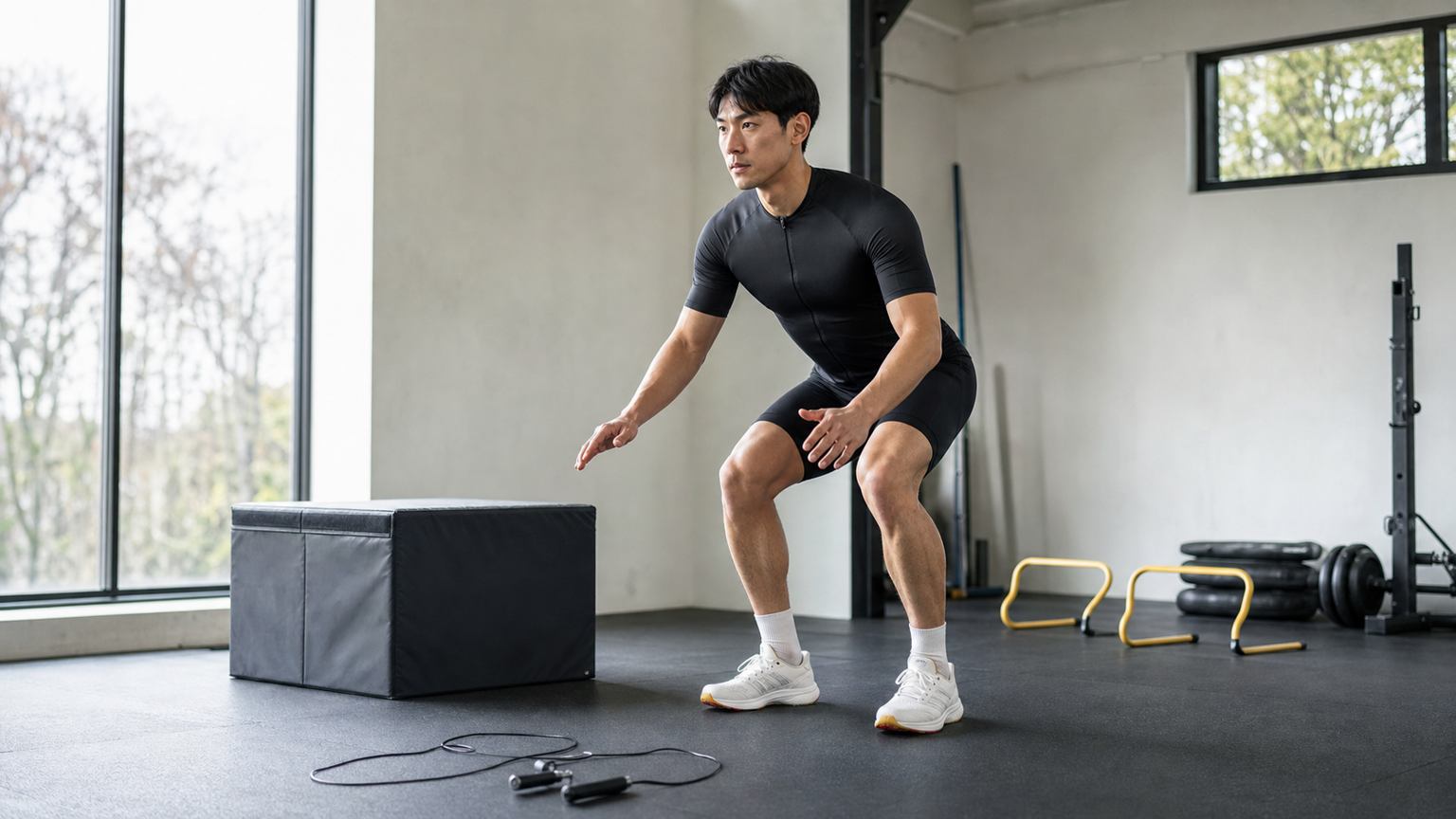
| 1 | Landing absorption | Box jump (jump up, step down) | Silent landing, knees aligned over toes, able to hold still for 2 seconds |
| 2 | Eccentric landing control | Drop landing (no rebound) | Stable absorption from a 30 cm drop |
| 3 | Slow SSC rebound | Continuous squat jumps, bounding | Ground contact time > 250 ms, stable posture |
| 4 | Fast SSC rebound | Jump rope, low-hurdle hops, ankle bounces | Ground contact time < 200 ms |
| 5 | Sport-specific reactivity | Single-leg horizontal hops, depth jump-rebound | Short contact, symmetrical, controlled |
Key safety principle: Only after learning to “catch yourself safely” (Levels 1-2) do you earn the right to talk about “jumping higher” (Levels 3-5). Reversing the order is the main cause of injury.
Quantified Checks for Landing Quality
Don’t rely on feel—use the following indicators to objectively determine whether you can progress:
- Sound: A loud thud on landing = insufficient absorption; ideally it should be quiet.
- Knee trajectory: Does the knee cave inward (valgus) at the moment of landing? If it does, stop and regress to strengthening the gluteus medius.
- Left-right symmetry: If the difference in single-leg landing stability between sides is more than one obvious grade, strengthen the weak side first.
- Ground contact time: Before entering Level 4, measure contact time with a force plate or an app. If it hasn’t shortened, the SSC hasn’t been developed yet.
Dosage and Recovery
Plyometric training volume is measured in total foot contacts:
- Beginner: 60–80 contacts per session, once per week
- Advanced: 100–140 contacts per session, twice per week (with ≥48 hours between sessions)
- The higher the intensity (depth jumps, single-leg), the more total volume must be reduced. This is quality-oriented training, not volume stacking.
Recovery principle: Plyometrics place significant stress on tendons and connective tissue; do not schedule similar stimuli or high-impact long runs within 48 hours. In the 7–10 days before a race, reduce volume but retain low-volume, high-quality stimuli—neural and elastic capacity can be maintained or even sharpened.
Transfer to Each Endurance Discipline
- Runners: Most direct—improves running economy and lower-limb stiffness, indirectly saving oxygen.
- Cyclists: Explosive power for starts and sprints, and acceleration over hilltops.
- Trail/Triathlon: Reactive control under changing terrain and fatigue-resistant landing stability.
Common Mistakes
- Treating plyometrics like aerobic training (jumping continuously until heart rate spikes and form breaks down)—it is neural quality training; fatigue means stop.
- Doing depth jumps without warming up—cold tendons are a high-risk window for injury.
- Stacking plyometrics on top of high-volume running fatigue days—the impact load compounds, and the cost outweighs the benefit.
The real payoff of plyometrics lies in your discipline to resist skipping levels.
“When I assess plyometric progression, I ask only one question: Can you land silently, hold still, and symmetrically on both sides? If you can’t, you’re not qualified to jump higher. Rebound is the reward; absorption is the ticket.” —A reactive strength coach spanning track and endurance disciplines
Related Reading
- Plyometric Training for Runners: Save Your Oxygen with Elastic Recoil
- The Science of Power and Speed: A Complete Guide to the Stretch-Shortening Cycle (SSC) and Plyometric Training
- How Plyometric Training Improves Running Economy: Landing, Rebound, and Tendon Stiffness
- The Safe Dosage of Plyometric Training: Don’t Let Enthusiasm Hurt You
戰略) Zwift Race 如何咬在第一集團 如何評估自己要開多少推力 (請開1.5倍速看)
7 年前
實景訓練台) 彰化經典百K 高強度喵團 90分鐘 跟著一起練功 2019 Indoor workout Changhua Classic 100 Taiwan
7 年前
CT 喇低賽) 武嶺牽車 才是王道 西進牽車四小時內秘訣 攝手位置 如何判斷 防抽筋小秘訣
7 年前
多機位拍片神器 DJI Action 2 拍出速度張力感 | 類空拍機視角 4陣列麥克風超強降風噪 實測! | 公路車 | CT Yeh
3 年前
[教學] Premiere 影片 手震 修正 教學 防抖 單眼 影像 GoPro 穩定 Video Stabilization
8 年前
邁金 T500 訓練台開箱!有下坡輔助、路感模擬、不用插電、直驅電機 !兩萬級距頂規享受新選擇!/ 公路車 / 室內訓練 / CT Yeh
1 年前
西進武嶺 免費訓練分析服務 Intervals | 練不夠還是練過頭?你哪一種類型選手?AI模型告訴你! | 備戰神器 | 公路車 訓練 | CT Yeh
4 年前
昇陽SYB車隊 & Fuji 菁英選手們的趣味經驗分享,長知識了!市民車友必看~ 一路被拉爆後才給問 | 戀戀197 武嶺 凸台經驗分享 | 公路車 | CT Yeh
4 年前