The Current Evidence on Menstrual Cycle-Based Training: Why "Individualized Monitoring" Is Replacing "Scheduling by Cycle Phase"
A Concept Where Marketing Has Outpaced Science
In recent years, “periodizing training according to the menstrual cycle” has been widely promoted: train hard in the follicular phase, reduce volume in the luteal phase. It sounds reasonable, but a high-methodological-standard systematic review published in 2025 in the Journal of Applied Physiology, along with a network meta-analysis, reached fairly conservative conclusions—the objective effect of different menstrual cycle phases on athletic performance is extremely small (most comparisons fall between 0.01–0.14), with high inter-study variability and many low-quality studies, making universal training-scheduling recommendations impossible. A 2025 evidence review in the Strength & Conditioning Journal also noted that there is currently a lack of evidence supporting the idea that “cycle-based periodization provides additional benefits over traditional methods.”
Objectively Small, Subjectively Real
But “small objective effect sizes” do not mean “nothing is happening.” The same body of literature consistently observes:
- During the mid-luteal phase, submaximal endurance efforts show increased carbohydrate oxidation and ventilation, and running economy may be slightly affected—but between-group differences are large.
- Individual subjective perception is often far more pronounced than objective data: many female athletes genuinely experience declines in fatigue, motivation, and recovery quality during the premenstrual/menstrual phase, even when force data show no significant changes.
This leads to a shift in direction within contemporary sports science: moving from “applying the same cycle template to all women” toward “individualized symptom and performance monitoring.”
An Individualized Monitoring Framework (Actionable)
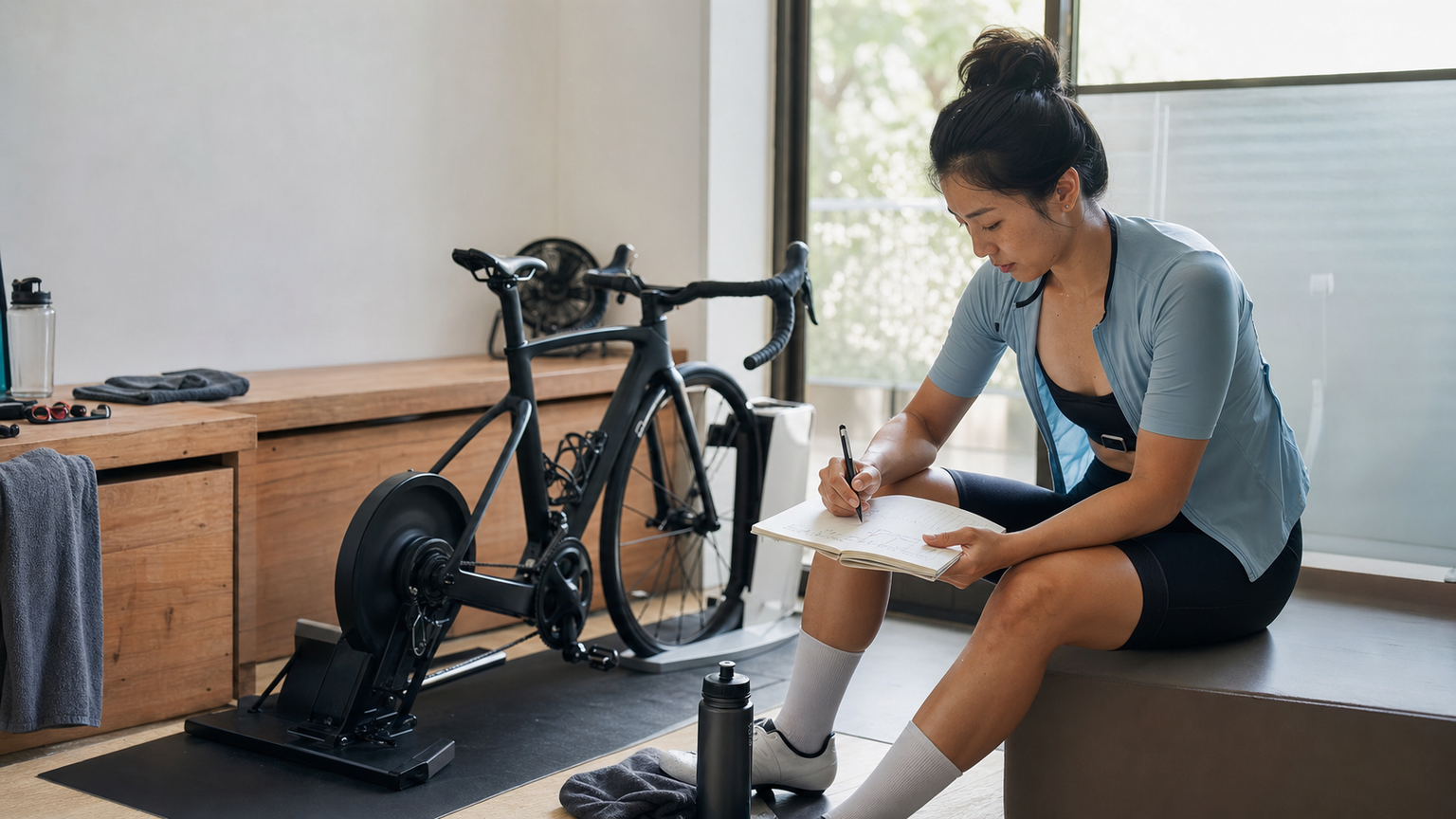
Rather than rigidly memorizing a template, build a personalized tracking system and collect data across 3 consecutive cycles:
| Tracking Item | Tool | Purpose |
|---|---|---|
| Cycle length and menstruation days | Cycle app / journal | Align training load with phases |
| Morning subjective ratings (sleep/fatigue/motivation, 1-10) | Simple scale | Identify personal “low-energy windows” |
| Key session performance (pace/power/RPE) | Training platform | See whether performance truly varies with phase |
| Symptoms (cramps, bloating, mood) | Markers | Arrange adjustments rather than cancellations |
What you do after collecting is “identify your personal pattern,” not apply group averages. Some people do decline in a certain phase; others show no difference at all—individual variation far exceeds average phase differences, which is exactly why universal templates fail.
Practical Recommendations
- Do not remove key stimuli because of phase: unless your personal data clearly shows that a certain type of session repeatedly falls apart in a certain phase, stick to the plan.
- Flexible adjustment over rigid periodization: give the “fine-tuning authority” for high-load sessions to daily readiness, rather than locking it into a phase in advance.
- Prioritize symptom management over phase theory: if menstrual pain affects sleep, address the sleep; if iron is low, get bloodwork and supplement—these are far more practical than “should I reduce volume in the luteal phase.”
- Oral contraceptive users are a separate case: for those using combined oral contraceptives, endogenous hormonal fluctuations are replaced by exogenous ones, making phase templates even less applicable—individualized monitoring is likewise the right answer.
Key Communication Points for Coaches and Athletes
Acknowledge the reality of subjective experience, but do not package it as pseudo-precise scientific scheduling. The biggest risks are two extremes: one is denying female athletes’ bodily sensations (“there’s no significant difference, so don’t make excuses”), and the other is over-medicalizing every cycle (“you can’t lift heavy in the luteal phase”). The pragmatic middle ground is: listen to individual data, preserve the main training structure, and hand adjustment authority to daily status.
“The biggest problem with menstrual cycle periodization isn’t that it’s wrong—it’s that it pretends to be precise. What science is telling us now is: group average differences are too small to base training schedules on, but your personal pattern is worth three cycles of your time to understand. Listen to your data, not to the marketing.” —A female exercise physiology researcher
Related Reading
- Menstrual Cycle-Based Training Periodization: The Scientific Status of Hormonal Fluctuations and Training Scheduling
- A Systematic Review of Periodized Training: Linear vs. Nonlinear vs. Undulating Periodization Compared
- Menstrual Cycle and Training Arrangement: Physiological Characteristics of Each Phase and Session Adjustment Approaches (Individual Variation Is Huge, Not a Fixed Rule)
- Running Volume Periodization: Stacking Base, Build, Peak, and Recovery Phases
西進武嶺 免費訓練分析服務 Intervals | 練不夠還是練過頭?你哪一種類型選手?AI模型告訴你! | 備戰神器 | 公路車 訓練 | CT Yeh
4 年前
單車AI教練!全新 ChatGPT4o 幫你分析訓練成果!排武嶺課表,分析騎車姿勢! 太神了! / 公路車 / CT Yeh / feat. 緯緯
2 年前
live) 超越北高 之一日北高12小時 策略
7 年前
2019 柯P 超越北高 第一集團實錄 (11小時實錄請參考另一部影片) 一日雙城 一日北高 NeverStop Taiwan Long Distance Cycling Challenge
7 年前
一個測試有沒有認真練車的方法😂 #公路車
10 個月前
[教學] Premiere 影片 手震 修正 教學 防抖 單眼 影像 GoPro 穩定 Video Stabilization
8 年前
#公路車 #Fitting 靠人工智慧APP 幫你調整單車
6 年前
白沙屯媽祖進香在家走!UREVO 坡度自調走步機 / 可連接訓練遊戲APP MyWhoosh / 邊看直播邊走起來 / CT Yeh
11 個月前