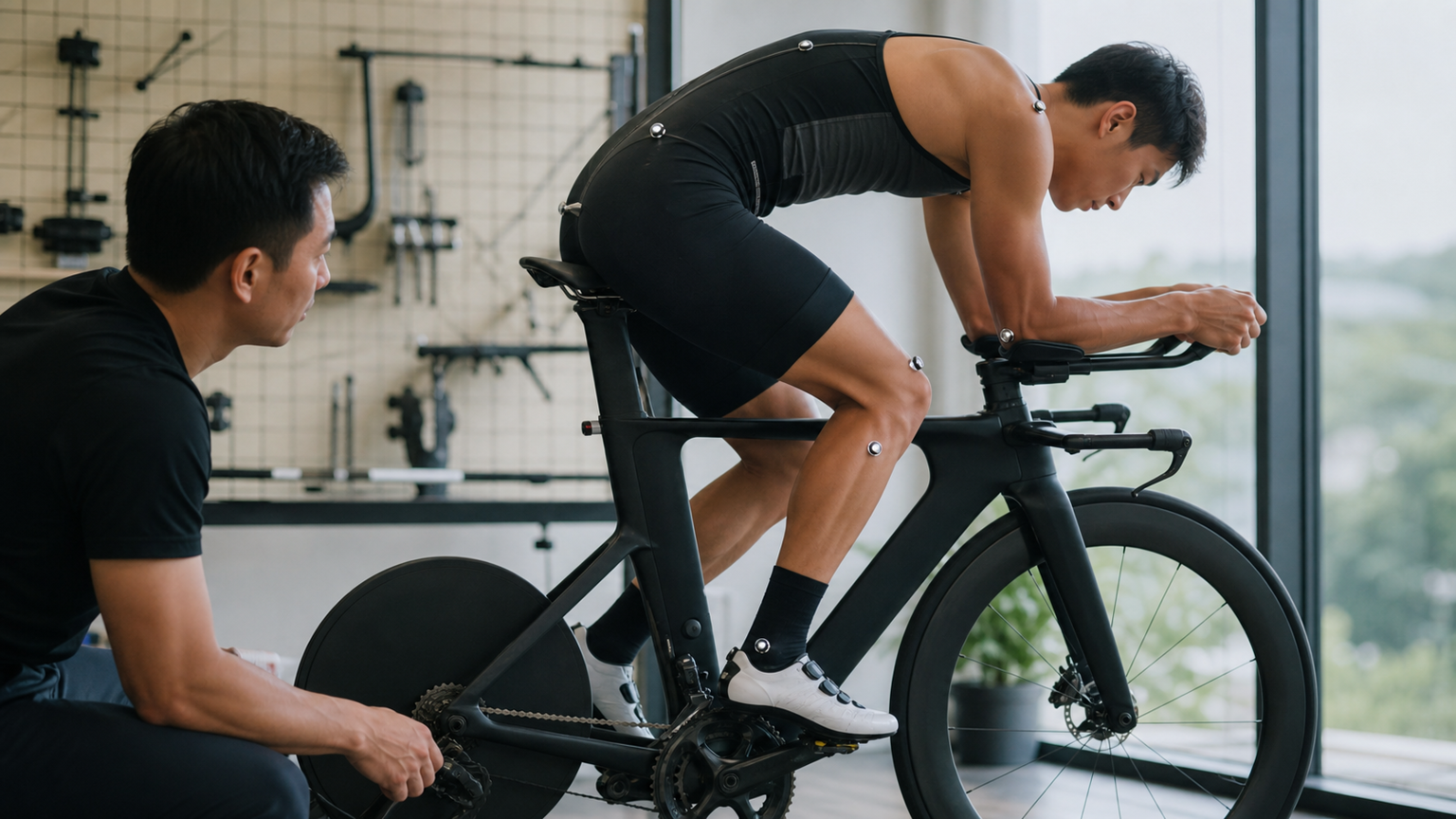
The Core of Triathlon Fit: It Only Counts If You Can Run Off the Bike
Road bike fit pursues pedaling efficiency and comfort; triathlon bike fit adds one more constraint—you still have to run 42km after dismounting. This leads to a forward-shifted saddle and a more open hip angle, sacrificing a little aerodynamics in exchange for run protection.
Road vs. Triathlon Geometry Comparison
| Parameter | Road Bike | Triathlon Bike | Significance of Difference |
|---|---|---|---|
| Effective seat tube angle | 73–74° | 76–78° | Hips rotated forward, sparing the quads |
| Hip angle (torso-thigh) | More closed | Open 5–10° | Protects running muscles |
| Handlebar drop | Depends on flexibility | Maximize aero without sacrificing run | — |
| Saddle to handlebar | Longer | More compact | Shortens reach |
The Physiology of a Forward-Shifted Saddle
Moving the saddle forward about 2–4cm effectively rotates the pelvis forward, reducing the workload on the glutes and hamstrings while making the quads dominant. This feels more powerful on the bike leg, but if overdone, your quads will protest during the first 5km of the run.
The Trade-off Between Position and Power
Dropping the handlebars another 2cm might save 5–8W of drag, but if the hip angle closes to the point you can’t sustain it, you’ll lose 10–15W of power and hurt your run. The fit order is always: sustainable position → run protection → aerodynamics.
Self-Check Indicators
- Can you hold the aero position for 90 minutes without needing to sit up frequently
- Whether the first 1km of the run after dismounting feels abnormally stiff
- Anterior knee pain after riding = saddle too low or too far forward
A Numerical Breakdown of a Real Fit Case
A 70.3 athlete originally had a seat tube angle of 74.5° and a drop of 11cm, with a wind tunnel CdA of 0.245—impressive—but every race, the quads burned by 30km into the bike and the first 5km of the run was 25"/km slower. After adjusting to a 76.5° seat tube angle (saddle moved forward 2.5cm) and reducing the drop by 2cm, CdA rose to 0.252 (roughly 18 seconds of extra drag cost over 90km), but the first 5km of the run no longer fell apart, and the half marathon was 2 minutes 40 seconds faster—a net gain of 2 minutes 20 seconds. This is the quantitative proof that “aerodynamics are for those who can still run.”
Post-Ride Discomfort and Corresponding Adjustments
| Post-Ride Symptom | Most Likely Cause | Adjustment Direction |
|---|---|---|
| Anterior knee (patellar) pain | Saddle too low or too far forward | Raise saddle / move back |
| Tightness behind the knee | Saddle too high | Lower saddle 3–6mm |
| Lower back pain | Excessive drop or weak core | Raise handlebars / strengthen core |
| Perineal numbness | Saddle nose tilted up too much or excessive pelvic rotation | Tilt nose down 1–2° |
| Stiff quads in first 5km of run | Seat tube angle too steep | Move saddle slightly back |
My 20 years of doing triathlon fits: the fastest position isn’t the one with the prettiest numbers in the wind tunnel, but the one where you can stay aero the whole way and still run after dismounting. Aerodynamics are for those who can still run.
Related Reading
- Triathlon-Specific Bike vs. Road Bike: Geometry, Aerodynamics, and a Buying Decision Tree
- Triathlon Bike vs. TT Bike: The Key Differences Between Two Time Trial Machines
- Bike Fit Differences Between Time Trial and Road Bikes: The Trade-off Between Aerodynamics and Comfort
- Triathlon Time Trial Bike vs. Road Bike: Which Suits Your Race
Fitting訓練兩用功率車 ! Thinkrider ST900 完整實測!/ 坡度升降 / 鄰居測試/ smart bike/公路車/ CT Yeh
2 年前
#公路車 #Fitting 靠人工智慧APP 幫你調整單車
6 年前
3D 列印車褲墊 / 舒適改善? / 無痕 x 分區壓縮 / ATK & Decider系列 / JE22黑科技 / #公路車 #CTYEH
11 個月前
CT 喇低賽) 武嶺牽車 才是王道 西進牽車四小時內秘訣 攝手位置 如何判斷 防抽筋小秘訣
7 年前
三鉄共購百人風中劍/ feat. 單車小D、Doris 、城希、Ruby、Ada/ 公路車 / CT Yeh
2 年前
單車AI教練!全新 ChatGPT4o 幫你分析訓練成果!排武嶺課表,分析騎車姿勢! 太神了! / 公路車 / CT Yeh / feat. 緯緯
2 年前
Live) 備戰2019彰化經典百K 賽前攻略 (已完賽請看新影片
7 年前
碟煞公路車 銑面器 !? 原來銑完差這麼多! 降低蹭碟機率! | TIME 公路車 保養小記錄 | CT Yeh
3 年前