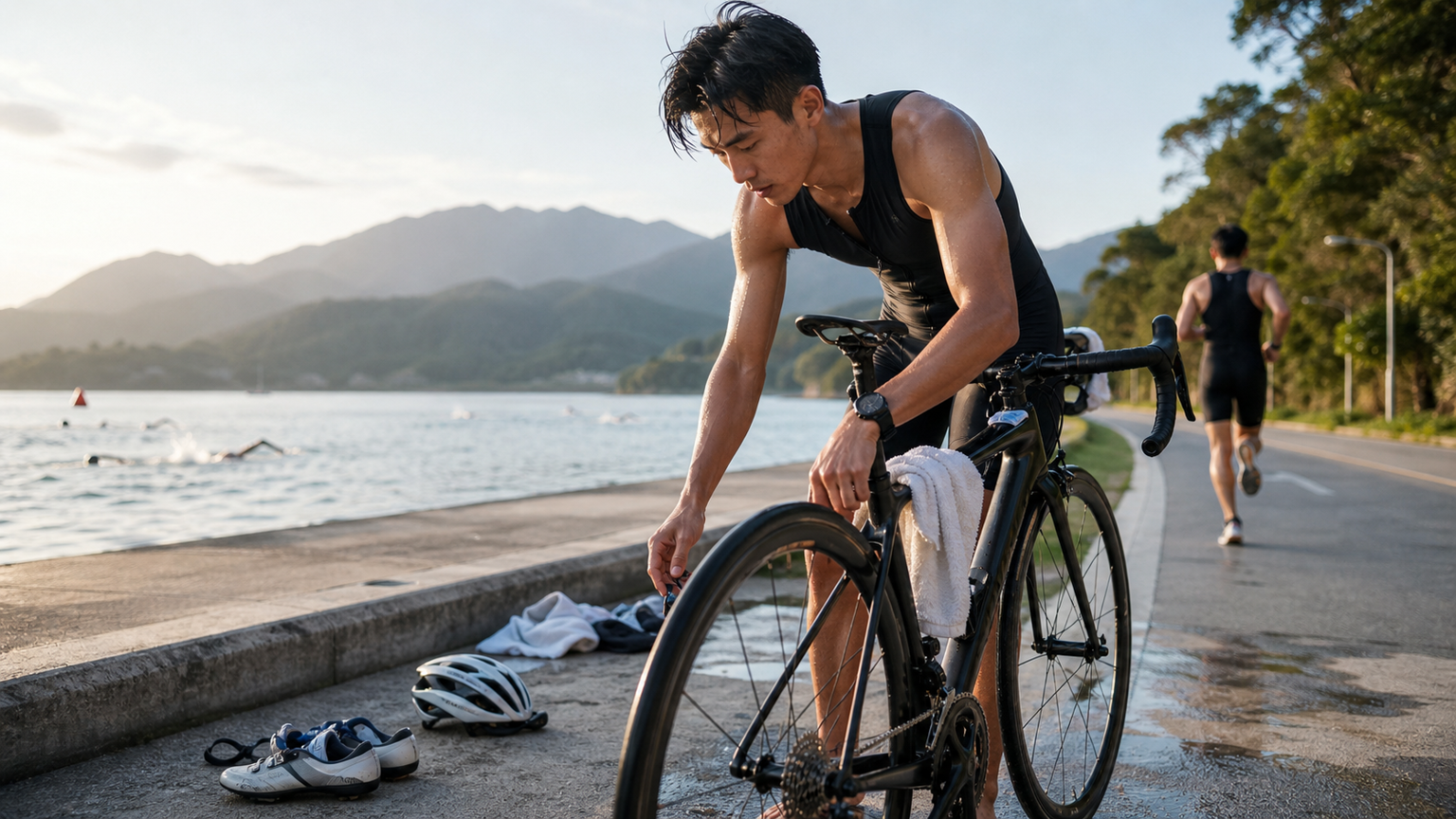
Not “Second-Rate Triathlon,” But a Distinct Discipline
Aquabike (swim + bike) and Duathlon (run-bike-run) are often treated as triathlon substitutes, but each has its own unique physiological demands and tactics.
Race Format Characteristics
| Event | Structure | Key Abilities | Common Distances |
|---|---|---|---|
| Aquabike | Swim + Bike | Upper-body endurance + sustained power | 1.9km/90km, etc. |
| Duathlon | Run-Bike-Run | Double transitions, biking after running | 10/40/5 standard |
Aquabike Pacing Differences
Without the run, the bike leg can be pushed 0.05–0.08 IF harder than in a triathlon, since there’s no need to protect the running muscles. However, the swim still requires heart-rate control to avoid depleting the upper body before getting on the bike.
Duathlon’s Hidden Challenge: The Second Run
The final run leg (R2) in run-bike-run is performed under the double fatigue of “tired from running → tired from biking,” making the pace-collapse rate higher than in a triathlon run. In a standard-distance D race, R1 should be 10–15 sec/km slower than a standalone 10km pace to save energy.
Who Should Train for These Two Events
- Runners with recurring injuries → Aquabike to maintain triathlon fitness
- Those who can’t swim but want to race → Duathlon as an entry point
- Those wanting cross-training in winter → Duathlon to maintain run-bike neuromuscular fitness
Sample Training Prescription (Duathlon)
Once a week, do an “R-B-R micro-brick”: run 3km → bike 30’ → run 2km, focusing on neuromuscular adaptation for the second run leg.
How Hard Should the Aquabike Bike Leg Be Pushed
“Not needing to protect the running muscles” doesn’t mean no limits. The Aquabike 90km bike leg is still constrained by glycogen and core temperature: a recommended IF of 0.05–0.08 higher than a same-distance 70.3 (e.g., 0.78 for 70.3, 0.83–0.86 for Aquabike), but VI should still be ≤1.06, and fueling should maintain 60–80g of carbs per hour. The most common mistake is an excited surge to 0.92 IF in the first 20km, then fading to 0.70 after 60km and grinding to the finish—averaging slower and more painful than a steady 0.84.
Duathlon Standard-Distance Segment Pacing Template
| Segment | Distance | Pace vs. Single-Sport Ability | Key Principle |
|---|---|---|---|
| R1 | 10km | 10–15"/km slower than 10K PR | Save energy for R2; don’t get carried away by the start |
| B | 40km | TT race IF 0.85–0.90 | Ease off slightly in the last 10km to wake up the running muscles |
| R2 | 5km | Run as fast as you can | Double fatigue; hold your cadence through the first 1km |
The 5km of R2 is where the Duathlon is truly won or lost—every 10 seconds saved in R1 will be repaid or reclaimed twofold in R2.
I often recommend injured triathletes spend a season on Aquabike. It lets you preserve your swim and bike fitness, and when you return after the running injury heals, you’ll find you haven’t regressed—you’ve improved. Don’t underestimate these two “half-ironmen.”
Related Reading
- Aquabike and Duathlon: Multisport Without Running or Swimming
- The Complete Duathlon Beginner’s Guide: Differences Between Run-Bike-Run and Standard Triathlon, Who It’s For, and Training Focus
- Cross-Training for Marathon Training: When and Why Swimming and Cycling Can Replace Running
- Integrating Cross-Training for Marathoners: Timing and Methods for Swim and Bike Auxiliary Training
靠單車減肥35公斤 心得分享與整理
7 年前
西進武嶺 免費訓練分析服務 Intervals | 練不夠還是練過頭?你哪一種類型選手?AI模型告訴你! | 備戰神器 | 公路車 訓練 | CT Yeh
4 年前
單車 一日北高 ( 雙城 ) 肥宅雙人瘋狂行 紀錄片 REACTO
10 年前
2019 柯P 超越北高 第一集團實錄 (11小時實錄請參考另一部影片) 一日雙城 一日北高 NeverStop Taiwan Long Distance Cycling Challenge
7 年前
#公路車 #Fitting 靠人工智慧APP 幫你調整單車
6 年前
一日北高前的高裝檢 | 北高 360 | 挑戰11小時的裝備 | 一日雙塔 | 補給
6 年前
2019 夏季KOM 5小 完賽心得 準備攻略 東進武嶺 夏季登山王之路 Taiwan KOM Challenge
7 年前
本週北高前練習,連同天比的226們也來⋯鐵車真的太猛了 #cycling #北高
2 年前