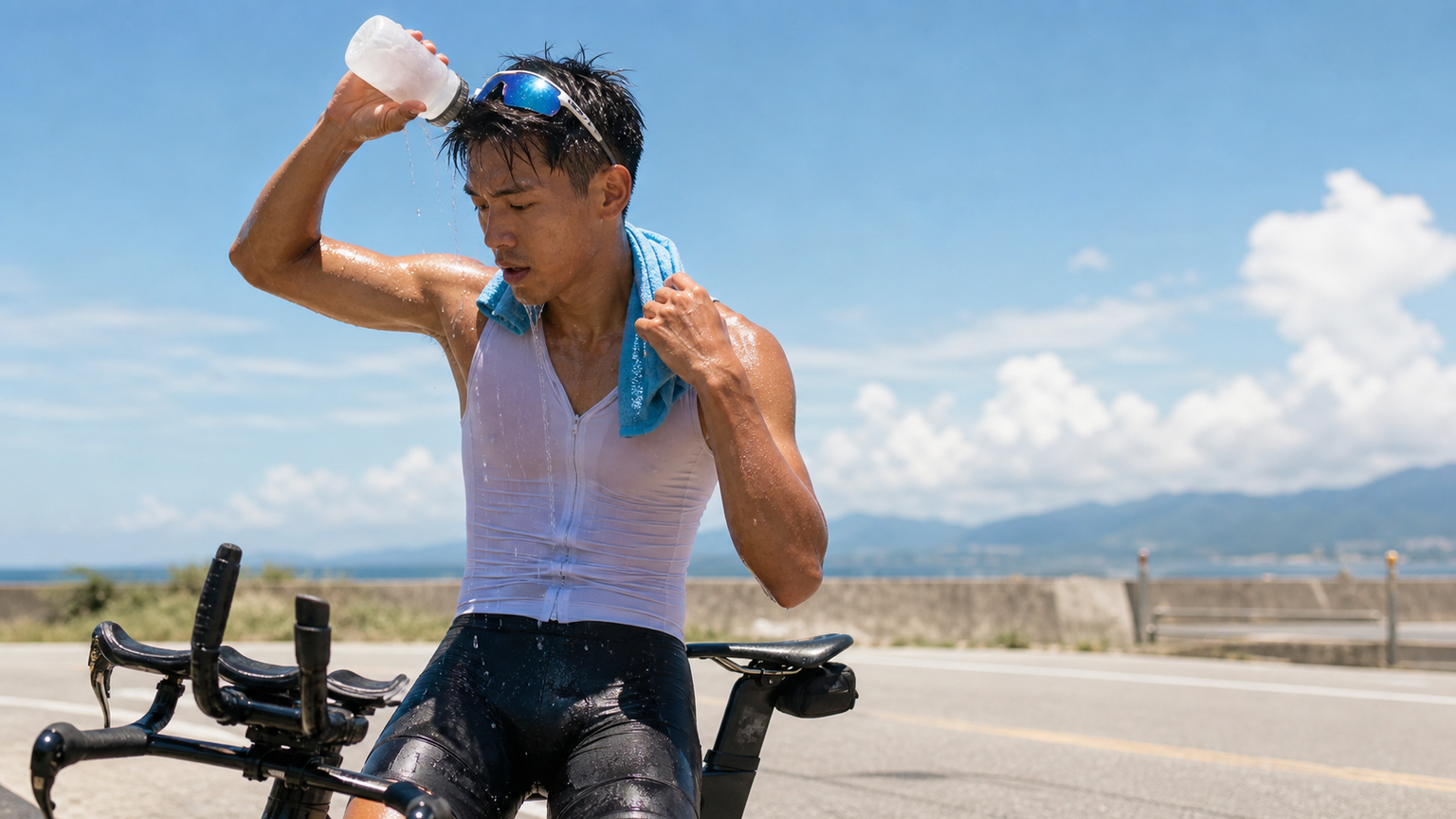
The Hidden Killer in Hot Races: Core Temperature
In an Ironman above 30°C, pace collapse is often linked to dehydration, rising body temperature, and reduced plasma volume. Heat acclimatization can significantly improve heat tolerance within 10–14 days.
Physiological Changes from Heat Acclimation
| Adaptation | Onset Time | Benefit |
|---|---|---|
| Increased plasma volume | 4–7 days | More stable cardiac output, lower heart rate |
| Earlier sweating, lower sweat sodium | 7–10 days | Earlier heat dissipation, sodium retention |
| Lower baseline core temperature | 10–14 days | Higher temperature ceiling |
Two Heat Acclimation Protocols
- Active: 60–90 minutes of low-to-moderate intensity daily in a hot environment (or with extra layers), for 10–14 consecutive days
- Passive (no hot environment pre-race): 30–40 minutes of hot water bathing after training, for 5–7 consecutive days; less effective but feasible
Pre-Race Tapering and Retention
Heat acclimation decays at a rate of roughly one day lost for every two days without exposure. Schedule the final heat exposure 2–4 days before the race to balance retention with avoiding added fatigue.
Race-Day Support
Heat acclimation does not replace cooling strategies: keep pouring water on yourself during the race, use ice sleeves, lower bike leg IF by 0.02–0.03, and increase fluid and sodium intake.
A 14-Day Active Heat Acclimation Schedule
The key is “time with core temperature at target,” not simply sweating. Each session must raise core temperature to about 38.5°C and hold it for 60+ minutes to provide a stimulus. Schedule: Days 1–3, ride 60 min @Z2 in a hot environment (or indoors with no wind plus extra layers); a heart rate 8–12 bpm higher than usual at the same intensity is normal. Days 4–7, extend to 75–90 min; heart rate at the same intensity will begin to drop (plasma volume has increased). Days 8–11, add 10–15 min at race intensity to test tolerance. Days 12–14, shorten to 45–60 min to maintain the stimulus without adding fatigue. Throughout, record morning heart rate, body weight, and urine color daily; if morning heart rate spikes for two consecutive days or weight drops >2%, reduce the load.
Ranking of Race-Day Cooling Tools by Effectiveness
| Method | Core Cooling Benefit | Race-Day Feasibility | Notes |
|---|---|---|---|
| Continuously pouring cold water on head and neck | High | High (at every aid station) | Cheapest and most effective |
| Ice in arm sleeves/collar | Medium–High | High | Most noticeable at the carotid artery |
| Lower bike IF by 0.02–0.03 | High (reduces heat production at the source) | High | Treats the root cause |
| Holding ice in the mouth | Medium | Medium | Also aids hydration |
| Pre-cooling (ice vest before the race) | Medium | Depends on venue | Use before the start |
I’ve sent athletes to hot IM races. Those who did heat acclimation barely lost any marathon pace; those who didn’t vanished after 30 km. Same legs—the only difference was whether those 10 days made the body suffer first.
Related Reading
- Heat Acclimation Training for Cyclists: Core Temperature, Plasma Volume Expansion, and a Seven-to-Ten-Day Timeline
- Heat Acclimation: Turning the Heat from Enemy to Home-Field Advantage in 10–14 Days
- Heat Acclimation: The Hidden Advantage for Taiwanese Cyclists
- Heat Acclimation Training Protocol: A Complete Guide to Building Heat Tolerance in 10–14 Days
西進武嶺 免費訓練分析服務 Intervals | 練不夠還是練過頭?你哪一種類型選手?AI模型告訴你! | 備戰神器 | 公路車 訓練 | CT Yeh
4 年前
#公路車 #西進武嶺 配速配瓦實驗 坡度分析 四小時內攻略 建大盃 NeverStop #西進武嶺攻略
6 年前
一日北高/長距離團騎 常見問題補充篇 / 組團或跟團的眉角 / 壯車友容易被瘦車友慢性拉爆 / 原來屁股痛可能是這個原因...? / 風場配速法 / 公路車 / CT Yeh
2 年前
西進武嶺 自製新版AI配速表產生器 x 賽前攻略 抱佛腳! 沒有功率計也可以產生配速表嗎?有什麼其他眉角賽前要注意的呢? | 西進武嶺 / 東進武嶺 KOM 攻略 | 公路車 | CT Yeh
4 年前
#公路車 #Fitting 靠人工智慧APP 幫你調整單車
6 年前
水金九不厭五分 10度寒流冷到不願停!feat. 卡卡 / 公路車 / CT Yeh
6 個月前
FTL 與 SYB 車隊專訪 西進武嶺 實用攻略分享! 2小時 如何練?!你不知道的眉角!新手準備武嶺必看 EP1 | 實力派女車友 | 精華版 | 公路車 | CTYeh
4 年前
CT 喇低賽) 武嶺牽車 才是王道 西進牽車四小時內秘訣 攝手位置 如何判斷 防抽筋小秘訣
7 年前