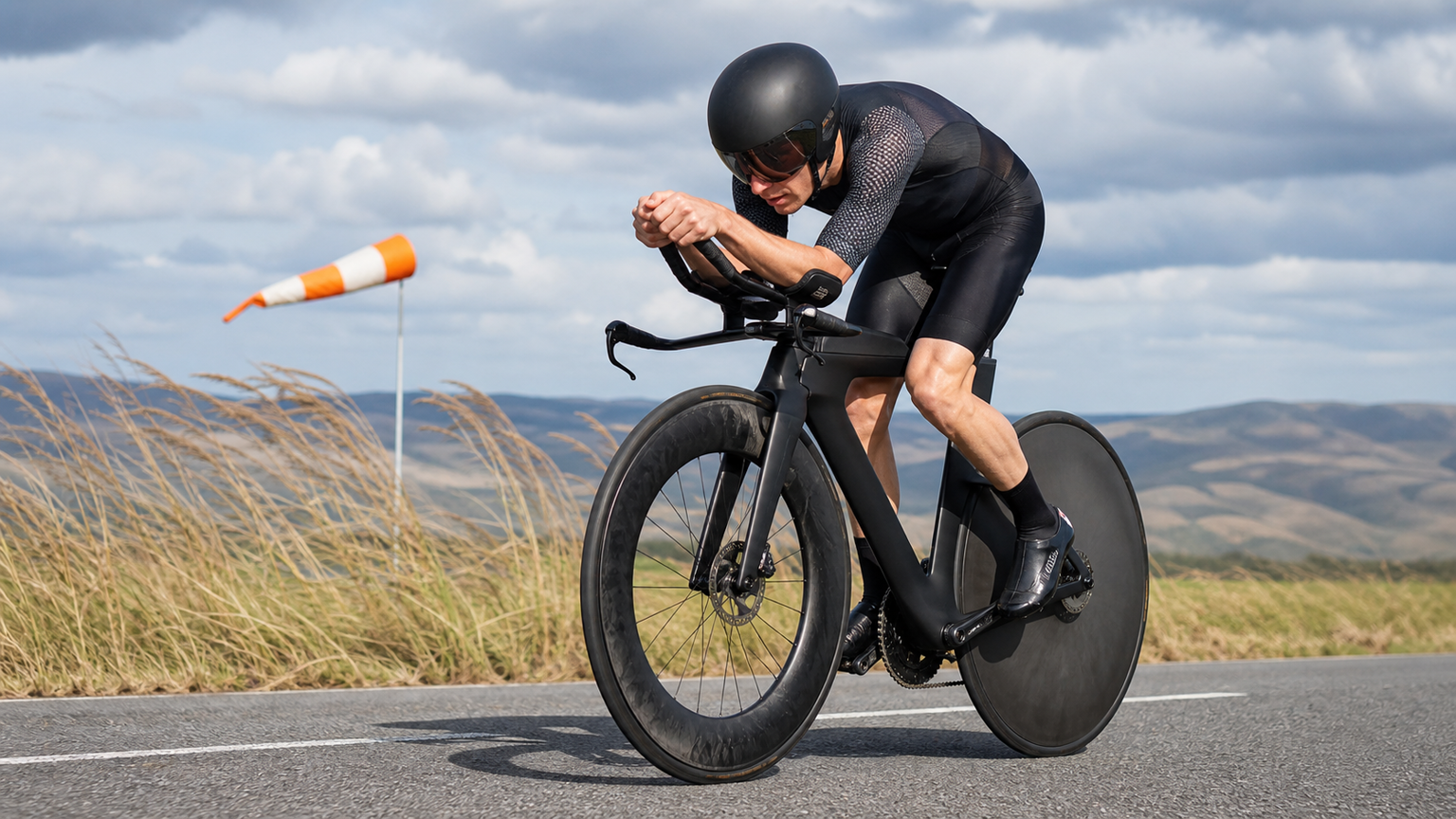
Wheelsets: The highest-aero gains for the smallest spend
In non-drafting triathlons, the bike leg is a personal battle against wind resistance. Deep-section and disc wheels can save significant watts in the 35–45 km/h range, making them the highest cost-performance aero investment after a bike fit.
Rim depth and suitable scenarios
| Rim depth | Aero | Crosswind stability | Suitable for |
|---|---|---|---|
| 40–50mm | Moderate | Good | Hilly courses, strong crosswinds |
| 60mm front/rear | High | Moderate | Mostly flat, normal wind conditions |
| 60mm front + rear disc | Highest | Rear wheel unaffected by crosswinds | Flat, low-crosswind courses |
Crosswinds are the real variable
Deep rims post impressive numbers in wind-tunnel tests with no wind, but in crosswinds the yaw moment increases significantly and handling deteriorates. For less skilled riders or courses with strong crosswinds, it’s better to choose slightly shallower rims for controllability—the loss from a crash caused by instability far outweighs those few watts.
The disc wheel trade-off
A rear disc wheel offers the best aerodynamics and is unaffected by crosswinds (being a closed surface), but it’s heavier and harder to handle on climbs and in strong crosswind sections. Flat, low-wind courses are its true home turf.
Tire and rim integration
Wide internal rim widths paired with 25–28C tires optimize both rolling resistance and aerodynamics; tire pressure should be set based on road surface and rider weight—too high isn’t necessarily faster and only makes the ride harsher.
Investment order
Fit → skinsuit → helmet → wheelset. Wheelsets are flashy, but if your position isn’t sorted first, you’re just saving a few watts for someone with a huge frontal area, diminishing the returns.
Quantifying the crosswind decision for rim depth
Deep rims post impressive wind-tunnel numbers in calm conditions, but crosswinds are the real variable: front wheels above 60mm show a marked increase in yaw moment in side winds, and less skilled riders lose confidence in handling, forcing them to slow down or tense up—the loss far outweighs those few watts of aero benefit. A practical rule of thumb—if the course forecast calls for sustained crosswind gusts above 25–30 km/h, drop the front wheel to 40–50mm for controllability; only on flat, low-wind courses should you consider the maximum aero combo of a 60mm front and rear disc wheel.
Rolling resistance parameters for tire and rim integration
| Setup | Rolling resistance | Aero | Recommendation |
|---|---|---|---|
| Wide internal rim + 25–28C tires | Low | Good | Optimal for most triathletes |
| Narrow rim + 23C high pressure | High (too harsh) | Average | Not recommended |
| Tire pressure too high (>7.5 bar on typical roads) | Increases | — | Lower based on weight and road surface |
Common mistake: putting the wheelset first in the investment order
Wheelsets are the most eye-catching, yet they should be bought last. The correct investment order is fit → skinsuit → helmet → wheelset: if your positional drag isn’t addressed first, you’re just saving a few watts for someone with a large frontal area, and the benefit is greatly diminished. Deep rims look cool, but crosswind days will teach you a lesson—clean up the aerodynamic drag of your body and position first, then let the wheelset finish the job, so every dollar buys you the most speed.
The wheelset is what most people want to buy first, yet it should be bought last. Deep rims look cool, but crosswind days will teach you a lesson. Clean up the aerodynamic drag of your body and position first, then let the wheelset finish the job—get the order right, and every dollar buys you the most speed.
Related reading
- 2026 Road Bike Wheelset Upgrade Guide: Practical Choices Between Aluminum, Carbon, and Rim Depth
- Bicycle Wheelset Aerodynamic Performance: Stability Analysis of Deep-Section Wheels in Crosswinds
- Bicycle Wheelset Upgrade Benefit Analysis: The Art of Trade-Offs Between Deep Rims, Weight, and Drag
- Road Bike Wheelset Depth Selection Guide: A Personalized Decision Tree for Rim Depth, Weight, and Crosswind Handling
再一組! 全碳幅條 碟煞/無內胎輪組 開箱! 到底好騎嗎? UNAAS X40 | 公路車 | CT Yeh
4 年前
鉅齒紋輪組!? ControlTech MEG-T50 EVO 碳纖維幅條輪組/ 功率對比實驗 / 公路車 / CT Yeh
2 年前
Unaas X50 全碳纖幅條輪 數據實測對比PK | Lun Hyper 的高階版 | 板輪爬坡也可以很厲害? ! 武嶺2小時大師一起親測! CP值超高 | 公路車 | CT Yeh
4 年前
功率實測 Lun Hyper 2023 碳幅條輪組 D45 碟煞 | 公路車 | CT Yeh
3 年前
Nepest NOVA 碳條輪組:輕量、空力、舒適一次滿足!/ 公路車 / CT Yeh
7 個月前
公路車 BB培林大升級! / 備戰海鷗繞圈賽 Canyon Aerod & TIME 一起改 / MIT大廠 CEMA對鎖式陶瓷培林BB & 導輪 / 公路車 / CT Yeh
2 年前
CT 喇低賽) 武嶺牽車 才是王道 西進牽車四小時內秘訣 攝手位置 如何判斷 防抽筋小秘訣
7 年前
首發!LUN HYPER 第五代 2025最新版 碳幅條x鈦合金 輪組 D40 開箱 / 居然開始捲高端輪組了 / 公路車 / CT Yeh
11 個月前