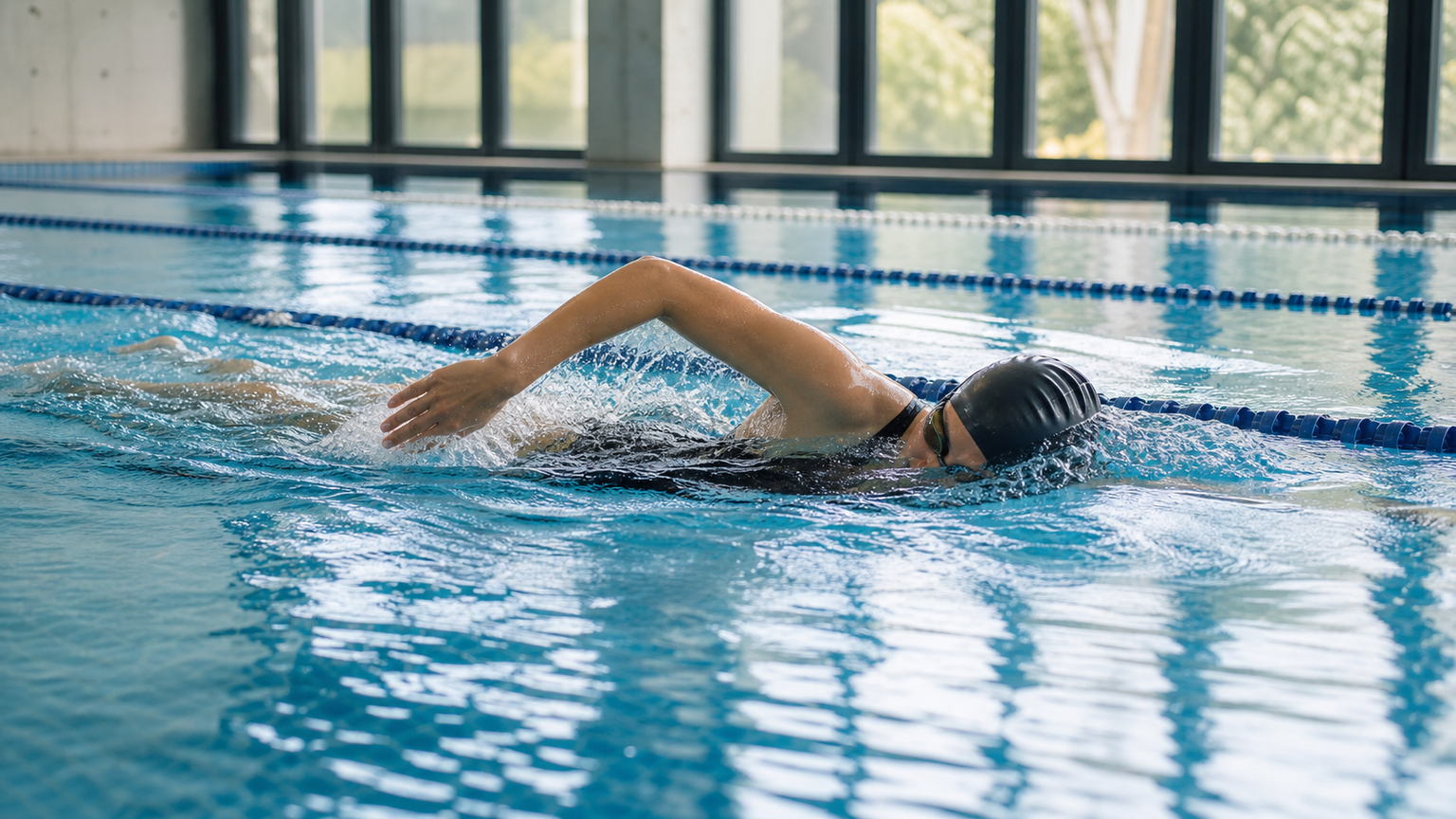
Adult Swimming: The Problem Is Almost Always Technique
Being strong at running and cycling yet slow in the water is the most common pain point for triathletes. The cause isn’t insufficient cardio—it’s excessive drag in the water and poor propulsion efficiency. Swimming offers the highest “return on technique investment” of any triathlon discipline.
Three Major Efficiency Bottlenecks
| Bottleneck | Symptom | Improvement Direction |
|---|---|---|
| Body position sinking | Legs keep dropping, very tiring | Neutral head, engaged core, light kick |
| Ineffective catch | Pulling a lot but not moving forward | High-elbow catch, front quadrant |
| Overexertion | The harder you try, the slower you go | Longer glide, lower stroke rate |
Focus on Drag, Not Propulsion
A beginner’s instinct is to “pull harder,” but drag in water is proportional to the square of speed. Flattening your body position and reducing drag first often yields faster results than adding more power.
Key Practice Prescriptions
- Body position: Kickboard/side-kick drills to train a horizontal body line
- Catch: Catch drills to feel the high elbow
- Tempo: Use a tempo trainer to control stroke rate; prioritize distance per stroke before speed
- Open water: One weekly long swim without walls to break the “rest on the wall” dependency
Quantifying Progress
Use “strokes per 25m (SWOLF)” to track efficiency: a drop in stroke count at the same pace means your technique is genuinely improving—more reliable than looking at time alone.
Mindset
Early in a technique rebuild, you’ll often get slower. That’s the normal “break it down before building it up” phase. Give yourself 8–12 weeks; don’t quit in week three and fall back into old habits.
Use SWOLF to Turn “Feel for the Water” into a Trackable Number
What adult triathletes lack most isn’t cardio but efficiency, and the most practical metric for efficiency is SWOLF (seconds per lap + stroke count for that lap). For example, swimming 25m in 22 seconds with 18 strokes gives a SWOLF of 40. The real sign that a technique rebuild is working is “SWOLF dropping at the same pace”—fewer strokes means more distance per stroke, which distinguishes “genuine improvement” from “just trying harder” better than time alone.
Quantified Improvement Paths for the Three Major Efficiency Bottlenecks
| Bottleneck | Self-Assessment Method | Goal |
|---|---|---|
| Body sinking | Kickboard float test to measure leg sink angle | Maintain near-horizontal position |
| Ineffective catch | Compare stroke count per lap at the same SWOLF | Stroke count decreases |
| Overexertion | Use a tempo trainer to lower stroke rate and check speed | Lower rate without losing speed |
Common Mistake: Giving Up in Week Three of a Technique Rebuild and Reverting to Old Habits
When rebuilding technique by focusing on drag reduction, you will almost certainly “get slower” at first—that’s a normal part of rebuilding movement patterns. Yet most people panic in weeks 2–3 when their pace worsens and revert to their old brute-force swimming style, throwing away all their progress. The right answer is to give yourself an 8–12 week “break it down before building it up” window, judging progress by SWOLF rather than time alone; once your stroke count starts dropping, speed recovery is only a matter of time.
I’ve coached countless triathletes who were strong at riding and running but couldn’t swim fast. The breakthrough almost never came from training harder—it came the day they finally stopped using brute force and started making their body “slippery.” Speed in swimming comes from reducing drag, not from applying more force.
Related Reading
- Triathlon Swimming Technique Refinement: Five Key Keys to Freestyle Efficiency
- Triathlon Swimming Pace Strategy: A Controlled Stroke to Save Energy
- Triathlon Swim Exit and T1 Transition Speed Optimization: The Critical 120 Seconds from Water to Bike
- Intermediate Swimmers Breaking Through Plateaus: Training Strategies to Progress from 1000m to 2000m
西進武嶺 免費訓練分析服務 Intervals | 練不夠還是練過頭?你哪一種類型選手?AI模型告訴你! | 備戰神器 | 公路車 訓練 | CT Yeh
4 年前
CT 喇低賽) 武嶺牽車 才是王道 西進牽車四小時內秘訣 攝手位置 如何判斷 防抽筋小秘訣
7 年前
#公路車 #西進武嶺 配速配瓦實驗 坡度分析 四小時內攻略 建大盃 NeverStop #西進武嶺攻略
6 年前
福隆鐵人團練隨拍
8 年前
FTL 與 SYB 車隊專訪 西進武嶺 實用攻略分享! 2小時 如何練?!你不知道的眉角!新手準備武嶺必看 EP1 | 實力派女車友 | 精華版 | 公路車 | CTYeh
4 年前
[教學] Premiere 影片 手震 修正 教學 防抖 單眼 影像 GoPro 穩定 Video Stabilization
8 年前
一日北高常見問題大集合 | 攻略 | 路線 | 訓練 | 補給 | 自行車 單車 | 一日雙城 | 雙塔 | TWB北高360 | 屁股痛
6 年前
[防寒衣體驗] 鐵人魂 三鐵 防寒衣試穿會 於松運 深水游泳池 鯨魚池
8 年前