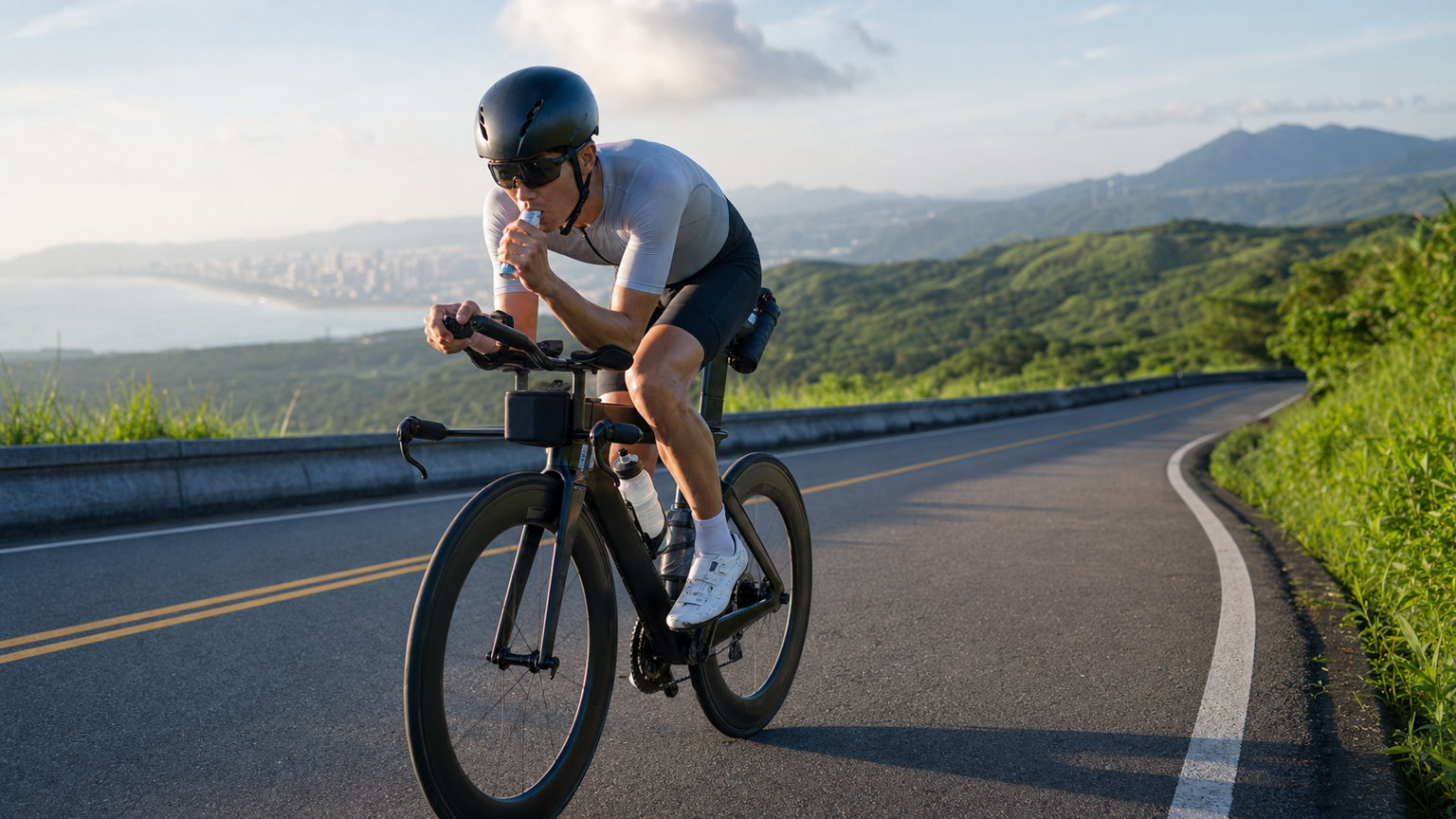
A Triathlete’s Long Ride ≠ A Casual Road Cycling Outing
Many triathletes go on long rides with friends, chatting while riding, with intensity fluctuating up and down. They come home exhausted but haven’t trained the abilities needed for race day. A triathlete’s long ride should train “sustainable output and fueling in the aero position.”
Three Goals of a Triathlete’s Long Ride
| Goal | Execution | Significance for Racing |
|---|---|---|
| Aero Position Tolerance | Maintain race position throughout | Being able to stay aero for the full race |
| Stable IF Output | Control power within race IF ±0.03 | Pacing discipline |
| Fueling Rehearsal | Eat according to the race schedule | Gut adaptation |
Intensity Structure
The main body of a 70.3/IM long ride should be at a low-variability output near race IF (VI < 1.05), not surging and easing. You can insert 2–3 blocks of 15–20 minutes at race intensity in the middle to simulate race-day rhythm.
The Aero Position Is Part of the Training Itself
Riding 4 hours in a comfortable upright position doesn’t guarantee you can stay aero for 4 hours in a race. Long rides must deliberately maintain the aero bar position, training the neck, shoulders, and core to tolerate that posture—this is sport-specific work that pure upright riding can’t deliver.
Fueling Is Part of the Workout
Strictly follow the race-day timeline for eating and drinking during long rides, treating the gut as an organ that needs training. If you haven’t practiced that fueling volume before race day, replicating it on race day is a gamble.
Quantifying Progress
On the same route and at the same IF, an increase in average speed or a decrease in heart rate indicates improved aerobic efficiency; being able to hold the aero position longer is a marker of improved sport-specific tolerance.
Three Quantifiable Disciplines to Turn Long Rides into a “Race Rehearsal”
A triathlete’s long ride isn’t about mileage—it’s about “sustainable output and fueling in the aero position.” Three quantifiable disciplines: (1) Maintain the race aero bar position throughout, recording “the number of minutes you can hold it without sitting up” and extending it week by week; (2) Keep the Variability Index (VI) below 1.05, avoiding surging and easing; (3) Fuel strictly on the race timeline, targeting 60–80g/h of carbohydrates for a 70.3. You can insert 2–3 blocks of 15–20 minutes @race IF in the middle to simulate race-day rhythm.
Quantifiable Indicators of Long-Ride Progress
| Indicator | Improvement | Significance |
|---|---|---|
| Average speed at same IF | Increases | Improved aerobic efficiency |
| Heart rate at same speed | Decreases | Same as above |
| Time able to hold aero position | Extends | Improved sport-specific tolerance |
| Gut response after fueling | No discomfort | Fueling strategy is race-ready |
Common Mistake: Turning a Triathlete’s Long Ride into a Casual Road Cycling Outing
The most common waste is riding with friends while chatting, with intensity fluctuating up and down, in a comfortable upright position for four hours—coming home exhausted without having trained the abilities needed for race day. Holding a comfortable upright position for 4 hours doesn’t guarantee you can stay aero for 4 hours in a race; if you haven’t rehearsed race-volume fueling, replicating it on race day is a gamble. Four hours of aimless riding delivers less training benefit than two purposeful hours of “race position, race intensity, race fueling.”
The value of a triathlete’s long ride isn’t in “how many kilometers you rode,” but in “how long you rode in race position, at race intensity, with race fueling.” What four hours of aimless riding builds is less than what two purposeful hours deliver. Treat the long ride as a rehearsal, not an outing.
Related Reading
- Designing Long-Distance Ride Workouts: Building from 2 Hours to 6 Hours
- Core Training for Triathlon: The Key to Holding the Aero Position and Maintaining Running Form
- A 4-Hour Cycling Fueling Plan: A Strategy for Uninterrupted Fuel Throughout
- Preparing for Long-Distance Cycling Challenges: Training Plan and Race-Day Strategy for 300K Ultra Rides
單車AI教練!全新 ChatGPT4o 幫你分析訓練成果!排武嶺課表,分析騎車姿勢! 太神了! / 公路車 / CT Yeh / feat. 緯緯
2 年前
#公路車 #西進武嶺 配速配瓦實驗 坡度分析 四小時內攻略 建大盃 NeverStop #西進武嶺攻略
6 年前
大禹嶺 到 武嶺牌樓 全程前後實況錄影 | 北進武嶺 | 東進武嶺 | KOM | 訓練台 | 坡度分析 | Taiwan KOM Last 10 km HARD | 公路車
6 年前
西進武嶺 免費訓練分析服務 Intervals | 練不夠還是練過頭?你哪一種類型選手?AI模型告訴你! | 備戰神器 | 公路車 訓練 | CT Yeh
4 年前
FTL 與 SYB 車隊專訪 西進武嶺 實用攻略分享! 2小時 如何練?!你不知道的眉角!新手準備武嶺必看 EP1 | 實力派女車友 | 精華版 | 公路車 | CTYeh
4 年前
一日北高/長距離團騎 常見問題補充篇 / 組團或跟團的眉角 / 壯車友容易被瘦車友慢性拉爆 / 原來屁股痛可能是這個原因...? / 風場配速法 / 公路車 / CT Yeh
2 年前
Never Stop 西進武嶺 前後雙機 完整全程錄影 訓練台 實境
8 年前
一日北高常見問題大集合 | 攻略 | 路線 | 訓練 | 補給 | 自行車 單車 | 一日雙城 | 雙塔 | TWB北高360 | 屁股痛
6 年前