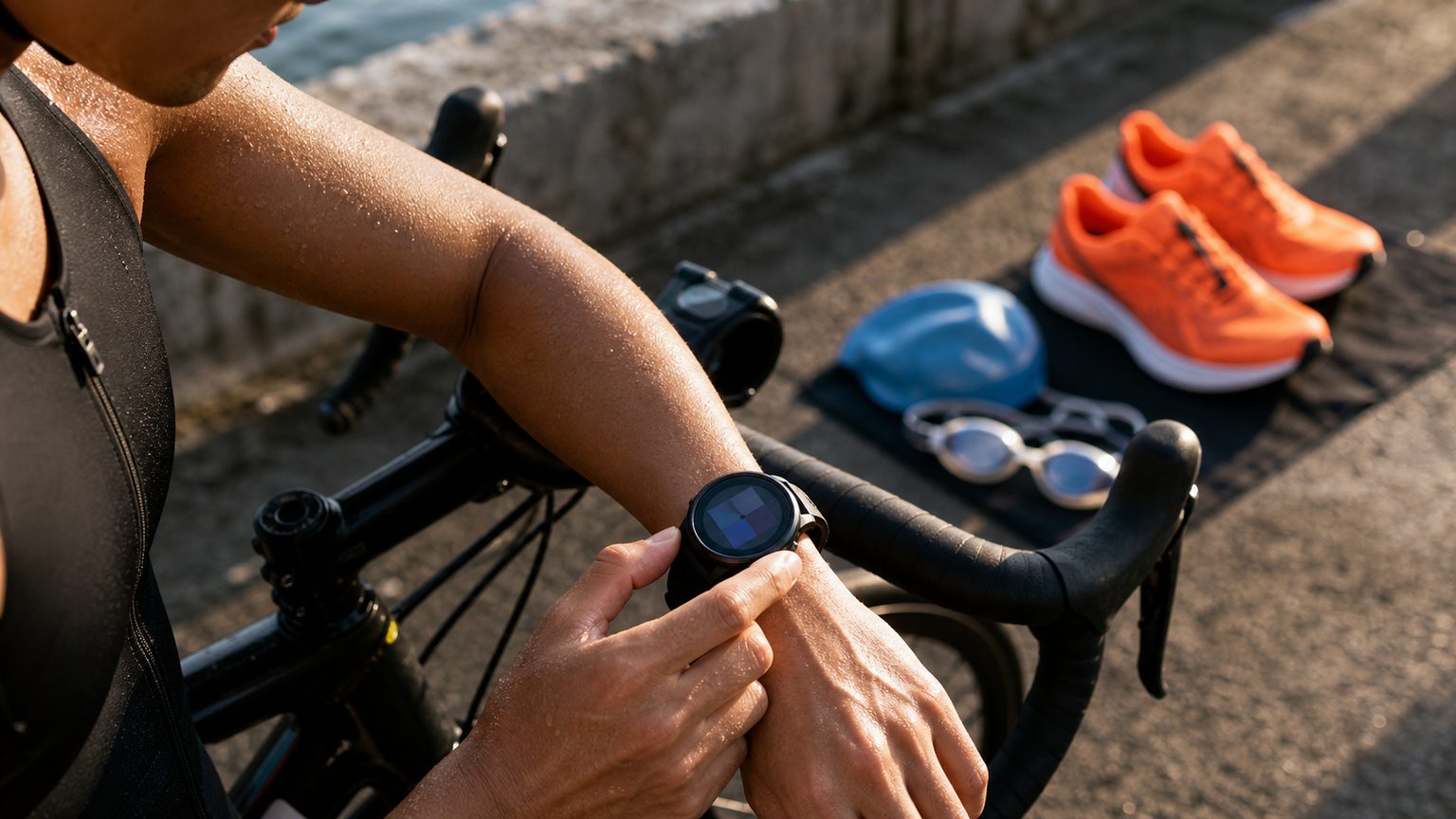
What You Stare At Is What Drags You Along
During a race, those who stare at “instant pace” or “instant power” are the most likely to surge or lose heart from fluctuating numbers. The design of data fields on your watch is an underrated pacing tool.
Recommended Display Fields by Discipline
| Discipline | Primary Field | Secondary Field | Deliberately Hidden |
|---|---|---|---|
| Swim | Distance | Elapsed Time | Instant Pace (meaningless) |
| Bike | 3-Second Power + Normalized Power | Heart Rate, Elapsed Time | Instant Speed (heavily affected by wind) |
| Run | Lap Pace (per 1km) | Heart Rate, Distance | Instant Pace (jumps too wildly) |
Bike: Use NP and 3-Second Power, Ignore Speed
Speed fluctuates wildly with wind and hills; watching it to pace means being led around by the terrain. Instead, focus on 3-second average power (smoothed) and normalized power (NP) for the whole segment to keep output steady, and your VI will naturally stay low.
Run: Watch “Per-Kilometer Lap Pace” Instead of Instant Pace
Instant pace jumps around every few seconds, and staring at it will cause unconscious surges and drops. Set auto-laps every 1km and only look at “last lap pace”—your pace will be much steadier, and your mind won’t be anxious.
Heart Rate as a Backup, Not the Main Control
In triathlon, heart rate drifts due to body temperature and dehydration, making it unsuitable as the primary metric. Its value lies in “abnormal alerts”—if heart rate suddenly spikes at the same power/pace, it means you should slow down or refuel.
Must-Do Before Race Day
Use race-day field configurations during pre-race training so your eyes get used to them. Switching layouts on race day is like learning to read the dashboard only when you’re on stage.
The Fields Each Discipline “Should Watch” and “Must Never Watch”
The watch layout is an underrated pacing tool. The principle: instant pace in the swim is meaningless (disrupted by breathing and sighting)—only watch distance and elapsed time; on the bike, never look at instant speed (wildly fluctuating due to wind and hills)—instead focus on 3-second power + overall NP; in the run, never look at instant pace (jumping every few seconds triggers surges)—instead set auto-laps every 1km and only watch “last lap pace.”
Field Setup Prescription by Discipline
| Discipline | Primary Field | Secondary Field | Deliberately Hidden |
|---|---|---|---|
| Swim | Distance | Elapsed Time | Instant Pace |
| Bike | 3-Second Power + NP | Heart Rate, Elapsed Time | Instant Speed |
| Run | Last Lap Pace (per 1km) | Heart Rate, Distance | Instant Pace |
Common Mistake: Switching Layouts on Race Day
Many people use one set of fields in training, then on race day think “this is an important race, I need to watch closely” and suddenly switch to a screen full of real-time data—that’s like learning to read the dashboard only when you’re on stage, letting your attention be hijacked by jumping numbers. The right answer is to use the race-day layout in all pre-race training so your eyes form muscle memory. The single most effective adjustment is often just removing the “instant pace” field: without that jumping number in sight, your pace actually becomes more even. Sometimes, looking less is the best pacing strategy.
When I adjust a watch layout for an athlete, I often change just one thing to steady their pace: remove “instant pace.” When you can’t see that jumping number, you actually run more evenly. Sometimes looking less is the best pacing strategy.
Related Reading
- Triathlon Heart Rate and Power Dual-Metric Pacing Method
- 2026 Smartwatch Running Form and Power Metrics Explained: Don’t Be Fooled by a Pile of Data
- Triathlon Power Meter Race Strategy: Using Data to Control 180 Kilometers of Fate
- The Pacing Philosophy of the Triathlon Bike Leg: Why “Fastest” Here Isn’t Really Fastest
西進武嶺配速器 3.0更新 / NEW 免功率FTP估算! / 大數據xAI體能模型 / 如何模擬人止關前集團效應 / 配速儲存功能 / AI全台自行車賽事行事曆 / 公路車 / CT Yeh
1 年前
西進武嶺 自製新版AI配速表產生器 x 賽前攻略 抱佛腳! 沒有功率計也可以產生配速表嗎?有什麼其他眉角賽前要注意的呢? | 西進武嶺 / 東進武嶺 KOM 攻略 | 公路車 | CT Yeh
4 年前
2026 車錶排行榜!誰是最多車友正在使用?練家子最愛哪款?🏆 (2萬名車友數據) / 公路車 / CT Yeh
5 個月前
西進武嶺 免費訓練分析服務 Intervals | 練不夠還是練過頭?你哪一種類型選手?AI模型告訴你! | 備戰神器 | 公路車 訓練 | CT Yeh
4 年前
2025 自行車錶排行榜 兩萬車友大數據 / Garmin Bryton 排名會大洗牌嗎? / 全新的碼表前身分析 /公路車 / CT Yeh
1 年前
武嶺配速表最佳使用方式 #bike
1 年前
單車胎壓觀察到的有趣現象,SRAM Quarq TyreWiz 2.0 無內胎胎壓計 / 裝了有哪些幫助? / Tubeless / 公路車 / CT Yeh
1 年前
2023 自行車錶排名 大數據 23,000位車友用什麼錶? Garmin Edge 對決 Bryton Rider 誰市佔高? 你用的上榜了嗎? | 公路車 | CT Yeh
3 年前