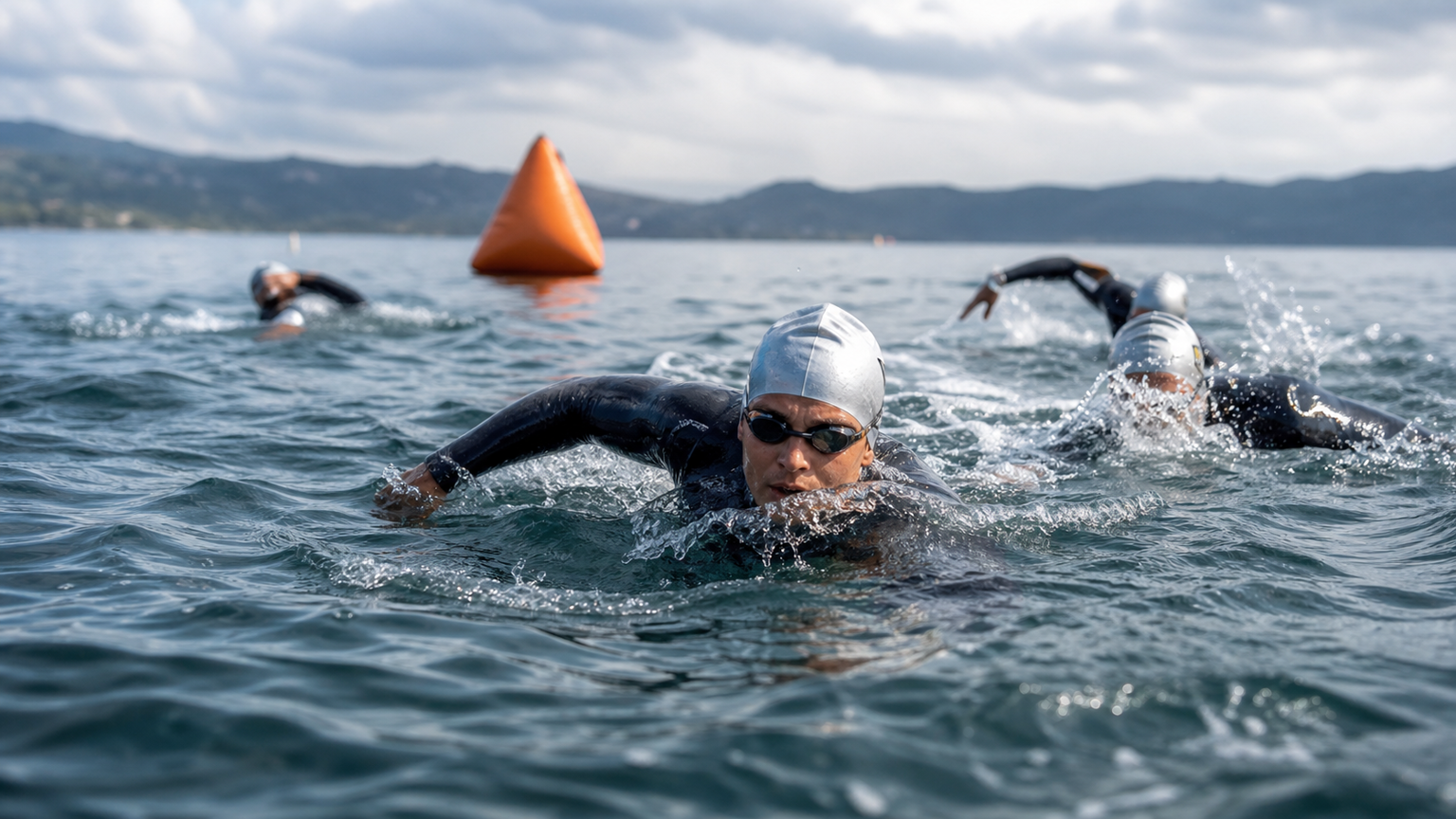
Pool Champion, Open-Water Rookie
The pool has lane lines, walls, clear water, and a constant temperature. Open water has none of that—plus waves, currents, no visible bottom, crowds, and cold. Being fast in the pool doesn’t mean being fast in open water—the latter requires dedicated training.
Open-Water-Specific Abilities Checklist
| Ability | Why the Pool Can’t Train It | Specific Drill |
|---|---|---|
| Straight-line navigation | Lane lines to follow | Closed-eye swimming + sighting practice |
| Head-up sighting | Not needed | Crocodile eye every 6–10 strokes |
| Endurance without walls | Rest every 25/50m | Continuous 800m+ without stopping |
| Physical contact | Exclusive lane use | Simulate with multiple swimmers sharing a lane |
| Cold-water adaptation | Constant temperature | Progressive cold exposure |
Core Workout 1: Sighting Integration
Open-water buoy-turn workout: 50m all-out → head-up sighting around the buoy → repeat 6–8 times, turning sighting into a reflex that doesn’t cost speed.
Core Workout 2: De-Walling
In the pool, deliberately swim 1000–1500m continuously “without pushing off the wall and without resting,” simulating the real rhythm of open water where there are no rest points, breaking the reliance on the wall to recover.
Core Workout 3: Crowd Simulation
Have 4–6 swimmers share a lane and swim 100–200m side by side, deliberately creating contact to train the nervous system not to panic from physical touch.
Cold Water and the Mind
What you must overcome first in open water is often mental (not seeing the bottom, the cold). Progressive exposure: first adapt standing in shallow water, then short distances, then longer distances. Learn back-float self-rescue before anything else.
Breaking Open-Water Ability into Individually Trainable Sub-Workouts
Being fast in the pool doesn’t equal being fast in open water. Three core specialty workouts: (1) Sighting integration—50m all-out → head-up buoy turn, repeat 6–8 times, turning sighting into a reflex that doesn’t cost speed, crocodile eye every 6–10 strokes; (2) De-walling—in the pool, swim 1000–1500m continuously without pushing off the wall or resting, breaking the reliance on the wall to recover; (3) Crowd simulation—4–6 swimmers sharing a lane to create contact, training the nervous system not to panic from physical touch.
Open-Water-Specific Abilities and Specific Drills
| Ability | Why the Pool Can’t Train It | Specific Drill |
|---|---|---|
| Straight-line navigation | Lane lines to follow | Closed-eye swimming + sighting |
| Head-up sighting | Not needed | Crocodile eye every 6–10 strokes |
| Endurance without walls | Rest every 25/50m | Continuous 1000m+ without stopping |
| Cold-water adaptation | Constant temperature | Progressive cold exposure |
Common Mistake: Training Only Fitness, Not the “Real Environment”
The most typical gap is a swimmer who can do 1500m in 21 minutes in the pool, then gets to open water and is rattled by waves, crowds, and not seeing the bottom, swimming a 28-minute pace—the bottleneck is entirely not cardio, it’s never having trained in the real environment. Cold water and the mind are often the primary obstacles; be sure to adapt first with progressive exposure (standing in shallow water → short distances → long distances), and learn back-float self-rescue first. Move your training to open water—that’s how you train the swim you’ll actually face in a race.
I’ve seen a pool swimmer who can do 1500m in 21 minutes get to open water and be rattled by waves and crowds into a 28-minute pace. The bottleneck in swimming is often not fitness, but “never having trained in the real environment.” Move your training to open water—that’s how you train the swim you’ll actually face in a race.
Related Reading
- The Unique Challenges of the Swim Leg in Triathlon: Differences Between Open Water and Pool Technique
- Open-Water Swim Training Plan: A Progressive Workout from 500 Meters to 3.8 Kilometers
- Triathlon Swim Training: Overcoming Fear and Improving Efficiency in Open Water
- Triathlon Swim Training: Key Technical Points for Open-Water Swimming
FTL 與 SYB 車隊專訪 西進武嶺 實用攻略分享! 2小時 如何練?!你不知道的眉角!新手準備武嶺必看 EP1 | 實力派女車友 | 精華版 | 公路車 | CTYeh
4 年前
西進武嶺 免費訓練分析服務 Intervals | 練不夠還是練過頭?你哪一種類型選手?AI模型告訴你! | 備戰神器 | 公路車 訓練 | CT Yeh
4 年前
福隆鐵人團練隨拍
8 年前
備戰 戀戀197 賽前關門點分析 西濱團練 #公路車 4K高畫質
6 年前
單車AI教練!全新 ChatGPT4o 幫你分析訓練成果!排武嶺課表,分析騎車姿勢! 太神了! / 公路車 / CT Yeh / feat. 緯緯
2 年前
CT Talk) 數據面窺看 武嶺大神們 平時的備戰 共通點 (娛樂性質XD)
7 年前
#公路車 #西進武嶺 配速配瓦實驗 坡度分析 四小時內攻略 建大盃 NeverStop #西進武嶺攻略
6 年前
實景訓練台) 彰化經典百K 高強度喵團 90分鐘 跟著一起練功 2019 Indoor workout Changhua Classic 100 Taiwan
7 年前