2026 Sports Sunglasses Buying Guide: The Science of Lens Color, Photochromic Adjustment, and Anti-Fog
Sunglasses Are an Underrated Safety Gear
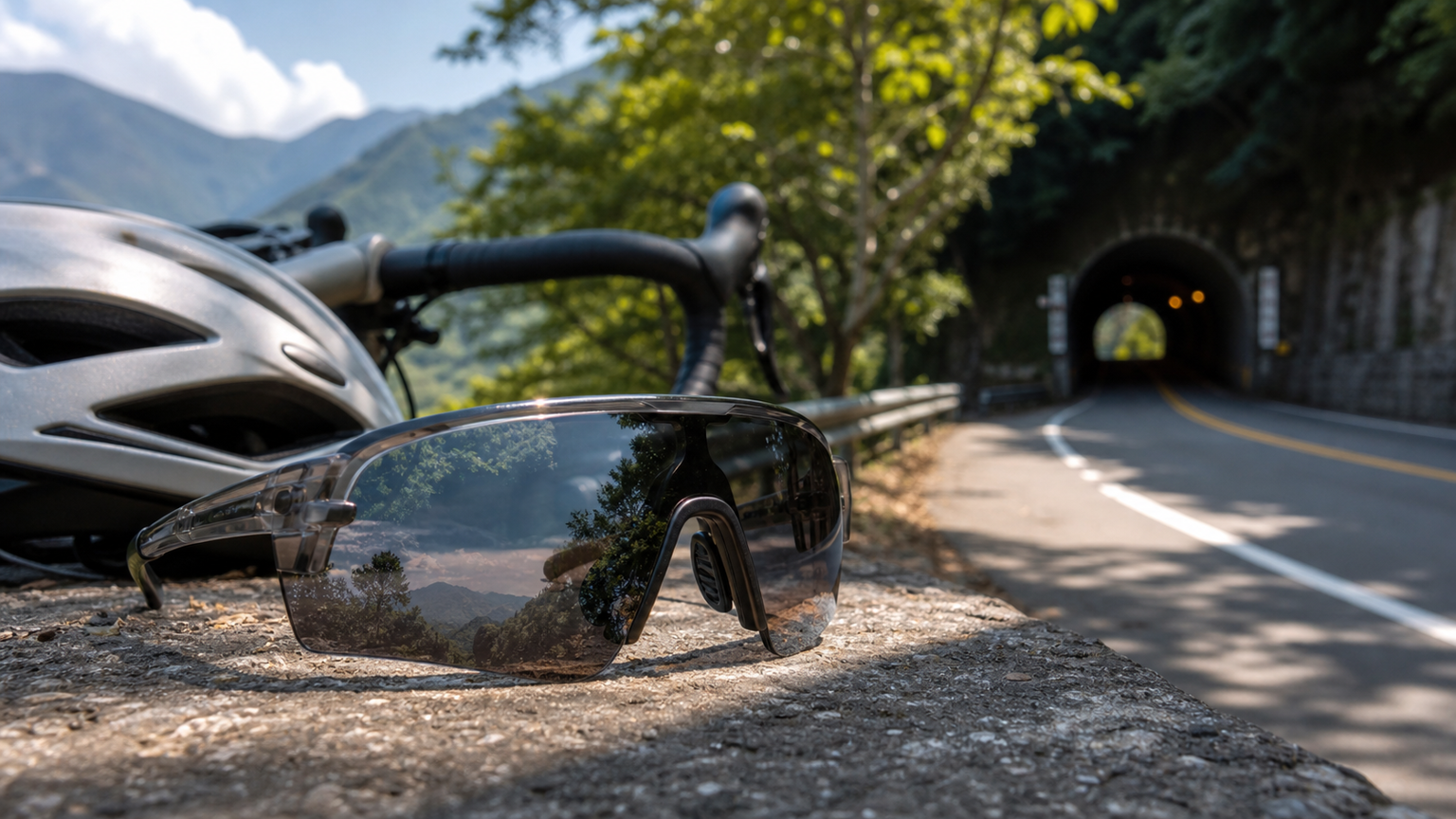
Many people treat sports sunglasses as accessories, but they are actually gear that directly affects safety: blocking wind, sand, and insects on high-speed descents, maintaining visibility in the rain, and reading road surface hazards. Choose the wrong lens, and a descent where you can’t see clearly becomes dangerous instead.
Lens Tints and Their Uses
| Lens Tint | Characteristics | Best Use Cases |
|---|---|---|
| Gray/Smoke | True color reproduction, reduces brightness | Bright sunny days, coastal rides |
| Brown/Amber | Enhances contrast, reveals road surface variations | Cloudy days, forest trails, reading terrain |
| Yellow/Orange | Boosts contrast, brightens | Overcast days, early morning, dusk |
| Clear/Low tint | Barely reduces light | Night riding, tunnels, rain |
| Photochromic | Automatically darkens and lightens with light | Mountain roads with alternating light, most versatile |
Is Photochromic Worth It
Taiwan’s mountain roads often switch rapidly between “tree shade—blazing sun—tunnels,” making fixed-tint lenses hard to cover all situations. Photochromic lenses automatically darken and lighten with UV intensity, making them the most practical choice for variable light conditions. The trade-offs are a higher price, a few seconds of transition delay, and reduced effectiveness behind car heat-insulating glass.
Anti-Fog Is a Must-Have in Taiwan
Taiwan is hot and humid. When climbing and sweating heavily, lenses fog up easily, and losing all visibility in an instant is extremely dangerous. When buying, be sure to confirm anti-fog coating or good ventilation design (frame vents, lens openings)—this matters far more than looks.
Lens Selection Decision Tree by Riding Scenario
Instead of obsessing over brands, choose lenses based on “what you ride most often”:
- Mainly long mountain rides (alternating shade, sun, and tunnels): Photochromic lenses are the top choice—one lens covers everything, saving you the hassle of swapping lenses mid-ride
- Mainly coastal or flat high-speed riding: Gray/Smoke fixed lenses, best for fighting strong glare and delivering true color
- Often night riding or heading out in the dark early morning: Must-have clear or light yellow lenses, which barely reduce light while blocking wind, sand, and insects
- Limited budget and want the best value: Buy a “one frame, multiple lenses” kit (sunny lens + clear lens)—cheaper than buying two pairs and covers both day and night
- Routes with many tunnels like Taroko: Fixed dark lenses are a big no-no (pitch black the moment you enter a tunnel); photochromic or clear lenses are the safe choice
No matter which you choose, UV400 full-spectrum protection and anti-fog design are non-negotiable baselines, not bonus features.
Coverage and Safety
Sports glasses feature large lenses and wraparound designs for: blocking side wind, deflecting flying stones, and providing a wide field of view. Typical fashion sunglasses have small lenses that let wind and sand in, making them unsuitable for high-speed riding.
The true test of sunglasses comes in those two seconds on a descent. When you burst out of a tunnel into blazing sun and everything goes white, you’ll be glad you chose the pair that lets you see the road instantly—not the best-looking one.
Related Reading
- Best Sports Sunglasses Recommendations: Optical Technology for Cycling and Running
- Cycling Sunglasses Buying Guide: Comprehensive Advice on UV Protection, Lens Tints, and Anti-Fog
- Goggle Buying Guide: Lens Tints, Anti-Fog Technology, and Solutions for Nearsighted Riders
- Bicycle Sunglasses Buying Guide: Photochromic vs. Polarized—Which Suits You Best?
開箱) 近視車友 也可以很帥的 Envis Transform 太陽眼鏡開箱 翔鷹 配近視框超便宜秘訣
7 年前
多機位拍片神器 DJI Action 2 拍出速度張力感 | 類空拍機視角 4陣列麥克風超強降風噪 實測! | 公路車 | CT Yeh
3 年前
梅山36彎 奮起湖 單車挑戰 下集 #公路車
6 年前
[教學] Premiere 影片 手震 修正 教學 防抖 單眼 影像 GoPro 穩定 Video Stabilization
8 年前
雷達尾燈 雷不雷? 邁金L508 智慧雷達尾燈 情境考驗實測 | 同場加映 2千元等級的專業車錶 C406 Pro | 公路車 | CT Yeh
3 年前
開箱!DJI Osmo Action 6 運動攝影機 2025 唯一發表旗艦新機種 / 感光元件大升級 / 直拍救星 / CT Yeh
8 個月前
大家都在開箱的...單車用藍芽對講耳機真的有幫助嗎? SENA BiKom 20 長距離旅遊 & 海鷗繞圈賽 實際體驗心得 / 公路車 / CT Yeh
9 個月前
近視雷射三個月後悔嗎?單車族/工程師必看,Smart TransPRK 術後血淚史與後遺症全公開 / CT Yeh
4 個月前