2026 Road Bike Saddle Buying Guide: The Personalized Science of Sit Bone Width, Cutouts, and Firmness
The Most Personal—and Most Often Mis-Chosen—Component
The saddle is the point of greatest pressure between your body and the bike. There is no “best” model, only the one that “best fits your sit bones.” A saddle that feels comfortable for someone else might leave you in too much pain to even want to ride—that’s what makes it so counterintuitive.
The Core of Saddle Selection: Sit Bone Width
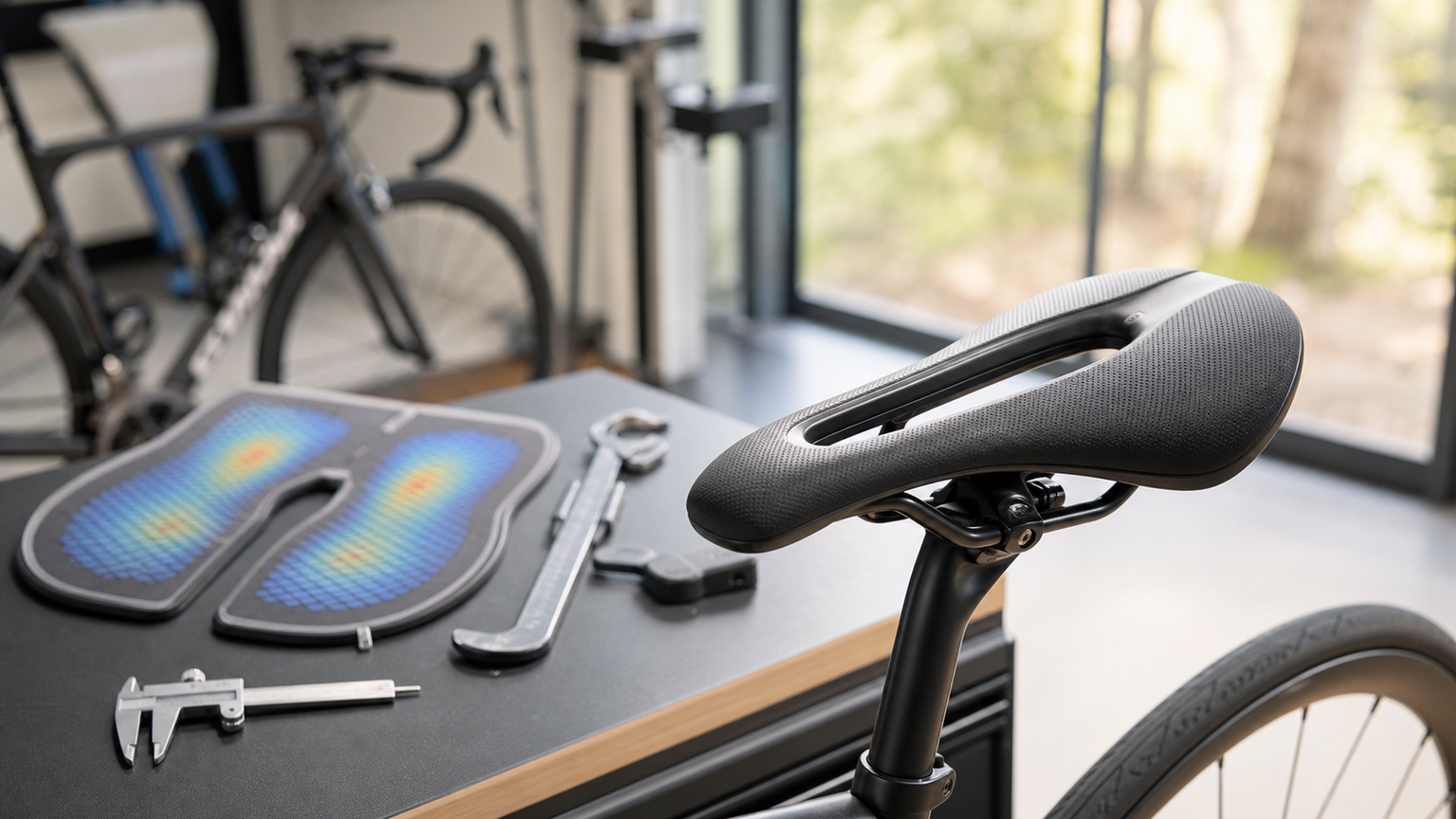
The key to hip support lies in the two “ischial tuberosities” (sit bones). Everyone’s sit bone spacing differs, and saddle width must correspond to it so that your weight rests on bones built to bear load, rather than on soft tissue, blood vessels, and nerves. Many bike shops offer sit bone measurement (sitting on a measuring pad to leave an imprint)—this is the first step in choosing a saddle, not judging by looks.
Specification Dimensions
| Dimension | Logic |
|---|---|
| Width | Corresponds to sit bone spacing; too narrow compresses soft tissue, too wide chafes the inner thighs |
| Central cutout/groove | Reduces perineal pressure, improves blood flow and numbness |
| Firmness | Too soft causes sinking and pressure over long rides; medium firmness works best for most riders |
| Length/nose | Short-nose designs favor those with aggressive forward-leaning positions |
Is a Cutout/Groove Worth It
Perineal numbness and compression of the reproductive system during long rides are real health concerns. A central cutout or recessed design can lower pressure in that area and improve blood flow. For long-distance riders and those with aggressive forward-leaning postures, it’s usually worth prioritizing.
The Firmness Myth
Intuition says softer is more comfortable, but on long rides, an overly soft saddle lets your sit bones “sink into” the foam, shifting pressure onto surrounding soft tissue instead—the longer you ride, the more it hurts. Most riders are best served by “medium firmness with good support.”
Reverse-Engineering Saddle Problems from Discomfort Symptoms
The “type of pain” from an ill-fitting saddle points to different setup errors. This reference chart can help you narrow down which direction to go when swapping saddles:
| Discomfort Symptom | Common Cause | Direction to Address |
|---|---|---|
| Soreness on both sides of the sit bones | Saddle too narrow; sit bones hang off and compress soft tissue | Measure sit bones, switch to a wider model |
| Chafing on inner thighs | Saddle too wide or nose too wide | Switch to a narrower or short-nose model |
| Perineal numbness, compression of reproductive system | No cutout / saddle nose tilted down causing pressure | Switch to a cutout model + adjust to level |
| Keep sliding forward while riding, perineal pressure | Saddle nose angled downward | Adjust to level first, then reassess |
| Pain everywhere but can’t pinpoint it | Likely not the saddle—it’s a fit issue | First correct saddle height and fore/aft position |
Key reminder: Before swapping saddles, make sure your bike fit (saddle height and fore/aft) is correct. Otherwise, the source of pain isn’t the saddle at all, and no number of replacements will help.
Test Riding Is the Only Truth
A saddle’s spec sheet can’t tell you if it fits. Be sure to test ride for at least 30 minutes, including rolling terrain. Many brands and bike shops offer demo programs—take advantage of them; it’s far more cost-effective than buying blind.
The saddle is the most personal component, and no one can decide for you. It reminds us of one thing: in this sport, the most expensive isn’t necessarily the best fit for you—what fits you is what’s right.
Related Reading
- The Science of Road Bike Saddle Selection: Shape, Materials, Sit Bone Width, and Pressure Mapping Analysis
- Road Bike Saddle Buying Guide: Sit Bone Width Measurement and Long-Distance Comfort Analysis
- Road Bike Saddle Buying Guide: Sit Bone Width, Padding Materials, and Nose Shapes Fully Explained
- Road Bike Saddle Buying and Sit Bone Width Measurement: The Complete Guide to Ending Saddle Soreness
Nepest NOVA 碳條輪組:輕量、空力、舒適一次滿足!/ 公路車 / CT Yeh
7 個月前
碟煞公路車 優缺點?換車一年半實際經驗分享 / 公路車 / CT Yeh
2 年前
再一組! 全碳幅條 碟煞/無內胎輪組 開箱! 到底好騎嗎? UNAAS X40 | 公路車 | CT Yeh
4 年前
一日北高/長距離團騎 常見問題補充篇 / 組團或跟團的眉角 / 壯車友容易被瘦車友慢性拉爆 / 原來屁股痛可能是這個原因...? / 風場配速法 / 公路車 / CT Yeh
2 年前
碟煞公路車 銑面器 !? 原來銑完差這麼多! 降低蹭碟機率! | TIME 公路車 保養小記錄 | CT Yeh
3 年前
鉅齒紋輪組!? ControlTech MEG-T50 EVO 碳纖維幅條輪組/ 功率對比實驗 / 公路車 / CT Yeh
2 年前
大禹嶺 到 武嶺牌樓 全程前後實況錄影 | 北進武嶺 | 東進武嶺 | KOM | 訓練台 | 坡度分析 | Taiwan KOM Last 10 km HARD | 公路車
6 年前
#公路車 #Fitting 靠人工智慧APP 幫你調整單車
6 年前