Neuromuscular Training for Cyclists: The Science of Boosting Power and Pedaling Efficiency
Most cycling training plans focus on developing the aerobic system: long rides, interval training, FTP improvement. However, one thing that is often overlooked is training the neuromuscular system — the system that determines your power output, pedaling efficiency, and ability to sustain power at high intensity.
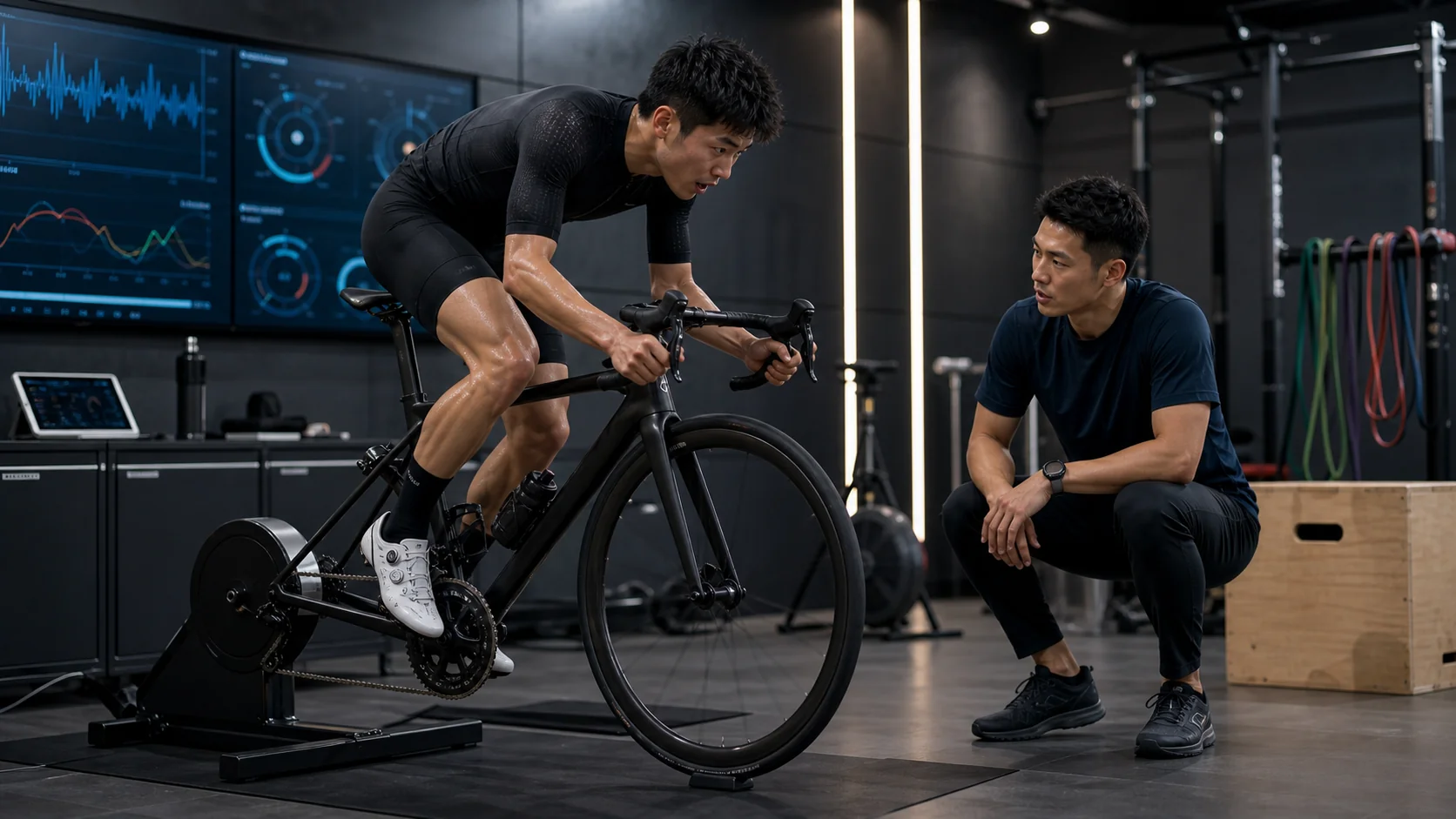
The Role of the Neuromuscular System in Cycling
What Is the Neuromuscular System?
The neuromuscular system is the coordinated work of the nervous system (brain, spinal cord, nerves) and the muscular system, controlling:
- Recruitment (which muscle fibers are engaged)
- Activation timing (when they contract)
- Coordination (how different muscle groups work together)
Why Does Neuromuscular Training Matter?
| Ability | Primary Limiting Factor |
|---|---|
| Maximum sprint power | Neuromuscular system |
| Repeated sprint ability | Aerobic + neuromuscular combined |
| Climbing attacks | Aerobic + neuromuscular combined |
| Long-distance endurance | Primarily the aerobic system |
The Science of Pedaling Efficiency
What Is Pedaling Efficiency?
Pedaling efficiency refers to the proportion of your total pedaling force that actually propels the bike forward.
Ideal pedaling should produce power through the entire pedal circle:
- 2 o’clock → 5 o’clock: Main power phase (quadriceps, glutes)
- 5 o’clock → 7 o’clock: Bottom pull-through (hamstrings)
- 7 o’clock → 11 o’clock: Backward kick (hamstrings)
- 11 o’clock → 2 o’clock: Top lift (hip flexors)
Measuring Pedaling Efficiency
Torque Effectiveness (TE) and Pedal Smoothness (PS) are two metrics provided by power meters:
| Metric | Description | Good Value |
|---|---|---|
| TE | Proportion of effective work out of total work | >70% |
| PS | Smoothness of the pedal stroke | >20% |
Key Neuromuscular Training Methods
1. Cadence Drills
Goal: Improve neural drive frequency and pedaling coordination
Methods:
- Single Leg Drill: Pedal with one leg (the other lifted or relaxed), 30 seconds per leg
- High Cadence Intervals: Target 110-130rpm, sustained for 1-2 minutes
- Spin-Up Drill: Gradually increase from 60rpm to your maximum cadence without shifting gears
Sample training plan (twice per week):
Warm-up: 10 minutes Zone 2
Main set: 6x (2 minutes at 110rpm+ / 2 minutes recovery)
Cool-down: 10 minutes Zone 1
2. Sprint Training
Goal: Recruit the maximum proportion of fast-twitch muscle fibers and boost peak power
Methods:
- Standing start sprints: From a stop or low speed, sprint all-out for 6-10 seconds
- Flying sprints: Build up to speed first, then sprint all-out for 10-15 seconds
- Uphill sprints: Sprint on a slight incline to increase the sense of resistance
Notes:
- Sprint training requires full recovery (3-5 minutes between efforts)
- Limit each session to no more than 6-8 sprints
- Ensure a thorough warm-up beforehand
3. Force Intervals (Standing Effort Training)
Goal: Improve pedaling force and boost climbing power
Methods:
- Low cadence, high force: Use a large gear (e.g., 52x14), pedal at 50-60rpm for 20-30 second efforts
- Standing pedaling: Stand out of the saddle and pedal for 1-2 minutes
- Climbing strength training: On an 8-10% grade, pedal at low cadence with high force
4. Start Reaction Training
Goal: Improve reaction speed for race starts or attacks
Methods: Sprint all-out immediately upon hearing a cue (or seeing a signal), simulating race conditions.
Pedal Stroke Technique Drills
Eliminating Dead Spots
The pedal stroke “dead spot” refers to the top (12 o’clock) and bottom (6 o’clock) positions, where force transfer efficiency is lowest.
Drill methods:
- Single-leg drills on a trainer: 5-10 minutes per session, focusing on force transfer throughout the entire pedal circle
- Light gear, high cadence: Using a light gear (90+rpm) helps you feel the smoothness of the pedal stroke
- Mental imagery: Imagine scraping mud off your shoe (top push) and scraping the floor with your sole (bottom pull-through)
Muscle Balance Training
Many cyclists have imbalanced left-right leg strength, which can lead to:
- Reduced pedaling efficiency
- Increased injury risk
- Power loss during climbs or sprints
Identifying imbalance: Left/right power data from power meters (such as Stages, Garmin Vector, Favero Assioma)
Correction methods:
- Increase single-leg training on the weaker side
- Adjust saddle height (a slightly higher position on the weak side can sometimes help)
- Strengthen the core (to stabilize the torso)
Neuromuscular Benefits of Strength Training
Many endurance cyclists resist strength training, but research shows:
Benefits of Strength Training for Cycling
| Benefit | Mechanism | Training Required |
|---|---|---|
| Increased sprint power | Greater fast-twitch fiber recruitment | Heavy squats |
| Improved pedaling efficiency | Enhanced neural coordination | Single-leg training |
| Delayed fatigue | Motor unit reserve | Comprehensive strength training |
| Injury prevention | Joint stability | Core + functional training |
Off-Season Strength Training Plan for Cyclists
Twice per week, 45-60 minutes each:
| Exercise | Sets x Reps | Load |
|---|---|---|
| Squat | 4x5 | Heavy (85-90% 1RM) |
| Single-leg squat | 3x8 | Moderate |
| Romanian deadlift | 3x8 | Moderate |
| Bulgarian split squat | 3x10 | Moderate |
| Leg curl | 3x12 | Moderate |
| Core stability work | Various | Bodyweight |
Note: Significantly reduce strength training during the race season, maintaining it with only minimal sessions.
Neuromuscular Demands of Taiwan’s Riding Conditions
Taiwan-Specific Training Needs
| Road Characteristic | Neuromuscular Demand |
|---|---|
| Frequent turns on mountain roads | Explosive start power |
| Rough road surfaces | Body stability |
| Urban traffic lights | Repeated starting power |
| Climbing over mountain passes | Sustained power output |
Accelerating from traffic lights while riding in Taiwan’s cities is actually a great neuromuscular training opportunity!
Integrating Training into Your Annual Plan
Neuromuscular Training Across the Annual Training Cycle
| Period | Focus | Frequency |
|---|---|---|
| Base phase (Nov-Jan) | Strength training + pedaling technique | 2x/week strength training |
| Build phase (Feb-Apr) | Sprints + power | 1x/week strength + 2x/week sprints |
| Peak phase (May-Sep) | Race specificity | Maintenance training |
| Post-season (Oct) | Recovery + assessment | Light training |
Conclusion
Neuromuscular training is an essential part of a complete cycling training plan. Through:
- Cadence drills to improve pedaling coordination
- Sprint training to boost peak power
- Strength training to build a foundation of force
You will build more well-rounded athletic ability on top of your aerobic foundation. Remember: the fastest cyclist isn’t just the one with the biggest aerobic engine, but the one who can deliver power most efficiently.
Related Reading
- Explosive Power Training for Cyclists: Neuromuscular Activation and Workout Design for Sprinting
- Jump Rope and Agility Training: Supplementary Training for Neuromuscular Coordination
- Power Training for Cyclists: Workout Design for Neuromuscular Activation
- Neuromuscular Power Intervals: Building Explosive Power with 10-Second All-Out Sprints
#公路車 #Fitting 靠人工智慧APP 幫你調整單車
6 年前
多機位拍片神器 DJI Action 2 拍出速度張力感 | 類空拍機視角 4陣列麥克風超強降風噪 實測! | 公路車 | CT Yeh
3 年前
靠單車減肥35公斤 心得分享與整理
7 年前
單車AI教練!全新 ChatGPT4o 幫你分析訓練成果!排武嶺課表,分析騎車姿勢! 太神了! / 公路車 / CT Yeh / feat. 緯緯
2 年前
[教學] Dashware 教學 如何製作有 速度 功率 心律的 騎車影片 Guages Video
8 年前
西進武嶺 免費訓練分析服務 Intervals | 練不夠還是練過頭?你哪一種類型選手?AI模型告訴你! | 備戰神器 | 公路車 訓練 | CT Yeh
4 年前
高雄綠園道鐵路自行車道 / 外地人能輕鬆駕馭 還是整路崩潰? / 2025 全線開通 春節實地探索一次!(附GPS連結)/ 公路車 / CT Yeh
1 年前
大家都在開箱的...單車用藍芽對講耳機真的有幫助嗎? SENA BiKom 20 長距離旅遊 & 海鷗繞圈賽 實際體驗心得 / 公路車 / CT Yeh
9 個月前