Lactic Acid and Fatigue: Debunking Common Myths in Exercise Physiology
“Lactic acid buildup causes muscle soreness and fatigue” — almost everyone has heard this claim. But it’s wrong. Modern exercise physiology has overturned many traditional beliefs about lactic acid. This article will walk you through the actual science.
The Basic Biochemistry of Lactic Acid
How Is Lactic Acid Produced?
When muscles work under low-oxygen or high-intensity conditions, glucose metabolism follows the “anaerobic glycolysis” pathway:
Glucose → Pyruvate → Lactate
Important clarification: Lactate production does not require oxygen deprivation! Even with plenty of oxygen available, muscles produce lactate during high-intensity exercise.
Lactic Acid ≠ Lactate
This is a common terminology confusion:
- Lactic Acid: The acidic form found in a test tube
- Lactate: At physiological pH (around 7.4), lactic acid almost completely dissociates into lactate ions
So the “lactic acid” in our blood is actually almost entirely lactate, which is neutral.
Debunking the Myth That Lactic Acid Causes Fatigue
The Traditional View
Traditionally: Lactic acid → Acidity → Interferes with muscle contraction → Fatigue
What Modern Research Has Found
1. Lactic Acid Itself Does Not Cause Fatigue
Studies show:
- Injecting lactate into muscles does not reproduce the feeling of fatigue
- Muscle pH decline (acidification) and lactate levels occur simultaneously, but the main cause of acidification is hydrogen ions (H+), not lactate
- Injecting lactate at normal pH levels does not impair muscle function
2. Lactate Is Fuel, Not Waste
This is the most important finding: lactate can be used directly as fuel by the heart, slow-twitch muscle fibers, and the brain:
| Organ/Tissue | How It Uses Lactate |
|---|---|
| Heart muscle | Directly oxidized as fuel (even preferred over other substrates) |
| Slow-twitch muscle fibers | Take up lactate produced by fast-twitch fibers and oxidize it |
| Liver | Converts it back to glucose (gluconeogenesis) |
| Brain | Uses lactate as supplementary fuel during high intensity |
Exercise physiologist George Brooks proposed the “Lactate Shuttle Hypothesis” to describe this mechanism.
The Real Fatigue Mechanisms
So what actually causes fatigue? Modern research points to multiple factors:
| Fatigue Type | Mechanism | Primary Factors |
|---|---|---|
| Peripheral fatigue | Within the muscle | Phosphocreatine depletion, potassium ion accumulation |
| Central fatigue | Brain/nervous system | Elevated brain temperature, serotonin/dopamine imbalance |
| Metabolic fatigue | Whole body | Glycogen depletion (bonking effect) |
| Perceived fatigue | Psychological | Rise in Rating of Perceived Exertion (RPE) |
Lactate Threshold and the Real Meaning of Training
What Is the Lactate Threshold?
Although lactate does not directly cause fatigue, blood lactate concentration remains an important training metric because it reflects the body’s metabolic state:
- Lactate Threshold 1 (LT1): Lactate begins to rise noticeably above resting levels (around 2 mmol/L), corresponding to the aerobic threshold
- Lactate Threshold 2 (LT2): The inflection point where lactate rises sharply (around 4 mmol/L), corresponding to the anaerobic threshold/FTP
| Training Intensity Zone | Lactate Level | Characteristics |
|---|---|---|
| Zone 1-2 | <2 mmol/L | Aerobic fat burning, sustainable for long durations |
| Zone 3 | 2-4 mmol/L | Lactate begins to rise, mixed aerobic/anaerobic |
| Zone 4 (FTP) | 4-6 mmol/L | Highest point where lactate production = clearance |
| Zone 5+ | >6 mmol/L | Rapid lactate accumulation, sustainable only for minutes |
How Does Training Raise the Lactate Threshold?
- Increase mitochondrial density: More mitochondria = more efficient lactate oxidation
- Increase capillary density: Better transport of lactate from fast-twitch to slow-twitch muscles
- Increase MCT proteins: More “vehicles” for lactate shuttling
- Enhanced enzyme activity: Increased activity of enzymes involved in lactate metabolism
The Truth About Delayed Onset Muscle Soreness (DOMS)
DOMS Is Not Caused by Lactic Acid
Delayed Onset Muscle Soreness typically peaks 24-72 hours after exercise, while lactate is cleared within 1-2 hours after exercise.
The real causes of DOMS:
- Micro-tears in muscle fibers (especially from eccentric contractions)
- Inflammatory response and swelling
- Sensitization of nerve receptors
Why Is Descending Especially Painful?
When riding downhill, the quadriceps primarily perform eccentric contractions (producing force while the muscle lengthens), which is the contraction type most prone to causing micro-damage.
This is why Taiwanese cyclists experience severe thigh soreness two days after descending Wuling, not lactic acid.
Applications of Lactate in Competitive Performance
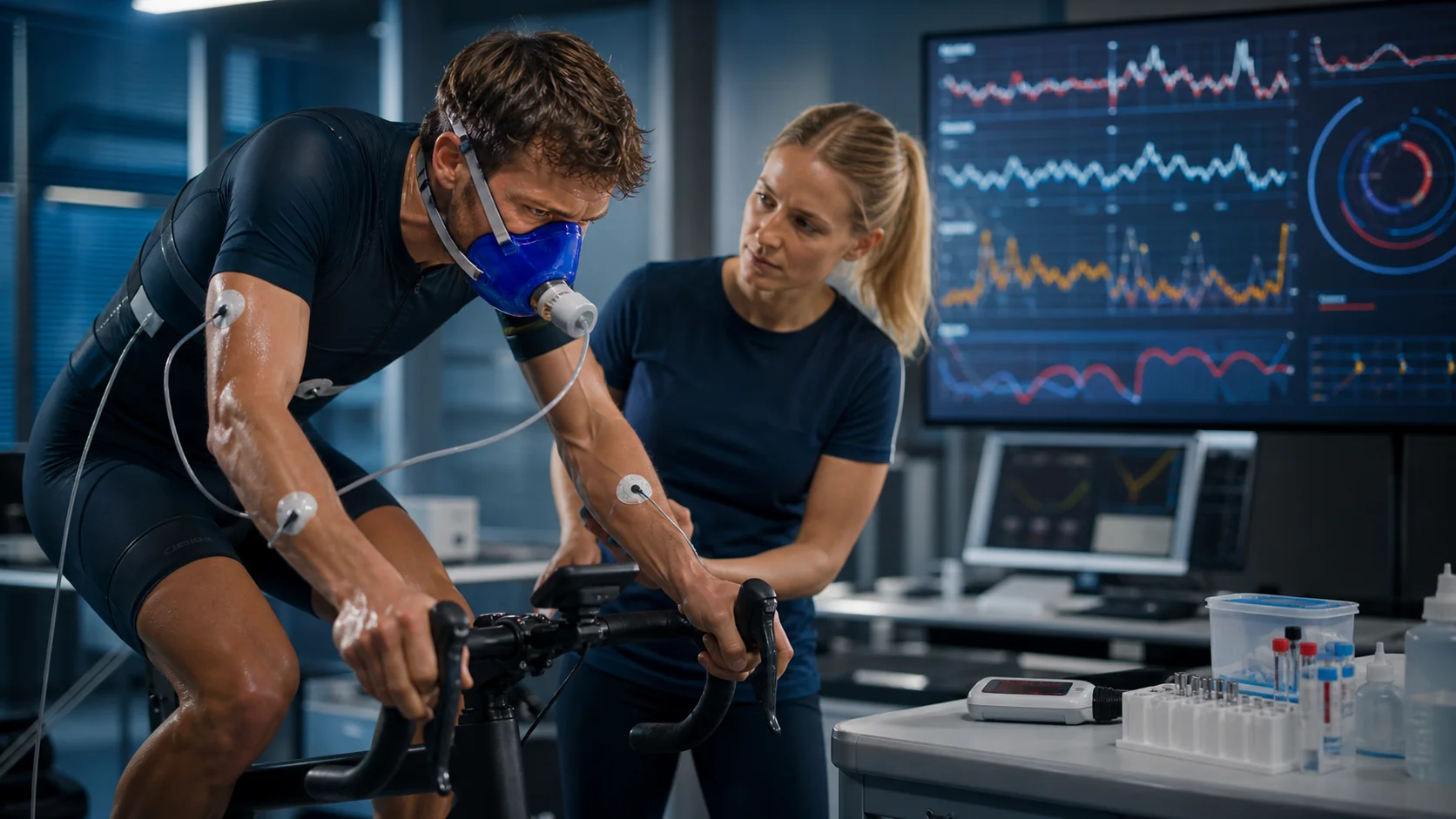
Practical Uses of Lactate Testing
| Application | Method | Purpose |
|---|---|---|
| Determining training zones | Ramp test + blood sampling | Precisely set Zone 2-4 boundaries |
| Monitoring training effects | Periodic retesting | Confirm whether the threshold has improved |
| Race strategy | Understanding your own metabolic profile | Decide on a sustainable pace |
Lactate Metabolism Characteristics of Pro Athletes
| Characteristic | Amateur Athletes | Pro Athletes |
|---|---|---|
| Power at LT2 | 250-320W | 380-450W |
| Lactate clearance rate | Slower | Significantly faster |
| Aerobic contribution | Lower | Higher (more efficient use of lactate as fuel) |
Practical Training Recommendations
Understanding lactate science allows us to train smarter:
1. Don’t Fear the “Burn”
The “burning sensation” during Zone 4 training (FTP intensity) is not damage—it’s a normal metabolic process. Training can improve your tolerance and clearance efficiency.
2. Raising LT1 (Aerobic Threshold) Matters Equally
Too many riders only focus on FTP (LT2) and neglect LT1. Long Zone 2 rides are highly effective for improving lactate clearance efficiency.
3. Active Recovery After Training Is Scientifically Supported
Easy spinning (Zone 1) does accelerate lactate clearance and leads to faster recovery than complete rest.
4. Diet Affects Lactate Metabolism
- Adequate carbohydrate intake: Provides more glycolytic substrate, improving efficiency at high intensities
- B vitamins: Important coenzymes in metabolic processes
Conclusion
Lactate is not your enemy—it is an important metabolic partner for your muscles during high-intensity work. The real fatigue mechanisms are far more complex than “lactic acid buildup.”
Understanding these scientific principles can help you:
- Stop abandoning high-intensity training just because you “feel the burn”
- Design training plans more precisely
- Understand why both Zone 2 aerobic training and high-intensity training are indispensable
Scientific training begins with debunking myths.
Related Reading
一日北高/長距離團騎 常見問題補充篇 / 組團或跟團的眉角 / 壯車友容易被瘦車友慢性拉爆 / 原來屁股痛可能是這個原因...? / 風場配速法 / 公路車 / CT Yeh
2 年前
鎮西堡 公路車首航 你排乳酸 我排卵... | 宇老又爆胎 要直接棄坑了嗎?
4 年前
一日北高常見問題大集合 | 攻略 | 路線 | 訓練 | 補給 | 自行車 單車 | 一日雙城 | 雙塔 | TWB北高360 | 屁股痛
6 年前
洗單車神器 吹水機! 實際洗車用用看 暴力洗鍊條大法 | 公路車 | CT Yeh
4 年前
靠單車減肥35公斤 心得分享與整理
7 年前
一個測試有沒有認真練車的方法😂 #公路車
10 個月前
福隆鐵人團練隨拍
8 年前
約騎爆笑地獄梗 大腸怎麼了🤣 #公路車 #cycling
3 年前