Italian Cycling Culture: From Café Culture to the Campagnolo Legend
If France is the holy land of bicycle racing, then Italy is the mother of cycling culture itself. In Italy, cycling is not just a sport — it is a way of life, a pursuit of aesthetics, and a connection to land and history. This article takes you deep into the unique world of Italian cycling culture.
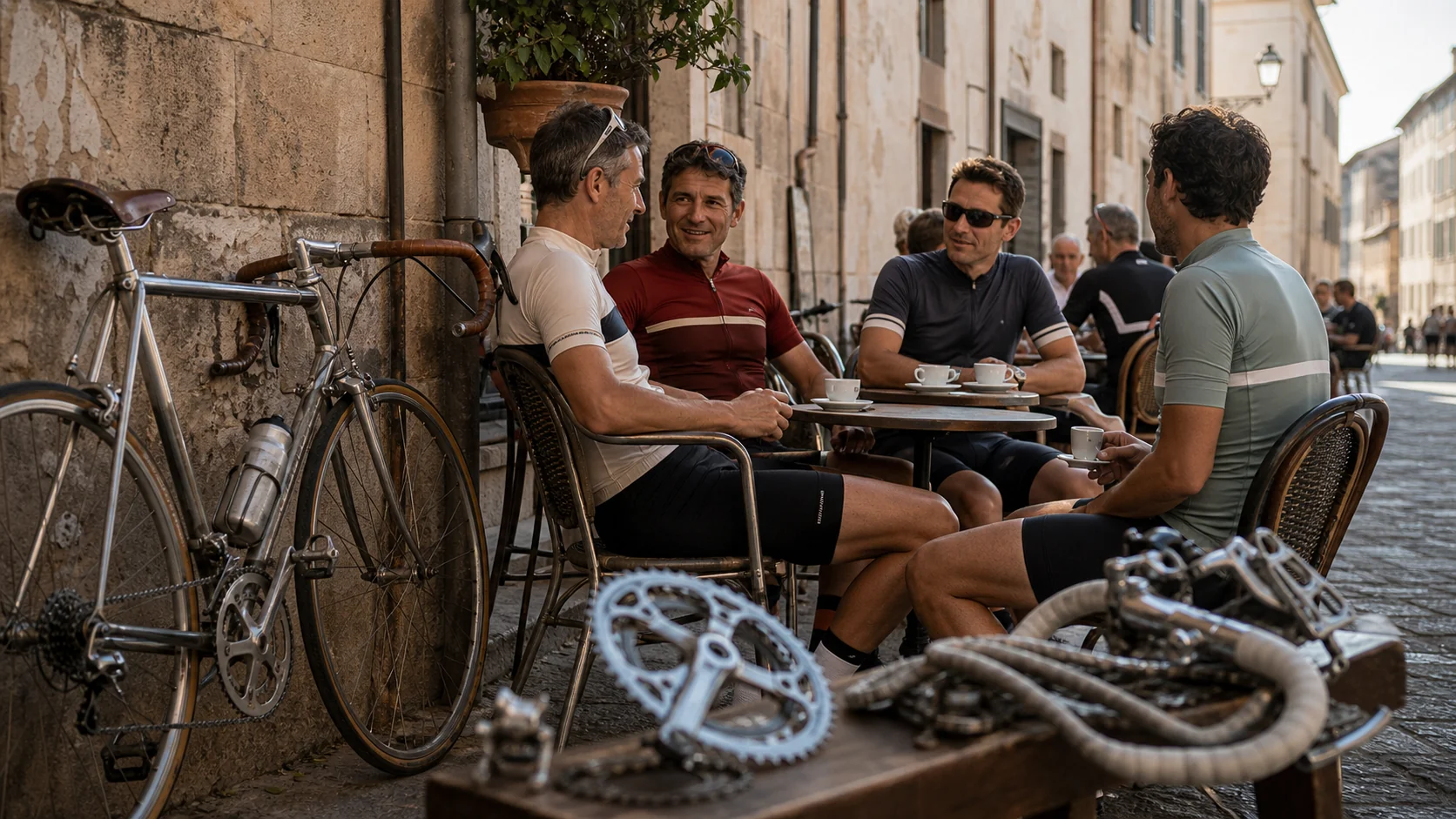
The Italian Riding Philosophy: Bella Figura
One of the core concepts of Italian culture is “Bella Figura” — literally “a beautiful figure,” extended to mean “doing everything with style and grace.”
This concept is fully embodied in Italian cycling culture:
| Standards for Italian Riders | Non-negotiables |
|---|---|
| Kit is always neat | Never ride in wrinkled clothing |
| Bike is always clean | Wash the bike after every ride |
| Riding posture is elegant | Never ride “ugly” |
| Coffee culture | Espresso before and after every ride |
In Italy, seeing a rider pedal without elegance is deeply embarrassing — almost a social faux pas.
The Inseparable Bond Between Italian Café Culture and Cycling
In Italian riding culture, the Bar (café) plays an indispensable role:
The Pre-Ride Coffee Ritual
The standard morning routine of an Italian rider:
- A quick Espresso at home or at the café
- Head out for the ride
- Refuel at a familiar café along the route (Espresso + Brioche)
- One more coffee to celebrate after the ride
Why Espresso rather than a long black?
- Small volume, quick caffeine intake
- Doesn’t upset the stomach
- Italians believe coffee should be a brief ritual, not a long, drawn-out drink
Italy’s Famous Cycling Coffee Stops
Italy has many historic cafés that have been riders’ fixed stops for decades:
- Caffè Rivoire in Florence: a cycling shrine in the Renaissance city
- Zara in Bologna: a legendary refueling stop for Giro d’Italia riders
- Small Bars in the Dolomites: a sweet reward after climbing
Italy’s Racing Culture
Giro d’Italia
The Giro d’Italia is Italy’s pride, and one of cycling’s three Grand Tours:
| Comparison | Giro d’Italia | Tour de France |
|---|---|---|
| Founded | 1909 | 1903 |
| Month held | May | July |
| Terrain | More high mountains, harder | Balanced terrain |
| Cultural atmosphere | Passionate, Italian flair | Rigorous French style |
| Leader’s jersey color | Pink jersey (Maglia Rosa) | Yellow jersey |
The origin of the pink jersey: In 1931, the newspaper of La Gazzetta dello Sport was printed on pink paper. The race leader began wearing pink, which has since become the highest symbol of honor in Italian cycling.
Italy’s One-Day Classics Tradition
Italy hosts several world-renowned one-day classics:
| Race | Feature | History |
|---|---|---|
| Milan-Sanremo | The longest one-day classic (295km) | Founded in 1907 |
| Il Lombardia | The autumn classic, known as “the race of the falling leaves” | Founded in 1905 |
| Strade Bianche | Tuscany’s white gravel roads | Founded in 2007 |
Campagnolo: Aristocracy of Components
The Founder’s Legendary Story
In 1927, a young rider named Tullio Campagnolo was racing over the Passo della Croce d’Aune in the Dolomites when his frozen hands couldn’t loosen the wingnuts of his rear wheel, costing him a chance at victory.
On the spot, he muttered a phrase that would become legendary:
“Bisogna cambià qualcosa de drio.” (Something back there needs to change.)
Two years later, in 1929, he invented the quick-release wheel-axle system, changing the history of the bicycle forever.
Campagnolo’s Technical Legacy
| Year | Invention/Innovation |
|---|---|
| 1929 | Quick-release wheel axle |
| 1933 | Cambio Corsa (the first rear derailleur) |
| 1950 | Gran Sport rear derailleur (the prototype of the modern derailleur) |
| 1968 | Nuovo Record groupset |
| 2008 | Super Record electronic shifting (prototype) |
| 2015 | Campagnolo EPS electronic shifting goes into full production |
Campagnolo vs Shimano vs SRAM
| Brand | Nationality | Cultural positioning | Market share |
|---|---|---|---|
| Campagnolo | Italy | Traditional craftsmanship, premium feel | ~10-15% |
| Shimano | Japan | Reliable performance, value for money | ~60-70% |
| SRAM | USA | Innovation, mountain-bike roots | ~20-25% |
Why do Italian riders favor Campagnolo?
- Emotional connection: Italy’s cycling tradition is inseparable from Campy
- Shift feel: Campagnolo’s Ergopower shifters have a distinctive tactile feedback
- Craftsmanship aesthetics: Every component pursues visual and tactile perfection
- Service life: A well-maintained Campy groupset can last more than 10 years
Where to Buy Campagnolo in Taiwan
In Taiwan, Campagnolo components are rarer than Shimano’s:
- Cycling specialty shops in major cities
- Online shopping (buying direct from Europe is often 20-30% cheaper than in Taiwan)
- Taiwanese distributors (though model selection is limited)
Italy’s Renowned Frame Brands
Historic Manufacturers
| Brand | Year Founded | Feature |
|---|---|---|
| Colnago | 1954 | Hand-built frames, ultimate craftsmanship |
| Pinarello | 1952 | The mount of Tour de France champions (Froome, Thomas, Pogačar) |
| De Rosa | 1953 | Founder Ugo De Rosa hand-builds every frame |
| Bianchi | 1885 | The world’s oldest bicycle brand, famous for its Celeste green |
| Wilier Triestina | 1906 | Traditional craftsmanship from northeastern Italy |
Bianchi’s Celeste
Bianchi’s Celeste (sky blue) is one of the most recognizable colors in cycling. This distinctive blue-green shade has several possible origin stories:
- The color of Italy’s azure sky
- The color of a Milanese queen’s eyes
- Also said to be simply the leftover paint at the factory
Whatever its true origin, Celeste has become a symbol of the Italian cycling spirit.
Italy’s Sacred Riding Destinations
The Dolomites
The Dolomites are a legendary mountain range in northeastern Italy, known as “the Queen of the Rocks”:
- A magnificent landscape of vertical cliffs and limestone peaks
- Home to several famous Giro d’Italia climbs (Stelvio, Pordoi, Gardena)
- Rideable year-round (summer is best)
- Taiwanese travel agencies offer “Dolomites cycling tour” packages
Tuscany
Tuscany’s rolling hills, vineyards, and cypress trees make it the most “Bella Figura” cycling backdrop:
- The unique riding sensation of the “Strade Bianche” white gravel roads
- Picture-perfect scenery the entire way (the Chianti wine region)
- Spring and autumn offer the most pleasant climate
Advice for Taiwanese Riders Cycling in Italy
If you’re planning to ride in Italy:
- Language prep: Learn basic Italian phrases (many mountain-town bar owners speak limited English)
- Cultural prep: Understand café culture, and try telling the difference between an Espresso and a Cappuccino
- Road condition prep: Mountain roads in Italy can be poorly maintained — research conditions in advance
- Best season: May (during the Giro) and September (most stable weather)
- Gear tip: Bring a lightweight rain jacket (mountain weather is changeable)
Conclusion
Italian cycling culture is a fusion of centuries of traditional craftsmanship, a Mediterranean way of life, and competitive passion. From Campagnolo’s quick-release axle to the magnificent climbs of the Dolomites, from Espresso at the café to Gelato after the ride, Italy shows us: cycling is not just a sport, but a life experience full of beauty.
For Taiwanese riders, understanding Italy’s cycling culture is a way to connect with one of the deepest roots of the cycling spirit itself.
Related Reading
- A Global Tour of Bicycle Café Culture: The World’s Most Instagram-Worthy Cycling-Themed Cafés
- Cycling in Search of Cafés in Taiwan: The Perfect Route Combining Riding and Coffee Culture
- Cycling Café Culture: Cycling Cafés Worth Visiting Across Taiwan
- Cycling and Coffee Culture: A Guide to Taiwan’s Café Cycling Routes and Coffee Shop Culture
荷蘭 Rapha 租公路車 騎 阿姆斯特丹 Amsterdam Rapha Cycling Club Bike Hiring
6 年前
2023自行車展!與環台賽選手一同表演賽 / 全自動AI Fitting?/ TIME新車發表/神秘充電桌等 精華分享 VLOG | CT Yeh | 公路車
3 年前
北海道 增毛町 單車文化體驗 Hokaido Cycling サイクリング
8 年前
#公路車 #Fitting 靠人工智慧APP 幫你調整單車
6 年前
下次拍照前要查清楚啦🤣 #cycling
7 個月前
靠單車減肥35公斤 心得分享與整理
7 年前
單車 一日北高 ( 雙城 ) 肥宅雙人瘋狂行 紀錄片 REACTO
10 年前
高雄綠園道鐵路自行車道 / 外地人能輕鬆駕馭 還是整路崩潰? / 2025 全線開通 春節實地探索一次!(附GPS連結)/ 公路車 / CT Yeh
1 年前