Complete Guide to Gravel Bikes: Exploring Taiwan’s Endless Off-Road Possibilities
The gravel bike has become one of the hottest categories in cycling in recent years. It’s not a pure road bike, and it’s not a mountain bike — it’s the perfect fusion of both. For riders in Taiwan, the gravel bike opens up an entirely new world of riding: the mysterious zones between paved roads and mountain trails, places a normal road bike can’t reach and a mountain bike would be overkill for.
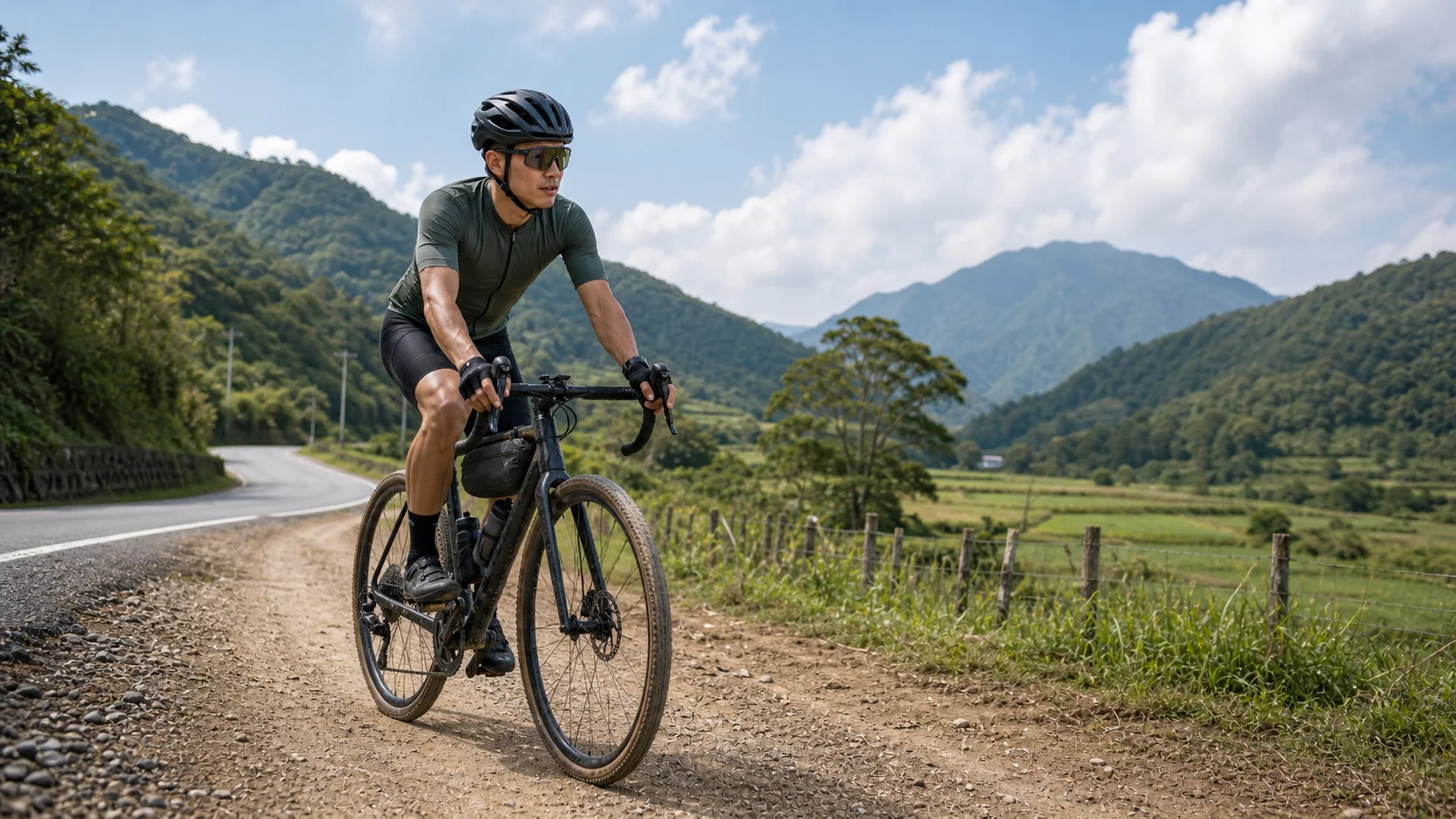
What Is a Gravel Bike?
Design Definition
A gravel bike is designed to be an all-rounder capable of handling a wide range of road conditions:
| Feature | Description |
|---|---|
| Tire size | 700x35-45c (wider than road, narrower than MTB) |
| Frame geometry | Between road and mountain bikes (more stable than road) |
| Drivetrain | 1x (single chainring) or 2x |
| Handlebar | Drop bar (road-style) or flared bar (wider angle) |
| Mounting points | Multiple rack/bag mounts (built for touring) |
Gravel Bike vs Road Bike vs Mountain Bike
| Comparison | Road Bike | Gravel Bike | Mountain Bike |
|---|---|---|---|
| Speed (pavement) | ★★★★★ | ★★★★ | ★★★ |
| Off-road capability | ★ | ★★★ | ★★★★★ |
| Comfort | ★★★ | ★★★★ | ★★★★ |
| Load carrying (touring) | ★★ | ★★★★★ | ★★★★ |
| All-terrain adaptability | ★★ | ★★★★ | ★★★★★ |
Core Gravel Bike Technology
The Critical Role of Tires
The biggest performance differentiator on a gravel bike comes from its tires:
| Tire width | Suitable conditions | Characteristics |
|---|---|---|
| 35-38mm | Mostly pavement, occasional gravel | High efficiency, limited off-road capability |
| 40-42mm | Works on both pavement and gravel roads | The most versatile choice |
| 45-50mm | Mostly gravel/dirt roads | Strong off-road capability, reduced road efficiency |
Tubeless systems are practically standard on gravel bikes today:
- Lower tire pressure (35-55 psi) without pinch flats
- Better traction on loose surfaces
- Sealant automatically seals small punctures
Differences in Geometry
Gravel bike geometry is designed to be more comfortable and stable than a road bike’s:
| Geometry feature | Road Bike | Gravel Bike |
|---|---|---|
| Top tube length | Shorter | Slightly longer |
| Head tube angle | Steeper (70-72°) | Slacker (68-70°) |
| Fork rake | Smaller | Larger (more stable) |
| BB height | Lower | Slightly higher (more ground clearance) |
| Wheelbase | Shorter | Longer (more stable) |
Choosing a Drivetrain
The 1x vs 2x debate:
| System | Pros | Cons | Best for |
|---|---|---|---|
| 1x (single chainring) | Simple, lightweight, no chain drop | Needs a wide-range cassette | Rolling/varied terrain |
| 2x (double chainring) | Wider gear range | Front derailleur adds weight and complexity | Fast flats + climbing combined |
Recommendations for riding Taiwan’s mountains:
- Mostly climbing: 1x with a 40T or 38T chainring paired with a 10-51T or 11-42T cassette
- Mixed flats and climbing: 2x with 46-30 or 48-32 chainrings
Recommended Gravel Routes in Taiwan
Taiwan’s abundant forest roads, mountain roads, and farm roads are ideal for gravel exploration:
Northern Taiwan
Wulai Forest Road Network (New Taipei City)
- Difficulty: Intermediate
- Conditions: Pavement transitioning to gravel forest roads
- Suggested starting point: Wulai Old Street
- Highlights: Mountain roads around waterfalls and hot springs
Jinshan–Shimen Farm Roads (New Taipei’s North Coast)
- Difficulty: Beginner
- Conditions: Farm roads, low-traffic roads
- Highlights: North Coast scenery, farmland views
Beiyi Highway Side Route Exploration
- Difficulty: Intermediate
- Conditions: Partly paved, partly gravel
- Highlights: Quiet mountain roads away from the main highway
Central Taiwan
Guguan to Deji Forest Road Exploration (Taichung)
- Difficulty: Advanced
- Conditions: Mixed pavement and gravel
- Highlights: Scenery along the Dajia River, Lishan agricultural area
Nantou Jiji Branch Line and Farm Roads
- Difficulty: Beginner to intermediate
- Conditions: Converted former railway bike path plus surrounding farm roads
- Highlights: Jiji Green Tunnel, rural scenery
Southern Taiwan
Meinong Agricultural Area (Kaohsiung)
- Difficulty: Beginner
- Conditions: Flat farm roads, occasional gravel
- Highlights: Some of Taiwan’s most beautiful flatland farm scenery, tobacco fields
Hengchun Peninsula Backroad Exploration (Pingtung)
- Difficulty: Beginner to intermediate
- Conditions: Remote backroads, areas near the beach
- Highlights: Lesser-known trails around Kenting
Eastern Taiwan
Coastal Mountain Range Farm Roads (Hualien, Taitung)
- Difficulty: Advanced
- Conditions: Mountain farm roads, some steep sections
- Highlights: Stunning views overlooking the Pacific Ocean
Gravel Bike Buying Guide
Budget Recommendations
| Budget (NT$) | Recommendation | Representative models |
|---|---|---|
| $20,000-40,000 | Entry-level gravel bike, mostly aluminum frames | Giant Revolt 2, Trek Checkpoint ALR |
| $40,000-80,000 | Mid-range carbon, full features | Specialized Diverge Comp, Cervelo Aspero |
| $80,000-150,000 | High-end carbon, premium groupsets | Cannondale Topstone Carbon, Orbea Terra |
| $150,000+ | Top-tier all-rounder | Specialized Diverge STR, 3T Exploro Race |
Key Considerations
1. Primary use case
- 70% road / 30% gravel: choose a gravel bike with more road-like geometry
- 50/50 mixed: choose a standard gravel geometry
- 30% road / 70% gravel: choose a gravel bike closer to a hardtail MTB
2. Tire clearance
Maximum supported tire width varies by frame:
- Entry-level gravel bikes: typically up to 42-45mm
- Advanced gravel bikes: up to 47-50mm
- Some designs: support 650b wheels (wider 2.1" tires)
3. Mounting points
If you plan to do bikepacking, check the frame has:
- Fork rack mounts (3-pack mounts ideal)
- Down tube mounts (for bottle cages or bags)
- Top tube bag mounts
- Rear rack mounts
Key Gravel Riding Techniques
Adjustments When Coming From a Road Bike
| Technique adjustment | Description |
|---|---|
| Lower tire pressure | 30-40% lower than road (typically 35-55 psi) |
| Loosen your grip | Gravel surfaces need your arms to absorb shock — don’t grip tightly |
| Lower your center of gravity | Gravel riding needs more stability than road riding |
| Learn to “drift” | Some tire slip on loose surfaces is normal — don’t overreact |
Climbing Technique
Climbing on gravel differs from climbing on the road:
- Move your weight forward on the saddle: on loose surfaces, shifting weight forward increases front-wheel traction
- Keep power delivery smooth: sudden hard pedal strokes can spin out the rear wheel
- Maintain a lower cadence (70-80rpm), which is more stable than a high cadence
Taiwan’s Gravel Cycling Community
Taiwan’s gravel cycling community is growing quickly:
- Gravel Taiwan (Facebook group): Taiwan’s largest gravel cycling community
- Various counties and cities regularly host gravel riding events
- Taiwan Gravel Route Database (a large number of Taiwan riders’ routes are uploaded on Komoot)
Conclusion
The gravel bike represents a philosophical shift in cycling: from the pursuit of speed to the pursuit of exploration. It lets you ride that dirt trail you’ve always wondered about but never taken, and discover that there’s another Taiwan waiting beyond the end of the pavement.
If you already own a road bike and have started wondering where that dirt path beside the road leads — maybe it’s time to consider a gravel bike.
Related Reading
高雄綠園道鐵路自行車道 / 外地人能輕鬆駕馭 還是整路崩潰? / 2025 全線開通 春節實地探索一次!(附GPS連結)/ 公路車 / CT Yeh
1 年前
多到選擇障礙... 換個單車把帶想一個小時 / BTP / 編織&軟木特有材質超吸睛! / 公路車 / CT Yeh
1 年前
2023自行車展!與環台賽選手一同表演賽 / 全自動AI Fitting?/ TIME新車發表/神秘充電桌等 精華分享 VLOG | CT Yeh | 公路車
3 年前
「悲情男車友」創作單曲 爆笑MV / 公路車 / CT Yeh / 4K劇情版
7 個月前
鉅齒紋輪組!? ControlTech MEG-T50 EVO 碳纖維幅條輪組/ 功率對比實驗 / 公路車 / CT Yeh
2 年前
台中大雪山 膏王領騎 震到都沒畫面了 公路車
5 年前
太平山單車員工旅遊 | 這樣玩CP值最高!| 公路車
5 年前
單車元宇宙新霸主?TrainingPeaks Virtual 實測 / Zwift 完美平替? 還是超越?/ 有台灣國旗!前身 indieVelo / 公路車 / CT Yeh
1 年前