Introduction
The freedom of open water swimming is captivating, but it comes with safety risks that pools don’t have. There’s no wall to grab onto at any moment, you may not see anyone else around, and the environment can change unpredictably—these factors make safety management in open water swimming a discipline in itself. Whether you’re participating in an organized event or training on your own, understanding how safety systems work is essential knowledge for every open water swimmer.
The Logic Behind Lifeguard Deployment
In organized open water swimming events, lifeguard deployment follows a specific logic, with the goal of ensuring that any swimmer in the water can receive assistance in the shortest possible time when needed.
Deployment Methods
| Deployment Type | Description | Applicable Scenarios |
|---|---|---|
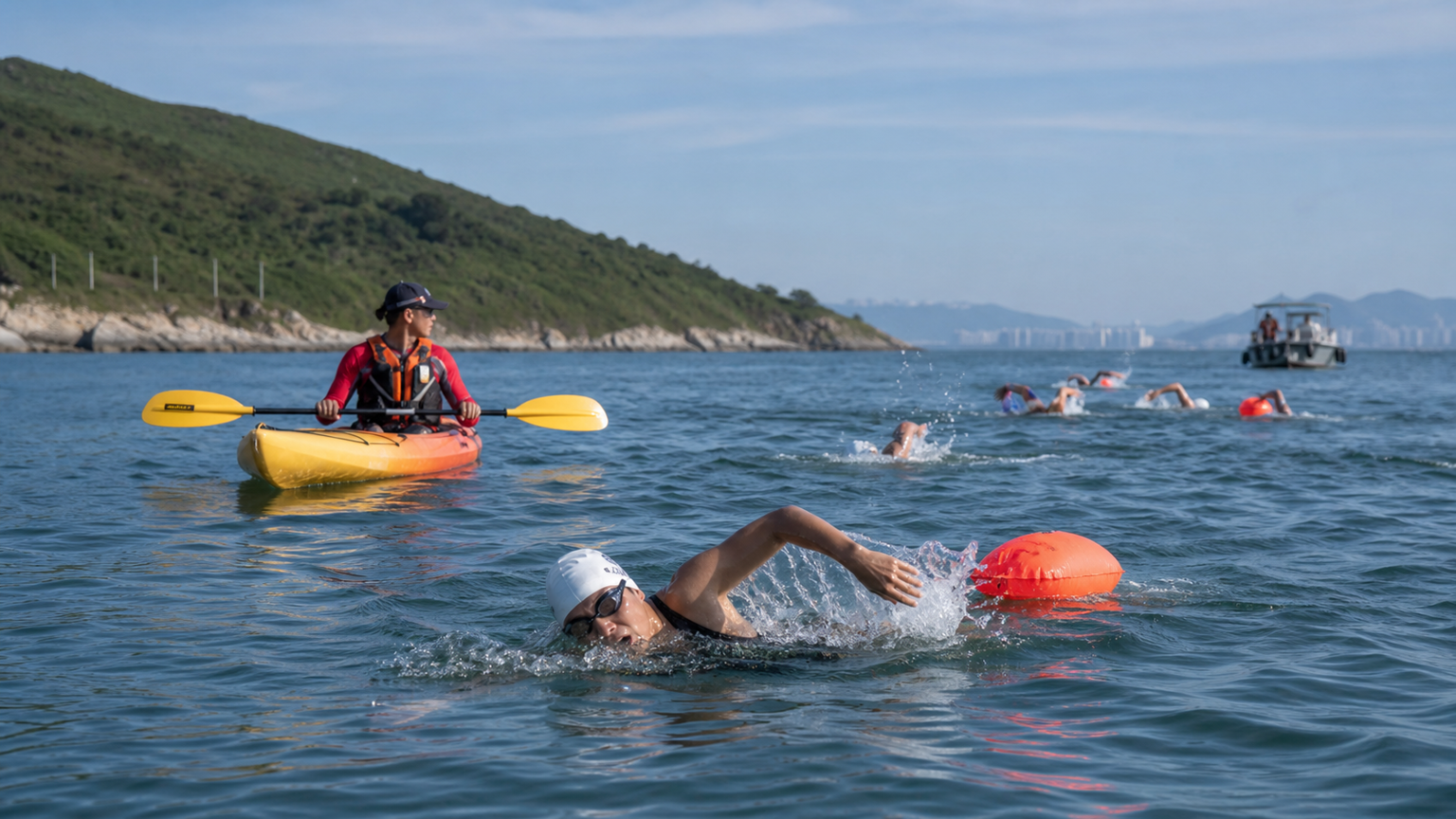
| Kayak Lifeguards | 1–2 lifeguards per kayak, patrolling near the swimmer group | Events of all sizes |
| JetSki | Rapid mobility for emergency rescues | Medium to large events |
| Support Boats | Stationary or slowly moving, available for swimmers to hold onto when needed | Long-distance events |
| Shore Lifeguards | Responsible for monitoring entry and exit areas | All events |
| In-Water Lifeguards | Swimming lifeguards patrolling near the start and finish areas | Densely packed event start zones |
Key Ratio: International events typically require 1 water rescue personnel for every 25–50 swimmers. For smaller self-organized training sessions, it’s recommended to have at least 1 kayak accompanying every 10 swimmers throughout.
How Swimmers Can Cooperate with the Rescue System
The effective operation of lifeguards requires cooperation from swimmers:
- Know the distress signal: Raising your hand and waving is the internationally recognized distress signal. Once given, stop moving forward immediately and wait for assistance
- Don’t swim out of rescue sight: Don’t swim in remote areas where lifeguards cannot see you
- Inform your planned route: During self-organized training, let a partner on shore know your swimming route and expected return time
Personal Safety Buoy: Features and Proper Use
The safety buoy (tow float) has become the most important piece of personal safety equipment in open water swimming in recent years, and it’s recommended that all open water swimmers carry one.
Features of the Safety Buoy
- Increased visibility: The bright orange-red buoy is highly visible on the water surface, allowing lifeguards and boats to spot you from a distance
- Emergency buoyancy assistance: When you need to rest or in an emergency, you can hold onto the buoy for supplemental buoyancy (but it cannot replace swimming ability)
- Storage function: Some models come with a waterproof storage pouch for your phone, energy supplies, and emergency contact card
Proper Usage
- Secure the tether: Attach the tether around your waist, with a length of approximately 60–80 cm, so the buoy trails behind you without interfering with your stroke
- Wear the belt: Use the belt with a quick-release buckle, and confirm the clip can be released quickly with one hand (for rapid removal in an emergency)
- Check inflation before swimming: Confirm the buoy is fully inflated and the tether is not tangled before setting off
- Avoid dependence: The buoy is an auxiliary tool and should not serve as your primary source of buoyancy. Focus on your swimming during training
Common Emergency Situations and Responses
Muscle Cramps
Most commonly occurring in the calves or feet, usually caused by cold water temperatures, excessive fatigue, or electrolyte deficiency.
Response steps:
- Stop moving forward and switch to backstroke or treading water to maintain buoyancy
- Reach for the cramped area and stretch it in the opposite direction (pull your toes upward)
- Wait 30–60 seconds for the cramp to subside before continuing
- If the cramp persists, raise your hand to signal the lifeguard for assistance
Sudden Panic Attack
The unfamiliar environment of open water, fatigue, or accidental collisions can trigger a sudden panic response.
Response steps:
- Immediately switch to backstroke, face upward, and confirm your airway is clear
- Grab the safety buoy and stop moving forward
- Close your eyes and perform abdominal breathing with a 4-second inhale and 4-second exhale, repeating 3–5 times
- Once your heart rate and breathing stabilize, assess whether to continue or seek assistance
Sudden Extreme Fatigue or Dizziness
May be caused by low blood sugar, heatstroke, or heart-related issues.
Response steps:
- Immediately raise your hand to signal for help—do not attempt to swim to shore
- Maintain a backstroke float on the surface to conserve energy
- Wait for the lifeguard to arrive
Safety Guidelines for Self-Organized Training
In unorganized, self-directed open water training, the full responsibility for safety rests on the swimmer:
- Never swim alone: You need at least one other person, or a kayak accompanying you
- Inform someone on shore: Someone on land must know you’re swimming and understand how to call for rescue
- Carry a waterproof phone or whistle: For calling for help in an emergency
- Know the water environment: Research tides, currents, and potential hazards in advance (reefs, boat traffic areas)
- Weather assessment: Stop training and exit the water immediately if wind picks up or signs of thunderstorms appear
Practical Advice
- Add basic first aid training (CPR, basic water rescue) to your learning checklist as a swimmer
- When participating in events, confirm the location of the nearest medical station before entering the swimmer holding area
- Save emergency contact numbers before and after training, and store them in the waterproof pouch of your safety buoy
- Don’t swim in areas where swimming is prohibited—these restrictions are typically established for safety reasons
- Training at a swimming club with a strong safety culture allows you to learn open water safety knowledge more systematically
Conclusion
Safety is the prerequisite for all the enjoyment of open water swimming. The presence of lifeguards, the equipment of safety buoys, and knowledge of emergency situations form a protective net that allows us to swim confidently toward the horizon. Respecting the water, understanding your own abilities, and being properly prepared for safety are the most fundamental responsibilities every swimmer has to themselves and to others. On this foundation, the vast beauty of open water can be fully enjoyed.
Related Reading
- Complete Guide to Swim Buoys and Safety Gear: A Lifesaver for Open Water Swimmers
- Open Water Safety Regulations: Taiwan Venues, Lifeguard Configuration, and Escort Swimming Rules
- Organizing Open Water Group Training: Marker Buoys and Lead Swimmer Setup
- Open Water Swimming Safety Rules: Buddy System, Current Reading, and Emergency Response
FTL 與 SYB 車隊專訪 西進武嶺 實用攻略分享! 2小時 如何練?!你不知道的眉角!新手準備武嶺必看 EP1 | 實力派女車友 | 精華版 | 公路車 | CTYeh
4 年前
2025 海鷗團體繞圈賽 網路直播 超激烈裁判長視角 / EIPC 李廷威、Waypoint 等眾多高手競爭 / feat. 卡密兒主持 / 海鷗繞圈賽
9 個月前
西進武嶺 自製新版AI配速表產生器 x 賽前攻略 抱佛腳! 沒有功率計也可以產生配速表嗎?有什麼其他眉角賽前要注意的呢? | 西進武嶺 / 東進武嶺 KOM 攻略 | 公路車 | CT Yeh
4 年前
西進武嶺 免費訓練分析服務 Intervals | 練不夠還是練過頭?你哪一種類型選手?AI模型告訴你! | 備戰神器 | 公路車 訓練 | CT Yeh
4 年前
CT 喇低賽) 武嶺牽車 才是王道 西進牽車四小時內秘訣 攝手位置 如何判斷 防抽筋小秘訣
7 年前
2023桃園團體繞圈賽 / 海鷗繞圈賽 | 全程空拍數據版 | 公路車 | CT Yeh
2 年前
[教學] Premiere 影片 手震 修正 教學 防抖 單眼 影像 GoPro 穩定 Video Stabilization
8 年前
空拍機 炸機 卡樹 救援隊出動! DJI Mavic Pro #空拍機
6 年前