Running Shoe Cushioning vs. Stability vs. Motion Control: How to Choose Your First Pair of Road Running Shoes
Introduction
Walk into any specialty running store, and you’ll see dozens of shoes on the shelves. The first question a salesperson often asks is: “What’s your arch like? Do you overpronate?” These questions point to the most fundamental classification system in the running shoe world—Neutral Cushioning, Stability, and Motion Control. Choose the wrong type, and you may experience discomfort at best, or knee, iliotibial (IT) band, or plantar fascia injuries at worst.
Taiwan’s climate is humid and hot, and urban road running is mostly on asphalt, which places higher demands on cushioning and breathability than in Europe or the US. This article starts from foot biomechanics to help you find the most suitable running shoe type for yourself.
Core Differences Between the Three Types
Neutral Cushioning
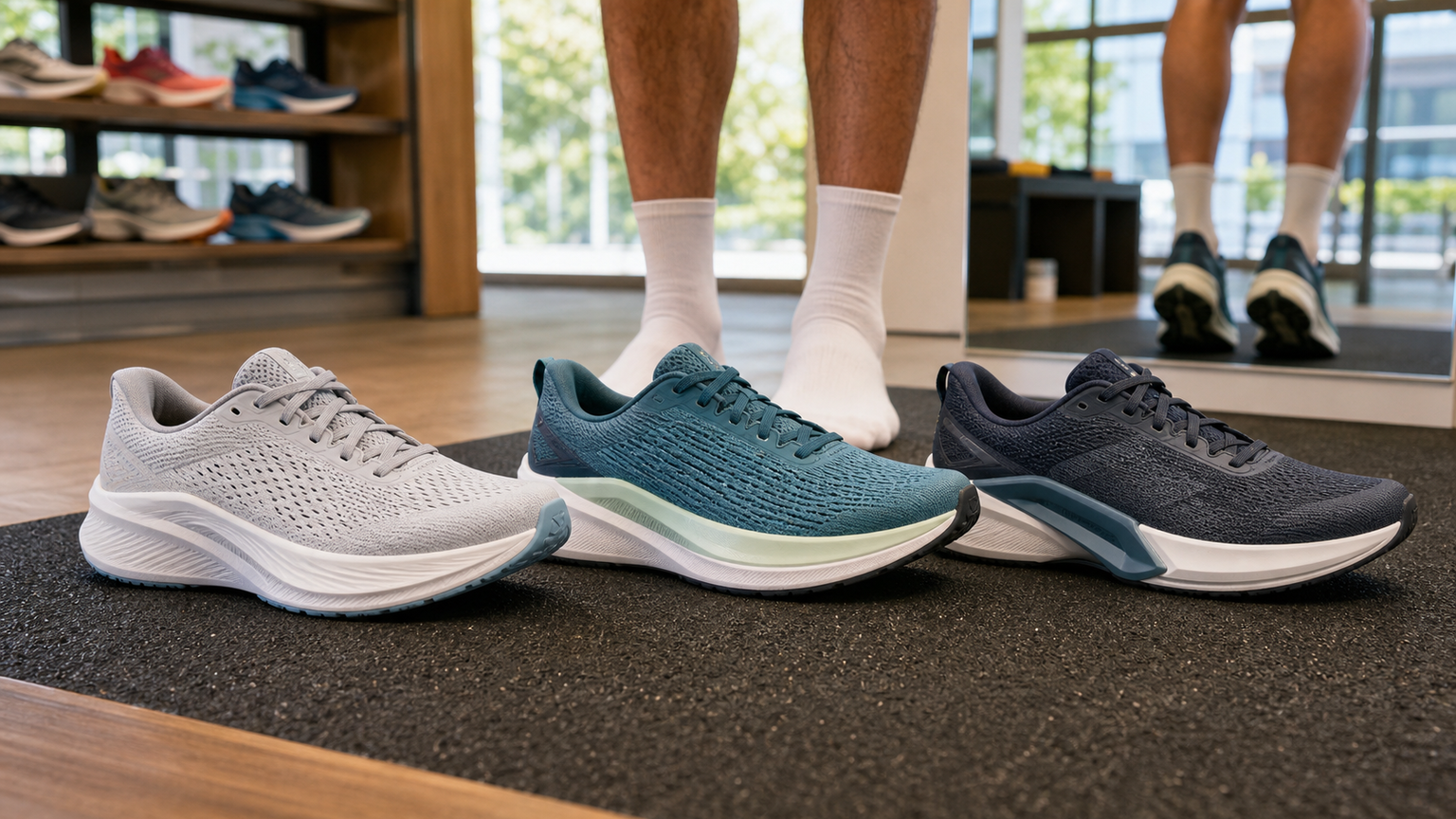
Suitable for runners with high arches or normal arches with a neutral gait. The midsole design emphasizes even cushioning without any corrective support. Representative models include the ASICS Gel-Nimbus, Brooks Ghost, and New Balance Fresh Foam 880.
These shoes typically use EVA foam or more advanced nitrogen-infused foam in the midsole, providing a consistent soft and bouncy feel from heel to forefoot. Taiwanese brand LAWA has also released cushioning models designed for tropical climates, featuring breathable mesh uppers paired with responsive midsoles at a solid value-for-money price.
Stability
Suitable for runners with mild to moderate overpronation, meaning those with lower arches whose ankles tend to collapse inward. A higher-density EVA or hard rubber “support post” is added to the medial side of the midsole to limit excessive pronation. Representative models: ASICS GT series, Brooks Adrenaline GTS, Saucony Guide.
| Brand | Model | Support Technology | Taiwan Price |
|---|---|---|---|
| ASICS | GT-2000 13 | Duomax + Trusstic | Approx. NT$4,000 |
| Brooks | Adrenaline GTS 24 | GuideRails | Approx. NT$4,500 |
| New Balance | 860v14 | Medial Post | Approx. NT$3,800 |
| Saucony | Guide 17 | PWRRUN + HOLLOW-TECH | Approx. NT$4,200 |
Motion Control
Suitable for runners with severe overpronation or flat feet. The soles are firmer and wider, with a large-area rigid support plate on the medial side. Representative models: ASICS Gel-Kayano (high-support version), New Balance 1540, Brooks Beast. These shoes typically weigh over 300g and are not suited for speed work, but they are indispensable for runners who need substantial corrective support.
How to Determine Your Foot Type
Wet Foot Test: Step in water, then step onto a dark floor or paper, and observe the shape of your footprint:
- The middle section connecting the forefoot and heel is very wide → Flat feet / low arches → Stability or Motion Control
- The middle of the footprint has a clear notch → Normal arches → Cushioning or Stability
- The middle of the footprint is barely connected → High arches → Cushioning
Gait analysis is more precise. It’s recommended to visit a store equipped with treadmill video analysis. ASICS and New Balance flagship stores in Taipei, Taichung, and Kaohsiung all offer free analysis.
Special Considerations for Runners in Taiwan
Given Taiwan’s hot and humid summers, it’s recommended to prioritize models with breathable mesh uppers, avoiding full leather or heavily treated waterproof materials (waterproof shoes for long races can actually cause blisters more easily). Taipei’s asphalt roads are aged and uneven in many areas, so the thicker soles of stability shoes also provide extra protection.
Practical Advice
- Shoe fitting time: In the afternoon to evening, because feet swell slightly after activity, making this the most accurate time to determine your size.
- Thumb-width space: After putting on the shoe, there should be about one thumb’s width of space in front of your big toe to avoid jamming your toenails on downhills.
- Try on both feet: Most people have slightly different-sized feet; go with the larger foot.
- Don’t rely solely on brand: Support levels vary greatly across different series within the same brand. Stability and cushioning models should not be used interchangeably.
- Beginner recommendation: If you haven’t had a gait analysis at all, start with a stability shoe—it offers more room for error.
Conclusion
Choosing shoes isn’t guesswork—it’s a combination of science and your individual anatomy. The right shoe type will protect your knees and Achilles tendons during 30 to 50 kilometers of weekly training, allowing you to run longer and healthier. It’s recommended to get a new gait analysis every year or two, as changes in body weight and muscle strength can alter your running shoe needs.
Related Reading
- The Complete Guide to Buying Running Shoes: How to Choose Between Cushioning, Stability, and Racing Types
- Running Shoe Buying Guide: Cushioning, Stability, Racing—How to Choose
- Choosing Running Shoes: Differences Between Cushioned, Stability, and Racing Shoes
- Your First Pair of Road Running Shoes: Key Considerations and Fitting Tips for Beginners
[教學] Premiere 影片 手震 修正 教學 防抖 單眼 影像 GoPro 穩定 Video Stabilization
8 年前
Nepest NOVA 碳條輪組:輕量、空力、舒適一次滿足!/ 公路車 / CT Yeh
7 個月前
訓練台體驗) 2019台北自行車展 三大家 訓練台體驗 Tacx Neo Flux 2 Xepdo Apx Wahoo Kickr
7 年前
白沙屯媽祖進香在家走!UREVO 坡度自調走步機 / 可連接訓練遊戲APP MyWhoosh / 邊看直播邊走起來 / CT Yeh
11 個月前
單車 一日北高 ( 雙城 ) 肥宅雙人瘋狂行 紀錄片 REACTO
10 年前
Unaas X50 全碳纖幅條輪 數據實測對比PK | Lun Hyper 的高階版 | 板輪爬坡也可以很厲害? ! 武嶺2小時大師一起親測! CP值超高 | 公路車 | CT Yeh
4 年前
再快都跟的上!? 單車跟隨攝影機之王 HOVERAir X1 PROMAX 全面實測 / 唯一!8K畫質&自行車專用模式和跟蹤信標&前後避障 / DJI Neo 可參考/ 公路車 / CT Yeh
1 年前
#公路車 #Fitting 靠人工智慧APP 幫你調整單車
6 年前