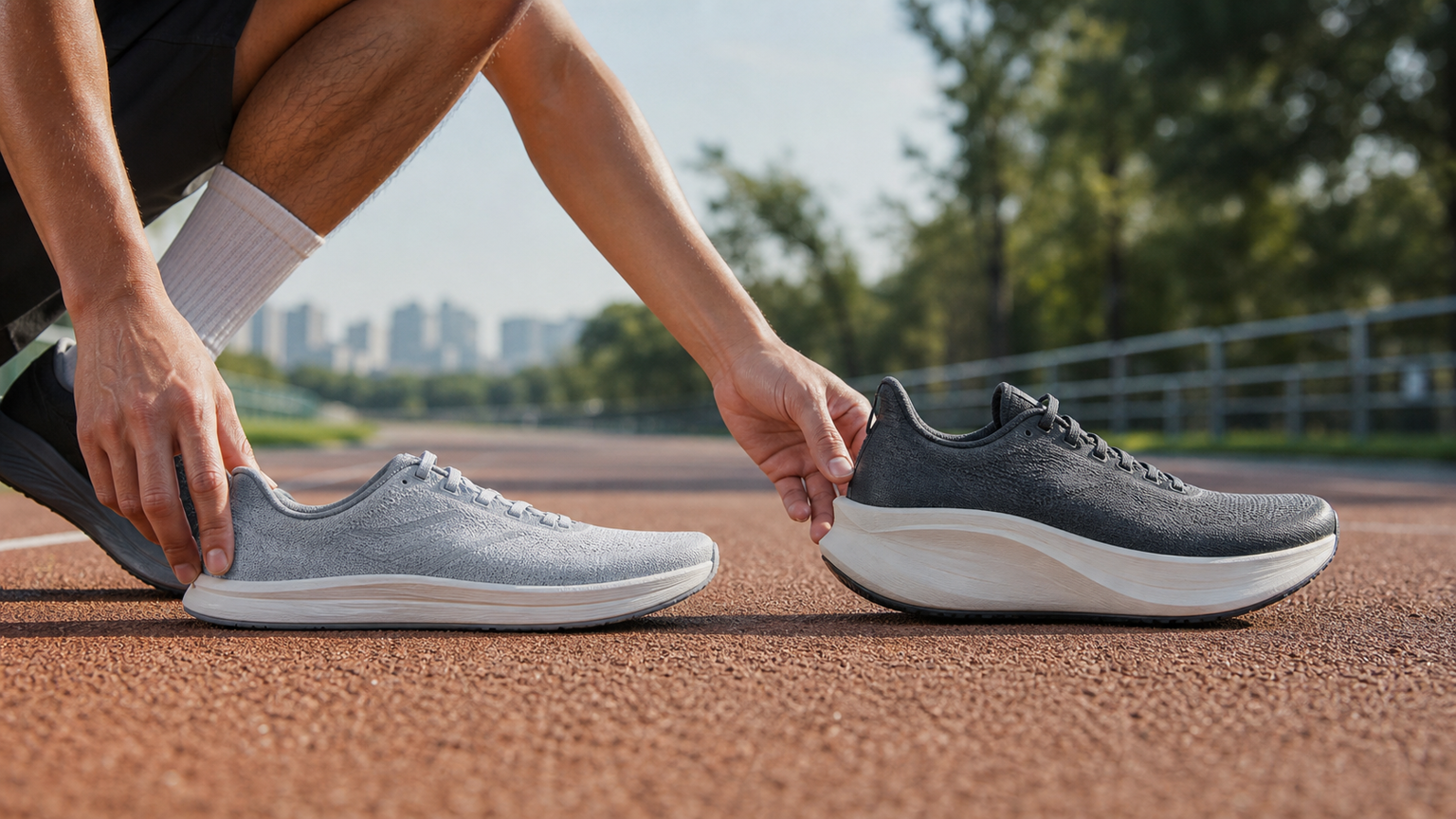
Introduction
A running shoe’s “heel-to-toe drop” (often just called “drop”) is the difference in height between the heel and the forefoot, measured in millimeters. Traditional running shoes typically sit in the 10–12mm range, while minimalist shoes trend toward 0mm. This number may look trivial, but it profoundly affects where your foot lands, how your calf muscles generate force, and your long-term injury pattern.
More and more runners in Taiwan are paying attention to drop, especially those experimenting with minimalist running or recovering from repeated heel injuries, who often start asking: “Should I switch to a lower-drop shoe?”
How Drop Relates to Biomechanics
High Drop (10–12mm)
A high-drop shoe elevates the heel, naturally guiding runners toward a heel strike, which is also how most people run day to day. This landing pattern spreads impact force across the knee and hip joints, placing less stress on the calf and Achilles tendon.
Pros:
- Easy for beginners to adapt to, with lower muscle fatigue
- More forgiving for runners with poor Achilles tendon elasticity
- Calves tire more slowly over long distances
Cons:
- Tends to reinforce heel-striking, increasing longitudinal impact on the knees
- Less effective at building calf and arch strength
Low Drop (0–4mm)
A low-drop shoe keeps the foot closer to horizontal, encouraging runners to land on the forefoot or midfoot, with force transmitted more directly through the Achilles tendon and calf muscles.
Pros:
- Trains more natural running biomechanics
- Reduces vertical impact force on the knee joint
- Builds arch and calf strength
Cons:
- Switching too quickly can cause Achilles tendinitis or metatarsal stress fractures
- Requires a 6–12 week adaptation period
- Challenging for slower runners or those with deeply ingrained heel-striking habits
Middle Ground (6–8mm)
Most running shoes today fall in this range — a compromise that suits the majority of runners.
Drop Comparison of Popular Running Shoes
| Brand / Model | Drop | Type | Recommended For |
|---|---|---|---|
| Nike Vaporfly 3 | 8mm | Low–Mid | Racing, forefoot strikers |
| ASICS Gel-Kayano 31 | 10mm | High | Daily training, heel strikers |
| Brooks Ghost 16 | 12mm | High | Beginners, daily training |
| Hoka Clifton 9 | 5mm | Low–Mid | Long distance, cushioning-first |
| Altra Torin 7 | 0mm | Zero Drop | Barefoot-style runners, forefoot strikers |
| Saucony Kinvara 14 | 4mm | Low | Advanced runners, midfoot strikers |
| Merrell Vapor Glove 6 | 0mm | Zero Drop | Minimalist training |
How to Determine Which Drop Suits You
Currently a habitual heel striker with no injury issues → Stick with a high drop (10–12mm); no need to change impulsively.
Recurring knee pain or IT band syndrome → Consider gradually lowering your drop while working on cadence training (target 180 BPM).
History of Achilles tendinitis → Use a high drop first to let the tendon rest; avoid low-drop shoes during recovery.
Want to try minimalist running → Start around 6–8mm and drop by 2mm every 6–8 weeks. Never jump straight to 0mm.
A Safe Transition Strategy from High Drop to Low Drop
Many runners in Taiwan give up on low-drop shoes because of calf soreness or Achilles issues — the key problem is usually transitioning too fast. Recommended approach:
- Weeks 1–4: Wear your old shoes 80% of the time, new low-drop shoes 20% of the time (no more than 5km per session)
- Weeks 5–8: 50/50 split
- Weeks 9–12: Primarily low-drop, with high-drop shoes as a supplementary training shoe
- Keep weekly mileage increases under 10%
Pairing the transition with eccentric calf raises to strengthen the Achilles tendon can significantly reduce injury risk during the switch.
Practical Advice
- Don’t treat “lower drop = more natural = better” as an absolute truth — everyone’s anatomy is different.
- Drop values can vary by as much as 8mm across different lines from the same brand, so always check the spec before buying.
- Runners in Taiwan wanting to try low drop should consider joining a coached training program to improve their gait at the same time.
- Older runners or those with less calf flexibility need a longer transition period — don’t rush it.
Conclusion
There’s no single “best” drop value — only the one that’s best for you. Understanding your own landing pattern and injury history, combined with a gradual shoe transition, is the right path to reducing running injuries and continuing to improve.
Related Reading
- Running Economy and Shoe Drop: The Energy Cost Difference Between 4mm, 8mm, and 12mm
- Running Shoe Heel-to-Toe Drop Fully Explained: 7 Injury Scenarios from Switching Shoes and a Complete Gradual Transition Guide
- The Science of Running Shoes: Trade-offs Between Heel Drop, Midsole Material, and Cushioning
- Running Gait Analysis: A Scientific Comparison of Heel Strike vs. Forefoot Strike
崇越盃武嶺冠軍高手 賽前JJSC 群峰會精華!對應大數據分析,會有落差嗎?/ feat. JJSC中部公路車約騎 /公路車 / CT Yeh
2 年前
2016/05/13 單車 冷水坑下滑
10 年前
CT 喇低賽) 武嶺牽車 才是王道 西進牽車四小時內秘訣 攝手位置 如何判斷 防抽筋小秘訣
7 年前
[教學] Premiere 影片 手震 修正 教學 防抖 單眼 影像 GoPro 穩定 Video Stabilization
8 年前
#公路車 #Fitting 靠人工智慧APP 幫你調整單車
6 年前
雷達尾燈 雷不雷? 邁金L508 智慧雷達尾燈 情境考驗實測 | 同場加映 2千元等級的專業車錶 C406 Pro | 公路車 | CT Yeh
3 年前
摔車後補裝備: 好市多新款單車安全帽& Specialized Romin 北高整路屁股都不痛的坐墊 | 一千元居然有MIPS | CT Yeh | 公路車
4 年前
再快都跟的上!? 單車跟隨攝影機之王 HOVERAir X1 PROMAX 全面實測 / 唯一!8K畫質&自行車專用模式和跟蹤信標&前後避障 / DJI Neo 可參考/ 公路車 / CT Yeh
1 年前