Introduction
Many runners follow a simple rule: replace shoes once the outsole wears through. But the real reason to retire a pair usually arrives earlier — compression and aging of the midsole cushioning material. Once EVA foam or supercritical foam loses its resilience, the shoe may still look fine on the outside, but its protection for your knees and hips has already dropped significantly. Taiwan’s summer heat also accelerates the aging of rubber and foam, meaning running shoes here often wear out faster than the same model would in a European climate.
Recommended Mileage for Running Shoes
Different materials and designs come with different expected lifespans:
| Shoe Type | Recommended Replacement Mileage | Material Characteristics |
|---|---|---|
| Standard EVA midsole (training shoes) | 600–800 km | Durable, but rebound noticeably declines over time |
| Supercritical foam (e.g. ZoomX, Pebax) | 300–500 km | Ultra-light and springy, but compresses and ages faster |
| Carbon-plate racing shoes | 300–400 km | The carbon plate lasts, but the midsole ages first |
| Minimalist / low-stack shoes | 500–700 km | Less material, so wear is easier to observe directly |
| Trail running shoes | 500–700 km | Outsole is abrasion-resistant, but the midsole has the same limits |
For a marathon trainee running 50 km a week, a standard training shoe typically hits its replacement threshold in about 12–16 weeks — a frequency many runners significantly underestimate.
How to Tell If Your Running Shoes Need Replacing
Visual Inspection
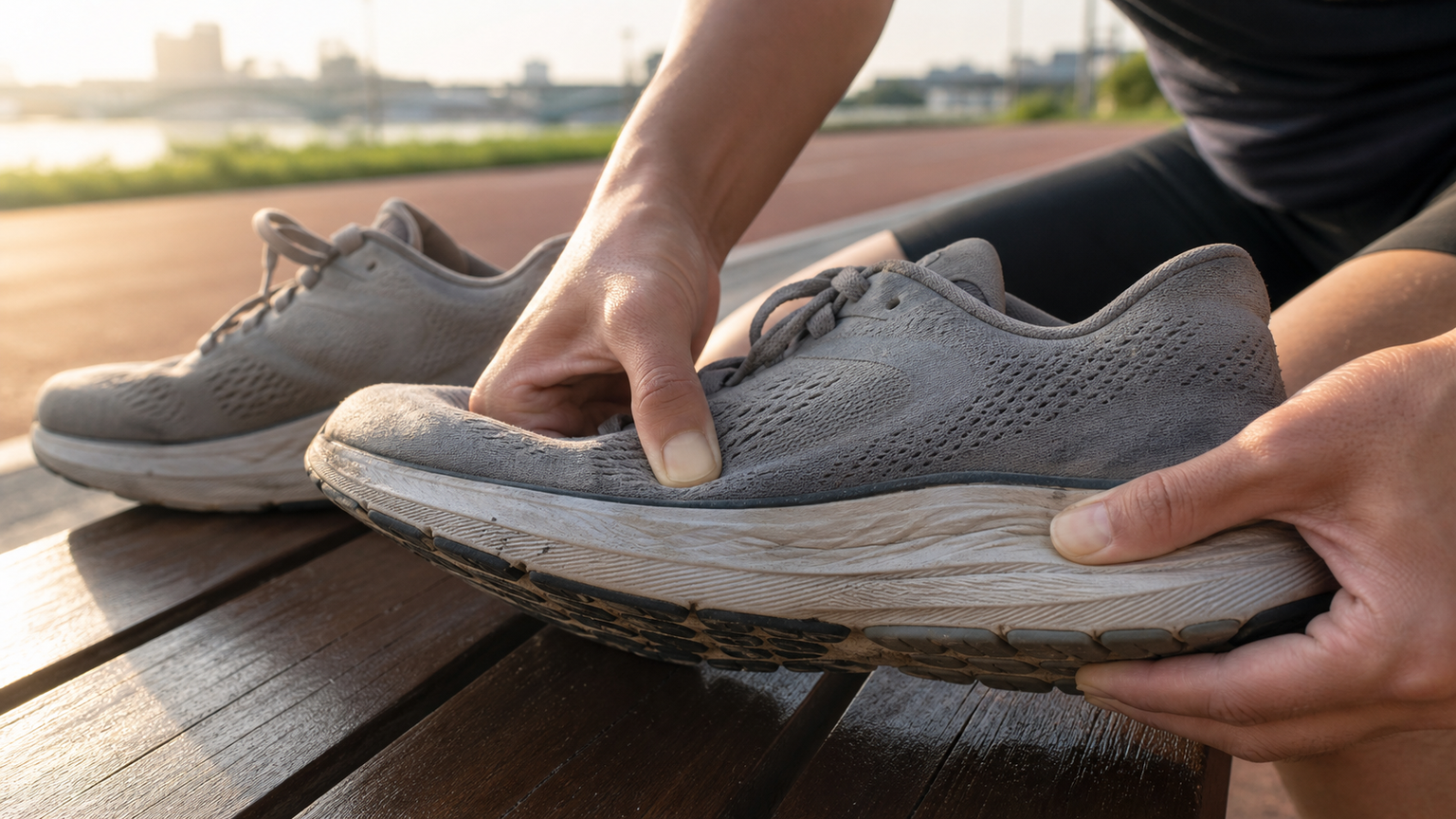
- Midsole creasing: Fine wrinkles or compression lines on the side of the midsole mean the EVA has lost its rebound capacity.
- Uneven outsole wear: If a specific area (such as the outer heel) has worn down more than 3–4mm, your gait has likely already shifted due to the shoe’s deformation.
- Upper deformation: Visible warping of the upper or separating seams signal that the shoe’s structural life is over.
Physical Sensations
- More knee or hip soreness than usual after a run, once you’ve ruled out overtraining, is often a sign that the shoe’s cushioning has degraded.
- Feeling a more direct impact from the road — a noticeably stronger “ground feel” compared to when the shoes were new.
- A burning sensation on the sole or heel after long runs can also be linked to declining midsole protection.
The Thumb Test
Press firmly on the center of the outsole with your thumb. If there’s almost no rebound and the indentation doesn’t spring back, the foam has been severely compressed.
How Taiwan’s Climate Affects Running Shoe Lifespan
Taiwan’s summer temperatures often exceed 35°C, and this heat significantly accelerates the aging of rubber and EVA:
- Avoid prolonged sun exposure: Shoes left on a scooter seat or inside a car will age faster than shoes used under normal conditions.
- Dry wet shoes quickly: With Taiwan’s frequent rainy season, shoes left wet for extended periods risk having their adhesive layers separate. Don’t use a dryer — stuff them with newspaper to absorb moisture and let them air-dry naturally.
- Rotate between multiple pairs: Giving the midsole 24–48 hours to recover between uses can extend overall lifespan by about 20–30%.
Strategies to Extend Running Shoe Lifespan
A Multi-Shoe Rotation System
Owning at least two pairs with slightly different functions and rotating between them is standard practice among professional runners and serious trainees:
- Training Shoe A (3 times per week)
- Training Shoe B or a lighter shoe (1–2 speed workouts per week)
- Race-day shoes (carbon plate, race use only)
This halves the wear rate on each individual pair, and the overall cost doesn’t necessarily increase.
Use Running Shoes Only for Running
Avoid wearing your running shoes for casual walking, shopping, or standing at work. The extra lateral pressure and different wear pattern from non-running use accelerate uneven wear.
Track Your Mileage
Garmin, COROS, and Apple Watch all let you register a shoe in the app and track its mileage; Strava offers this feature too. Setting a 500 km alert is a good practice — when it triggers, reassess whether it’s time for a replacement.
Cost Calculation
Using a typical Taiwan training shoe priced around NT$3,500–5,000, assuming 2,000 km of running per year:
- With only one pair: you’d need 3 pairs per year, costing NT$10,500–15,000 annually
- With two pairs in rotation: each pair lasts longer, but the annual cost stays roughly similar
- Carbon-plate racing shoes are a separate cost, with each pair typically good for about 3–4 marathons
Practical Tips
- When you buy new shoes, write the purchase date and your cumulative mileage at the time on the box, so you can calculate usage later.
- If a pair is used only for walking, its lifespan is 2–3 times longer than for running — midsole compression happens far more slowly than outsole wear.
- Retired running shoes can be downgraded to walking shoes or everyday wear rather than thrown away — they still have value.
- Seasonal sales at major brand flagship stores in Taiwan (May–July, November–January) are a good time to stock up on training shoes.
Conclusion
Running shoes shouldn’t be replaced only when they “break” — they should be replaced once the midsole “fails.” Building a habit of tracking mileage, rotating between multiple pairs, and proper maintenance not only extends the life of your shoes but, more importantly, protects your knees and Achilles tendons, helping you run longer and healthier.
Related Reading
- The Complete Guide to Running Shoe Lifespan: When Should You Replace Them? 7 Wear Signs and Science-Based Mileage Management
- How to Extend Running Shoe Lifespan: The Complete Guide to Proper Running Gear Maintenance
- When Should You Replace Your Running Shoes? A Complete Guide to Wear Signs and the Risks of Running in Worn-Out Shoes
- Running Shoe Rotation Strategy: Why You Shouldn’t Run One Pair Into the Ground
詳測) 小米 電動打氣筒 公路車胎要充多久? 值得買嗎? 米家充氣寶 小心燙手!
7 年前
2025 自行車錶排行榜 兩萬車友大數據 / Garmin Bryton 排名會大洗牌嗎? / 全新的碼表前身分析 /公路車 / CT Yeh
1 年前
摔車後補裝備: 好市多新款單車安全帽& Specialized Romin 北高整路屁股都不痛的坐墊 | 一千元居然有MIPS | CT Yeh | 公路車
4 年前
大家都在開箱的...單車用藍芽對講耳機真的有幫助嗎? SENA BiKom 20 長距離旅遊 & 海鷗繞圈賽 實際體驗心得 / 公路車 / CT Yeh
9 個月前
靠單車減肥35公斤 心得分享與整理
7 年前
#公路車 #Fitting 靠人工智慧APP 幫你調整單車
6 年前
2020 前十五名 台灣車友還在用的車錶? 同場加映武嶺四小時內的車友都用哪些車錶,以及車錶靈異經驗分享 北高居然騎了960公里!? | 車錶送修分享 | 公路車 | CT Yeh
5 年前
Live) 備戰2019彰化經典百K 賽前攻略 (已完賽請看新影片
7 年前