Introduction
Backstroke is often considered the “easier” stroke because facing upward means no special breathing technique is required. However, this perception often leads swimmers to lower their technical standards for backstroke, leaving many people’s backstroke permanently stuck at a “barely manageable” level rather than truly efficient competitive technique.
The core efficiency code of backstroke lies in the coordination between stroke rhythm and shoulder roll. These two elements are interdependent—if either one goes wrong, it results in lost speed and unnecessary energy expenditure.
The Biomechanical Significance of Shoulder Rotation
The propulsion in backstroke comes primarily from the arm pull. However, if your shoulders remain level, the depth of your arm pull and effective propulsion distance will both be limited.
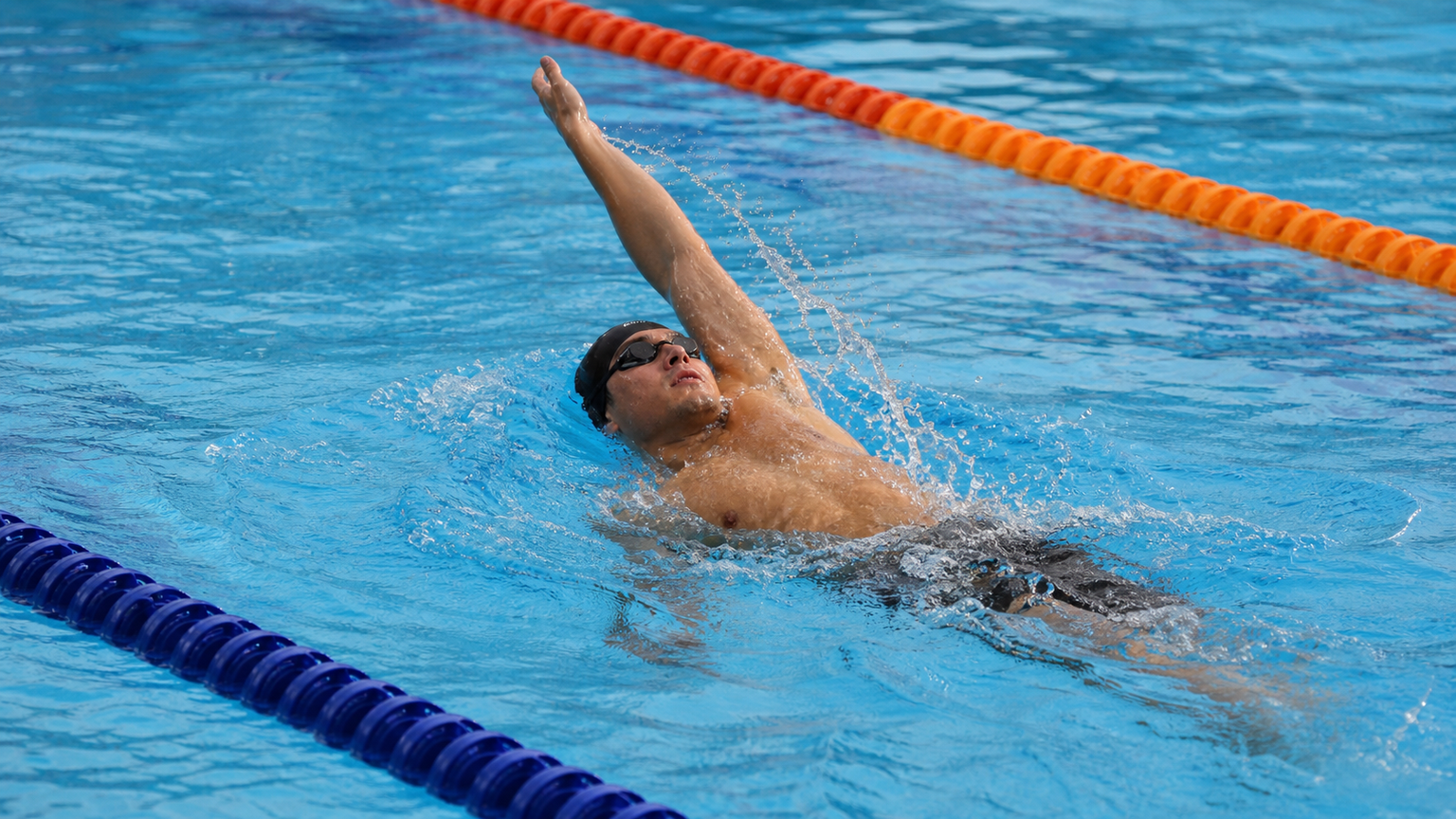
Proper backstroke technique requires the body to rotate along its longitudinal axis. With each arm entry, the shoulder on the entering side should sink downward into the water while the opposite shoulder rises above the surface. This rotational movement brings the following benefits:
- Increased entry depth: The sinking shoulder allows the arm to reach deeper into the water, starting the catch in a more effective position
- Extended pull distance: Rotation engages the entire upper body in propulsion, not just the arm muscles
- Reduced drag: At the moment the body presents its side to the water, frontal resistance decreases
- Shoulder joint protection: The forced arm recovery over the head places tremendous stress on the shoulder without rotational assistance
| Rotation Angle | Effect Description |
|---|---|
| 0 degrees (completely level) | Insufficient pull depth, high shoulder strain, slow speed |
| 30–45 degrees | Standard rotation range, balancing propulsion and drag |
| 45–60 degrees | Commonly used by advanced swimmers, maximizing pull depth |
| Over 60 degrees | Excessive rotation, causing snaking, actually increasing drag |
Synchronizing Stroke Rhythm and Rotation
The stroke rhythm in backstroke should stay in sync with shoulder rotation. Specifically:
Entry Phase: As the right hand enters the water, the right shoulder rotates downward while the left shoulder rises. The hand enters outside the line of shoulder extension, pinky finger first (the standard backstroke entry method).
Catch Phase: The hand quickly establishes a “high elbow” position in the water, with the forearm perpendicular to the direction of propulsion. At this point, body rotation reaches its maximum angle.
Pull Phase: The arm pushes down along the side of the body to the thigh, and the body begins rotating in the opposite direction, preparing for the other arm’s entry.
Recovery Phase: During the recovery, the arm should remain straight, thumb exiting the water first and pinky entering first, completing a full rotation cycle.
A common mistake many swimmers make is having a stroke rhythm that is too “flat”—both arms propelling through the water almost simultaneously with no noticeable lateral body rotation, making it look like two oars pulling at the same time. Proper backstroke should have a distinct alternating feel of “one side working, the other side recovering.”
Common Problems and Corrections
Problem One: Body Snaking
This is usually caused by excessive rotation, or a lack of coordination between the kicking rhythm and arm strokes. Correction: Ensure a steady kicking rhythm (6-beat) and be mindful of the upper limit of rotation angle.
Problem Two: Hips Sinking
The most common problem in backstroke. Causes include the head tilting too far back, causing the hips to sink as a counterbalance, or insufficient core strength. Correction: Look straight up (not backward at the ceiling) and engage the core.
Problem Three: Off-Course Pull Path
The arm does not pull along the body’s longitudinal axis in the water but sweeps outward, reducing propulsion efficiency. Correction: Practice “wall-touch backstroke,” swimming along the pool wall to feel the correct body position.
| Common Error | Primary Impact | Correction Method |
|---|---|---|
| Insufficient rotation | Shallow pull depth, weak propulsion | Exaggerated rotation drills to reinforce movement awareness |
| Excessive rotation | Body snaking, increased drag | Coordinate with kick rhythm, control rotation timing |
| Hips sinking | Greatly increased drag, slow speed | Engage core, adjust head position |
| Entry point crossing the midline | Body twisting, snaking | Entry point outside the line of shoulder extension |
Practical Advice
- Single-arm backstroke drill: Pull with one arm while the other rests against the thigh, feeling the relationship between body rotation and single-arm propulsion. This drill quickly builds muscle memory for shoulder roll.
- With a kickboard: Hold a kickboard on your abdomen and practice backstroke kicking while observing your body’s waterline to correct hip sinking.
- Video analysis: Have someone film your backstroke from poolside, paying special attention to whether the entry point crosses the midline and whether body rotation amplitude is consistent.
Conclusion
The beauty of backstroke lies in its “flow”—the body moves through the water like a rotating dance, with every action interlocking. When stroke rhythm and shoulder rotation are truly coordinated, you’ll feel a lightness of being “carried by the water” rather than the effort of “struggling through it.” This transformation isn’t a matter of talent but an accumulation of technical understanding and practice volume.
Related Reading
- Backstroke Pull Efficiency: Optimizing Entry Point and Exit Angle
- Backstroke Technique Essentials: A Guide to Improving Rotation Axis and Pull Efficiency
- The Core of Backstroke Technique: The Triangular Relationship Between Body Roll, Straight-Arm Entry, and Steady Kicking
- The Scapular Rotation Principle in Backstroke: Finding Your Body Axis to Stop Snaking
CT 喇低賽) 武嶺牽車 才是王道 西進牽車四小時內秘訣 攝手位置 如何判斷 防抽筋小秘訣
7 年前
風櫃嘴 衝刺慢動作回放!
8 年前
西進武嶺 自製新版AI配速表產生器 x 賽前攻略 抱佛腳! 沒有功率計也可以產生配速表嗎?有什麼其他眉角賽前要注意的呢? | 西進武嶺 / 東進武嶺 KOM 攻略 | 公路車 | CT Yeh
4 年前
Insta 360 One 超級防手震技術實測
7 年前
如何把 GoPro 影片 翻轉 批次 轉正?
6 年前
抖肩舞 台灣x日本交流版 (台灣 vs 前橋) 赤城山登山賽 coincidance
8 年前
抖肩舞 APOLLO RIDE 生日趴 搖滾混音無尺度版 Coincidance 甩肩舞
8 年前
[教學] Premiere 影片 手震 修正 教學 防抖 單眼 影像 GoPro 穩定 Video Stabilization
8 年前