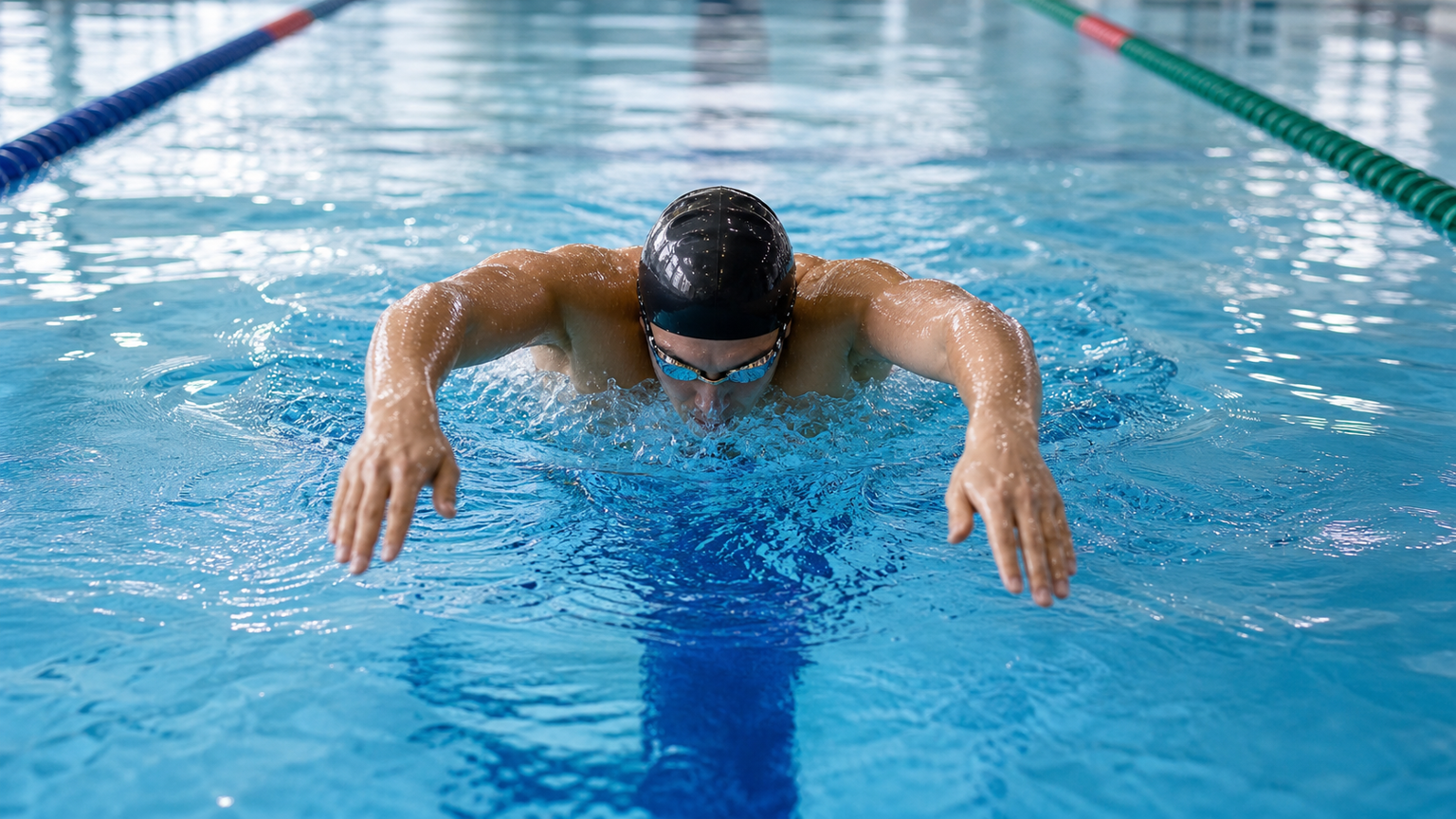
Introduction
Breaststroke is the only one of the four competitive strokes that uses symmetrical pulling and symmetrical kicking. It looks the most “natural,” yet it is often the most difficult to refine technically. Many people have swum breaststroke for over a decade without significant speed improvements, and a large part of the reason lies in not finding the correct pull width.
Stroke width refers to the maximum distance your hands spread outward in the water. If this distance is too wide, drag increases and propulsive force is wasted; if too narrow, you cannot establish enough surface area to catch the water. Finding your optimal stroke width requires combining an understanding of breaststroke propulsion mechanics with your individual physical characteristics.
The Mechanics of Breaststroke Propulsion
Breaststroke propulsion comes primarily from two phases: the outward catch sweep and the inward press. The hands spread outward from the chest (out-sweep), catch a resistance point in the water, then quickly press inward and together (in-press), pushing the water backward to drive the body forward.
In this “out-sweep → in-press → streamline extension” cycle, every phase is closely related to stroke width:
- Out-sweep width determines the initial surface area of the catch
- The path length of the in-press determines the distance over which propulsive work is done
- The streamline quality of the extension determines glide efficiency
| Stroke Width | Catch Surface Area | Propulsive Work Distance | Drag | Overall Efficiency |
|---|---|---|---|---|
| Too wide (over 1.5× shoulder width) | Large | Long but taxing | High | Low |
| Moderate (shoulder width to 1.2×) | Medium | Optimal | Low to medium | Highest |
| Too narrow (narrower than shoulder width) | Small | Short | Low | Medium-low |
The Upper Limit of the Out-Sweep
During the breaststroke out-sweep, elbow position is key. The correct approach is: during the out-sweep, keep the elbows higher than the wrists and the forearms vertical, allowing the palms and forearms to form the largest effective catching surface.
When the out-sweep exceeds the appropriate width, the elbows can no longer stay high, the forearms begin to flatten, and the catching surface area actually shrinks. At the same time, an overly wide out-sweep forces the arms to take “a longer route” to return to the in-press position, adding non-propulsive wasted work.
A practical way to judge: at the widest point of the out-sweep, the elbows should still be in front of the shoulders, not moved to the side or behind them. Once the elbows move to the side of the shoulders, it means the out-sweep is too wide.
Key Points of the In-Press Technique
After the out-sweep ends, the in-press is the primary propulsive phase of breaststroke. The hands quickly press inward and downward from the outside, pushing water backward while the body’s center of mass shifts forward.
Key points of the in-press:
- Speed matters: The faster the in-press, the greater the impulse imparted to the water behind, and the stronger the propulsion
- Hands meet in front of the chest: At the end of the in-press, the hands should meet directly in front of the chest, not in front of the abdomen (too far back) or in front of the chin (too far forward)
- Extend immediately: Once the in-press is complete, the hands immediately shoot forward into the streamlined glide position, avoiding wasted time lingering in front of the chest
Common mistakes at a glance:
- Out-sweep too flat: The palms push outward horizontally instead of diagonally outward and downward, failing to catch effective water
- Out-sweep too wide: The elbows move to the side of the shoulders, entering an unfavorable mechanical position
- In-press too slow: Insufficient propulsion, feeling like “stirring the water” rather than “pushing the water”
- Hands meeting in front of the chin: The upper body rises too high, breaking the streamline and increasing drag
Coordination Between the Breaststroke Kick and Pull
Choosing your breaststroke pull width cannot be separated from the rhythm of the breaststroke kick. The standard breaststroke rhythm is: pull → kick → glide, with the three phases clearly separated.
The pull (out-sweep → in-press) comes first, the kick follows, and the two do not overlap. Many beginners are accustomed to “pulling and kicking at the same time.” Although this may look like hard work, it causes the two propulsive actions to cancel each other out, resulting in extremely poor efficiency.
The glide phase (arms extended forward, legs straight) is an important component of breaststroke efficiency, making full use of the forward momentum generated by each pull and kick rather than rushing into the next stroke cycle.
Practical Advice
- Out-sweep width test: Slowly perform the out-sweep motion in the water and feel for the critical point where your elbows begin to drop—that is your maximum appropriate out-sweep width.
- Stroke counting: Count how many strokes you take per 25 meters, and try to reduce the stroke count while maintaining speed. This usually means each stroke is more efficient.
- Glide training: After each breaststroke kick, let your body glide fully and feel the sensation of coasting on momentum, rather than rushing into the next stroke.
- Underwater video: Breaststroke is the stroke that most requires underwater observation. Elbow position and forearm angle are nearly invisible from above the surface. If conditions allow, be sure to perform underwater video analysis.
Conclusion
The optimal breaststroke pull width varies from person to person, depending on shoulder flexibility, arm length, and muscle strength distribution. There is no single “perfect width” that works for everyone, but there is a universally applicable principle: keep your elbows in front of your shoulders, and keep your forearms perpendicular to the water surface throughout the entire catch phase. Starting from this principle, you will naturally find the optimal stroke width for your own body.
Related Reading
- Breaststroke Pull Too Wide: Technical Corrections for Lost Propulsion Efficiency
- In-Depth Analysis of Breaststroke Pull Technique: Pull Arc and Push Timing
- Advanced Breaststroke Technique: Speed Differences and Technical Choices Between Narrow-Kick and Wide-Kick Breaststroke
- Breaststroke Pull-Kick Coordination: Biomechanics of Glide Timing and Heel Recovery Angle
CT 喇低賽) 武嶺牽車 才是王道 西進牽車四小時內秘訣 攝手位置 如何判斷 防抽筋小秘訣
7 年前
抖肩舞 台灣x日本交流版 (台灣 vs 前橋) 赤城山登山賽 coincidance
8 年前
戰略) Zwift Race 如何咬在第一集團 如何評估自己要開多少推力 (請開1.5倍速看)
7 年前
西進武嶺 免費訓練分析服務 Intervals | 練不夠還是練過頭?你哪一種類型選手?AI模型告訴你! | 備戰神器 | 公路車 訓練 | CT Yeh
4 年前
單車 梅山36灣 坡度介紹 路段介紹 空拍 (相關遊記影片,請參考說明或我的頻道喔,歡迎訂閱)
6 年前
CT 喇低賽) 單車 比賽總是沒照片? 攝影師的觀點大公開 姿勢就是力量! 請加速1.25倍收看
7 年前
白沙屯媽祖進香在家走!UREVO 坡度自調走步機 / 可連接訓練遊戲APP MyWhoosh / 邊看直播邊走起來 / CT Yeh
11 個月前
3D 列印車褲墊 / 舒適改善? / 無痕 x 分區壓縮 / ATK & Decider系列 / JE22黑科技 / #公路車 #CTYEH
11 個月前