A Comprehensive Comparison of Turn Techniques in Four Swimming Strokes: The Art of Touch, Flip, and Rhythm
Introduction
In a 200-meter individual medley race, swimmers must execute seven turns. If each turn is 0.3 seconds faster than an opponent’s, the cumulative advantage across seven turns exceeds 2 seconds—enough to decide the gold medal in elite competition.
Turn technique is often the most overlooked training component among amateur swimmers, but in competitive swimming, it is a critical moment where technique and strategy are highly integrated. This article compares the key points and common mistakes of turn techniques across the four strokes, helping you maximize the propulsion from every turn.
Freestyle: Flip Turn
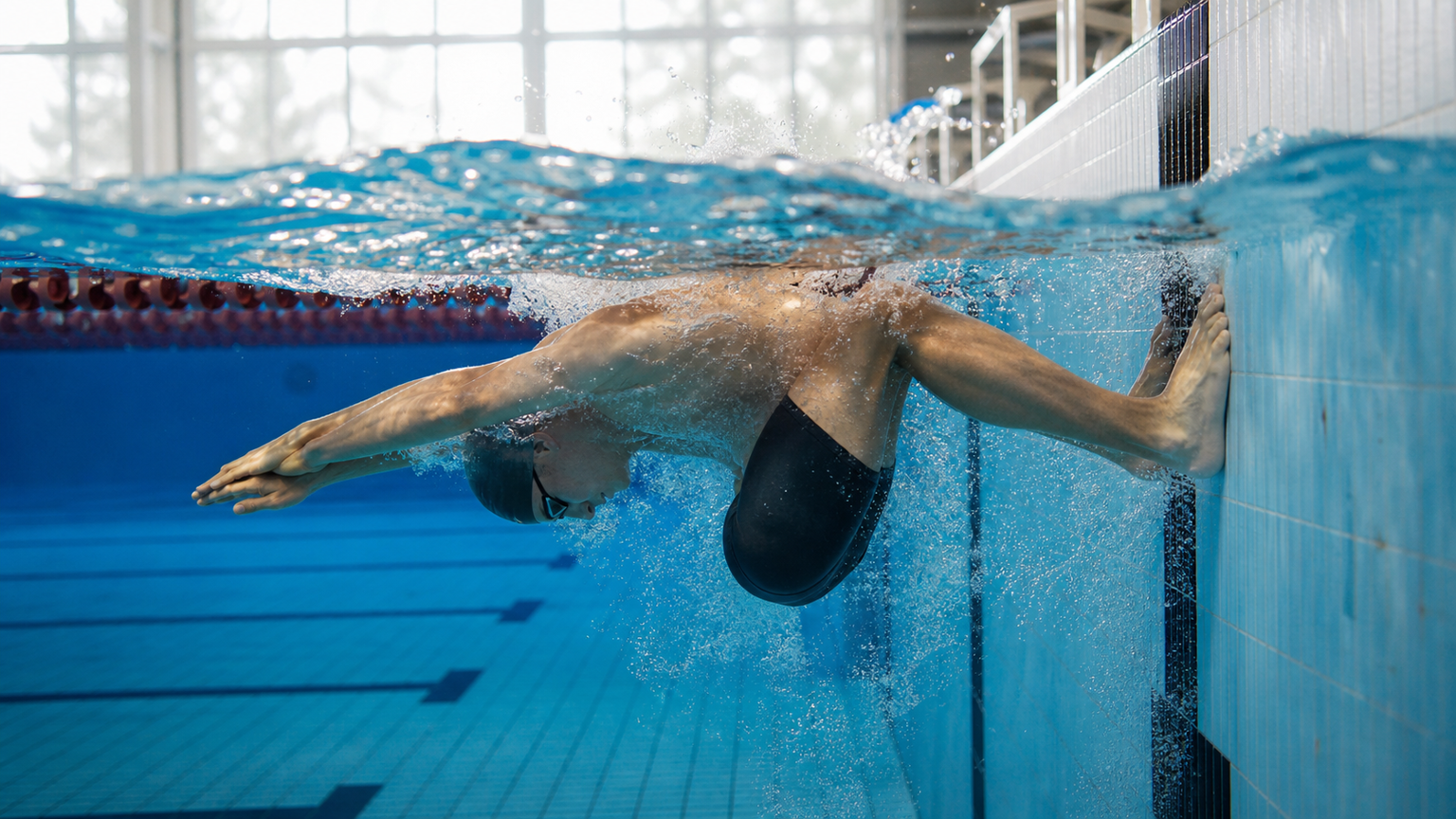
The freestyle flip turn is the most widely recognized competitive turn technique and the fastest way to turn.
Key Technical Points:
- Complete the final arm stroke approximately 1–1.5 meters from the wall, assessing the distance
- Tuck the head down and roll forward, bringing the feet over the head to plant on the wall
- When the feet plant on the wall, bend the knees to approximately 90 degrees, with the soles flat against the wall
- After pushing off, streamline the body and perform 1–3 dolphin kicks before starting to stroke
- The entire turn can be completed without touching the wall (no hand touch required)
Common Mistakes:
- Rolling too far from the wall, resulting in a poor push-off angle and lost propulsion
- Twisting the body after the roll, failing to push off in the correct direction
- Starting to stroke too early after the push-off, losing underwater streamline glide time
Backstroke: Open Turn or Flip Turn
There are two primary backstroke turn methods: the traditional “touch-and-flip turn” and the modern “backstroke flip turn.”
Touch-and-Flip Turn (Traditional):
- After the final arm stroke, touch the wall with the hand, rotate the body 180 degrees, and push off into the backstroke start
- The movement is relatively simple but slower than the flip turn
Backstroke Flip Turn (Competitive):
- Approximately 1–1.5 meters from the wall, after the final arm stroke, rotate the body into a prone position
- Use the momentum of the rotation to complete the flip, planting both feet on the wall
- After pushing off, dolphin kicks may be performed before rotating back to the backstroke position
- Rule requirement: The body must be in the backstroke position before touching the wall; the flipping motion is considered part of the turn
Key Backstroke Turn Rules:
| Rule Point | Description |
|---|---|
| Touch Requirement | Must touch the wall in the backstroke position (for flip turns, touch before the flip) |
| Underwater Dolphin Kick | Underwater dolphin kicks are permitted after the push-off before resuming backstroke |
| No Standing | Standing on the pool floor is not permitted during the turn |
Butterfly: Two-Hand Touch Turn
Butterfly rules require both hands to touch the wall simultaneously, which limits turn speed, but there is still room for optimization.
Key Technical Points:
- Touch the wall with both hands simultaneously; fingers may point downward (aiding the push-off motion)
- After touching, plant one foot on the wall first, followed by the other, rotating the body 180 degrees
- After pushing off, maintain an underwater streamline, performing dolphin kicks until speed drops before surfacing to breathe
- The first breath is recommended 5–10 meters after the start
Efficiency Focus:
The transition from the two-hand touch to the push-off should be as quick as possible. Immediately after the hands touch, let the body initiate the rotation without pausing. Many swimmers show a noticeable pause after touching the wall, and during that time, all forward momentum is completely lost.
Breaststroke: Two-Hand Touch Turn
Breaststroke, like butterfly, requires both hands to touch the wall simultaneously, but the push-off style differs—breaststroke pushes off in the direction of the breaststroke kick.
Unique Breaststroke Turn Points:
- After pushing off, the first stroke is completed underwater (one full arm pull plus a breaststroke kick is permitted before surfacing)
- This underwater pull-out is one of the most important techniques in breaststroke and can contribute more than 5 meters of glide distance
- Underwater pull-out rules: Pull both arms down to the thighs, then execute a breaststroke kick, and only then surface
Comparison Table of the Four Stroke Turns
| Stroke | Touch Requirement | Push-Off Style | Underwater Action | Key Technical Challenge |
|---|---|---|---|---|
| Freestyle | No hand touch required | Push off with both feet | Dolphin kick | Judging distance for the flip |
| Backstroke | Must touch in backstroke position (except competitive flip turn) | Push off with both feet | Dolphin kick → rotate to backstroke | Timing and direction of the rotation |
| Butterfly | Both hands touch simultaneously | Push off with both feet | Dolphin kick | Quick transition from touch to push-off |
| Breaststroke | Both hands touch simultaneously | Push off with both feet | Underwater pull-out | Depth and distance of the pull-out |
Practical Advice
- Time every turn during practice: Start timing from the final arm stroke to the head surfacing after the push-off. An ideal turn time (including underwater dolphin kicks) is approximately 2–3 seconds.
- Practice distance perception: Repeatedly practice “how many strokes from the wall to begin the flip,” flipping accurately without looking at the wall, relying on memory and feel to judge distance.
- Emphasize underwater dolphin kicks: The underwater dolphin kicks after freestyle and backstroke turns are among the fastest propulsion phases; dedicate time to specifically training kick intensity and streamline.
Related Reading
- Refining Turn Technique: Hand-Foot Coordination and Wall Push-Off Power in Touch-and-Flip Turns
- Applying Swimming Turn Technique in Competition: How to Gain Time with Flip Turns
- Complete Turn Technique Analysis: Wall Plant Timing and Push-Off Angle in Freestyle Flip Turns
- Refining Swimming Turn Technique: Push-Off Timing and Streamline Maintenance in Flip Turns
抖肩舞 台灣x日本交流版 (台灣 vs 前橋) 赤城山登山賽 coincidance
8 年前
CT 喇低賽) 武嶺牽車 才是王道 西進牽車四小時內秘訣 攝手位置 如何判斷 防抽筋小秘訣
7 年前
戀戀197 競賽組 | 50頁投影片心得報告 | 賽後檢討 攻略 #公路車
6 年前
Insta 360 One 超級防手震技術實測
7 年前
如何把 GoPro 影片 翻轉 批次 轉正?
6 年前
2024桃園團體自由車邀請賽!4K環台賽等級拍攝 全賽事精華!/ 集團大摔車 / 60隊菁英好手衝線 / 公路車 CT Yeh
1 年前
2020 戀戀197 全程4K雙錄影 訓練台實境 市民競賽組 M30 M40 #公路車
6 年前
抖肩舞 APOLLO RIDE 生日趴 搖滾混音無尺度版 Coincidance 甩肩舞
8 年前