Introduction
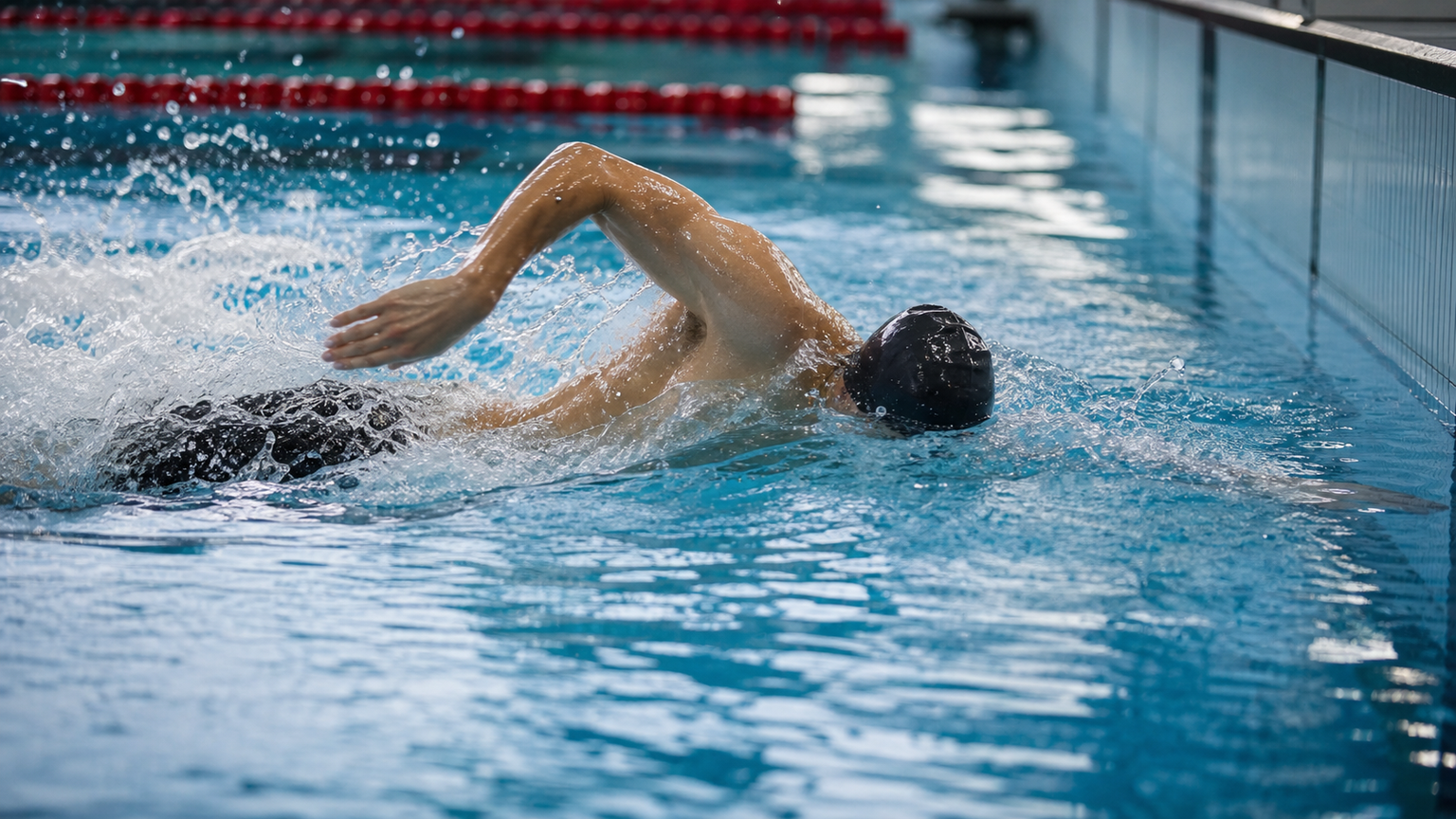
Watch a 50m freestyle final, and you’ll notice that elite swimmers barely breathe in the final 5–10 meters, keeping their heads close to the surface and sprinting all-out. This is not a reflex under race pressure, but a carefully considered tactical decision.
Holding your breath in the final meters of a swim can deliver a clear speed advantage, but it also requires overcoming intense physiological discomfort. Understanding the physiology behind it and systematically training this ability is an essential subject for every sprint swimmer.
Why Does Breathing Slow You Down?
The effect of the freestyle breathing motion on speed comes from three main aspects:
Head rotation increases drag
Rotating the head to breathe disrupts the body’s horizontal streamline. Even for the most technically skilled swimmers, speed still dips briefly at the moment of breathing. The shorter and faster the race, the more significant this impact becomes.
Stroke rhythm is interrupted
The arm on the breathing side often undergoes subtle rhythm changes during the breath, and both the hand entry angle and pull force can be affected.
Body rotation increases
Breathing requires extra body rotation, and at high swimming speeds this rotation can add lateral drag.
Physiological Basis: Energy Supply in the Final 5 Meters
A 50m sprint relies almost entirely on anaerobic metabolism—the phosphocreatine system (CP system) provides explosive power for the first 5–8 seconds, with glycolysis supporting what follows. In such a short race, oxygen replenishment has limited impact on immediate energy output.
In other words, holding your breath in the final 5 meters will not impair your muscles’ immediate output due to “oxygen debt”—because the energy at that moment simply does not depend on aerobic supply. The discomfort from breath-holding comes mainly from rising carbon dioxide levels (hypercapnia), not from true oxygen deprivation.
| Race Distance | Primary Energy System | Feasibility of Not Breathing |
|---|---|---|
| 50m | Phosphocreatine + Glycolysis | High (minimal breathing possible throughout) |
| 100m | Glycolysis + Aerobic | Medium (1–2 strokes without breathing in the latter half) |
| 200m and above | Aerobic dominant | Low (regular breathing needed to replenish oxygen) |
A Systematic Approach to Training Breath-Holding Ability
Improving breath-holding capacity requires gradually increasing anaerobic tolerance, allowing the body to adapt to maintaining movement quality under high CO₂ conditions.
Basic breath-hold training:
- Static breath-holding: Practice deep breathing followed by breath-holding on land, recording maximum hold time each session, 2–3 times per week
- Static breath-holding in water: Face-down in the water (with safety precautions and a coach present), building psychological comfort with breath-holding
Swimming breath-hold training:
| Training Method | Description | Recommended Frequency |
|---|---|---|
| 12.5m sprint without breathing | Half-lap all-out sprint without breathing | 4–6 reps per session |
| Progressive extension | Extend no-breath distance by 2.5m each week | Depends on individual progress |
| No breathing for final 5m | In 25m swimming, stop breathing for the last 5m | End of each practice |
| Hypoxic Sets | Longer-distance swimming breathing every 3–5 strokes | 1–2 times per week |
Safety notes:
A serious reminder: static breath-hold training, especially in-water static breath-holding, carries a risk of shallow water blackout. Any in-water breath-hold training must be supervised by a coach or partner—never do it alone.
Breathing Strategy in Races
The ultimate goal of building breath-holding ability is to let you strategically choose when to breathe during a race:
Example 50m freestyle strategy:
- First 10–12.5m after the start (first breathing opportunity)
- Mid-pool, breathe every 2–3 strokes depending on individual ability
- Final 5–10m: no breathing at all, sprinting all-out to the wall
Mental preparation
The discomfort of breath-holding in the final meters is real, and it must be faced and overcome repeatedly in training. The more you put yourself in this uncomfortable state during practice, the easier it is to stay calm and maintain movement quality in competition.
Practical Advice
- Don’t do breath-hold drills at the end of a fatiguing session: Do them when energy levels are good, ensuring movement quality doesn’t break down from fatigue
- Coordinate with sprint stroke rhythm: Not breathing doesn’t mean slowing your stroke—maintaining or even increasing stroke rate is the goal
- Progress gradually: Don’t rush to achieve 10 meters without breathing at once; start from 5 meters and extend steadily
Conclusion
Not breathing for the final 5 meters is a dual test of sprint swimming technique and mental toughness. Understanding its physiological basis, you’ll see this is not brute force but a scientifically sound tactic. Train this ability systematically, and your 50m results will improve in ways that surprise you.
Related Reading
- Research on Breathing Deceleration: Speed Differences Between Breathing and Non-Breathing, and Training Solutions
- Swimming Breathing Technique: Pros and Cons of Side Breathing vs. Bilateral Breathing
- The Physiology of Swimming Breathing: CO₂ Accumulation and the Control Mechanism of the Breathing Drive
- Swimming Breathing Pattern Training: Building Tolerance for 3-Stroke and 5-Stroke Breathing
西進武嶺 自製新版AI配速表產生器 x 賽前攻略 抱佛腳! 沒有功率計也可以產生配速表嗎?有什麼其他眉角賽前要注意的呢? | 西進武嶺 / 東進武嶺 KOM 攻略 | 公路車 | CT Yeh
4 年前
風櫃嘴 衝刺慢動作回放!
8 年前
CT 喇低賽) 武嶺牽車 才是王道 西進牽車四小時內秘訣 攝手位置 如何判斷 防抽筋小秘訣
7 年前
水金九不厭五分 10度寒流冷到不願停!feat. 卡卡 / 公路車 / CT Yeh
6 個月前
#公路車 #Vo2Max #最大攝氧量 測驗 體驗 | 心肺測試
6 年前
戰略) Zwift Race 如何咬在第一集團 如何評估自己要開多少推力 (請開1.5倍速看)
7 年前
#公路車 #西進武嶺 配速配瓦實驗 坡度分析 四小時內攻略 建大盃 NeverStop #西進武嶺攻略
6 年前
CT 喇低賽) 單車 比賽總是沒照片? 攝影師的觀點大公開 姿勢就是力量! 請加速1.25倍收看
7 年前