Introduction
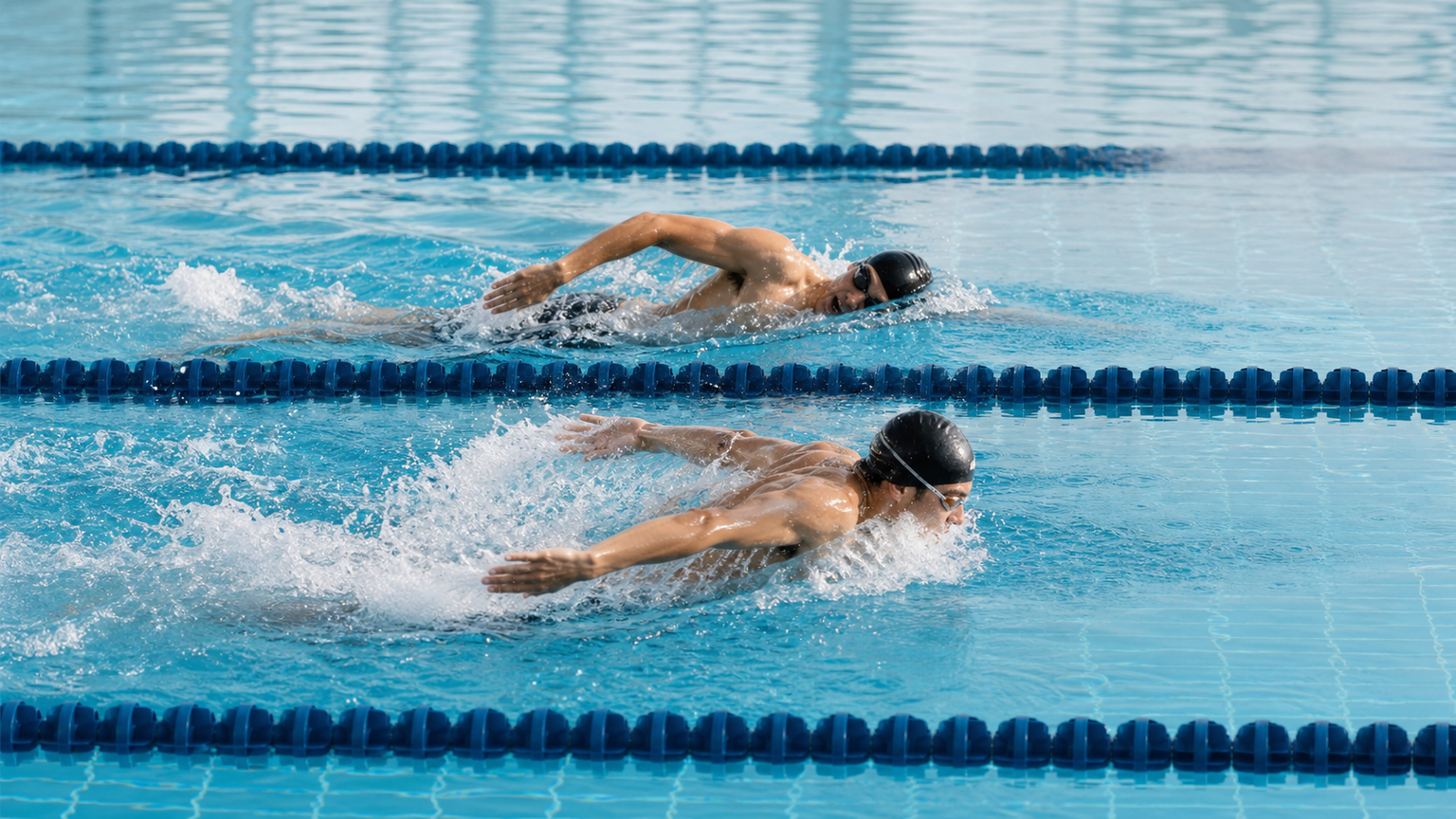
When designing training plans, swimming coaches often divide the four strokes into two groups: “long-axis strokes (freestyle, backstroke)” and “short-axis strokes (butterfly, breaststroke).” This classification is not merely an academic grouping—it reflects fundamental differences between the two stroke categories in biomechanics, energy expenditure, and training logic.
Understanding this difference allows you to make more informed decisions when planning your training and to manage your energy more effectively during races.
Core characteristics of long-axis strokes
Long-axis strokes (freestyle, backstroke) refer to strokes in which the body rotates along the longitudinal axis (from head to feet). The propulsion in these strokes comes from:
- Kinetic energy generated by body rotation: The rotation itself contributes to propulsion, rather than being merely a byproduct of breathing
- Alternating arm pulls: While one arm pulls, the other recovers, creating nearly continuous propulsion
- Alternating leg kicks: Providing stability and auxiliary propulsion
The energy expenditure characteristic of long-axis strokes is high sustainability. Because propulsion is nearly continuous, there is no pronounced “peak resistance,” and lactate accumulation is relatively slow, making these strokes suitable for long-distance endurance swimming. Top swimmers typically choose freestyle for long-distance events precisely because of its high sustainability.
Core characteristics of short-axis strokes
Short-axis strokes (butterfly, breaststroke) refer to strokes in which the body performs an undulating motion along the transverse axis (from left shoulder to right shoulder). The propulsion in these strokes comes from:
- Synchronous arm propulsion: Both arms push backward simultaneously, providing a momentary surge of powerful propulsion
- Synchronous leg kicks (dolphin kick or breaststroke kick): Providing another peak of propulsion
- Kinetic energy transfer from the undulating motion (butterfly): The body’s wave-like rise and fall itself contributes to propulsion
The energy expenditure characteristic of short-axis strokes is intermittent peaks. Within each stroke cycle, there are pronounced “propulsion peaks” and “resistance peaks,” energy expenditure fluctuates, lactate accumulates faster, and long-distance sustainability is lower than that of long-axis strokes.
| Comparison item | Long-axis strokes (freestyle, backstroke) | Short-axis strokes (butterfly, breaststroke) |
|---|---|---|
| Axis of rotation | Longitudinal axis rotation | Transverse axis undulation |
| Propulsion pattern | Nearly continuous | Intermittent peaks |
| Energy expenditure | Steady and sustainable | Peak expenditure with short recovery periods |
| Suitable distance | Middle to long distance | Short to middle distance |
| Lactate accumulation rate | Slow | Fast |
| Distance before technical breakdown | Long | Short |
Practical implications for energy distribution
Energy distribution strategy for long-axis strokes
Because propulsion is continuous, energy management in long-axis strokes more closely follows the endurance pacing logic of running or cycling: find a sustainable “cruising speed” and complete the race with a negative-split strategy. Restrain the pace early, accelerate later, and total time is optimized.
Core physical demands: aerobic endurance, lactate threshold, stroke efficiency.
Energy distribution strategy for short-axis strokes
Each stroke cycle in short-axis strokes is a mini “explosion → recovery” cycle, making energy management more similar to aerobic interval training. Technical breakdown occurs quickly; once core fatigue prevents maintaining the undulating motion or kick rhythm, speed loss is “cliff-like” rather than “linear.”
Core physical demands: anaerobic capacity, explosive power, core undulation stability, technical fatigue resistance.
Training plan arrangement logic
Ordering recommendations for same-day training:
- Technical training for short-axis strokes (butterfly, breaststroke) should be performed when energy levels are sufficient, typically scheduled early in the session
- Endurance training for long-axis strokes (freestyle, backstroke) can be scheduled later in the session, as technique is less prone to breakdown under fatigue
Weekly energy allocation:
| Training day type | Recommended focus |
|---|---|
| High-intensity day | Short-axis stroke technique + sprinting |
| Endurance day | Long-axis stroke long-distance |
| Recovery day | Easy long-axis stroke swimming, focusing on feel and technique |
| All-around day | Balanced across all four strokes, technique-focused |
Special considerations for individual medley
The individual medley (IM) race order is: butterfly → backstroke → breaststroke → freestyle. This order is not random; it descends from the most energy-demanding stroke (butterfly) to the least energy-demanding (freestyle), allowing swimmers to transition to less demanding strokes just as their energy levels decline.
The biggest challenge in IM energy distribution is: how to avoid overexerting during the butterfly leg while still maintaining sufficient speed. Many swimmers start the butterfly too fast, exhaust themselves by the backstroke and breaststroke legs, and completely fall apart in the freestyle.
Practical recommendations
- Know your short-axis technical breakdown point: Do timed practice sets to identify at what distance your butterfly or breaststroke technique begins to deteriorate. This is your training ceiling and requires dedicated training to extend
- Build an aerobic foundation with long-axis strokes: Schedule at least one 1000–2000 meter long-axis endurance swim per week—an effective way to improve base conditioning for all strokes
- Prioritize quality over quantity in short-axis training: Training volume for butterfly and breaststroke should not be excessive. The core of each session is technical quality; continuing to practice after technical breakdown only reinforces bad movement patterns
Conclusion
The long-axis versus short-axis classification is an important framework for understanding swimming training logic. It tells us that the endurance base built in freestyle cannot be directly converted into fatigue resistance in butterfly; conversely, the explosive power developed through butterfly training requires different training methods to serve freestyle. Recognizing this difference makes your training plan more targeted and your energy distribution in races more precise.
Related reading
- Swimming medley workout: freestyle-focused full-body training with breaststroke and butterfly
- Swimming medley training: energy distribution and technical challenges of 25m per stroke
- Swimming medley training: benefits of balanced four-stroke training for individual strokes
- Swimming lactate metabolism: energy system analysis of different strokes
CT 喇低賽) 武嶺牽車 才是王道 西進牽車四小時內秘訣 攝手位置 如何判斷 防抽筋小秘訣
7 年前
一日北高/長距離團騎 常見問題補充篇 / 組團或跟團的眉角 / 壯車友容易被瘦車友慢性拉爆 / 原來屁股痛可能是這個原因...? / 風場配速法 / 公路車 / CT Yeh
2 年前
類空拍神器 Feiyu Pocket 2s (有優惠連結)三軸穩定 運動攝影機 開箱!比GoPro 還強的滑順視角!三小時長時間錄影 行車記錄器 | 環花東365實測 | 公路車 CT Yeh
4 年前
Live) 備戰2019彰化經典百K 賽前攻略 (已完賽請看新影片
7 年前
西進武嶺 免費訓練分析服務 Intervals | 練不夠還是練過頭?你哪一種類型選手?AI模型告訴你! | 備戰神器 | 公路車 訓練 | CT Yeh
4 年前
靠單車減肥35公斤 心得分享與整理
7 年前
戰略) Zwift Race 如何咬在第一集團 如何評估自己要開多少推力 (請開1.5倍速看)
7 年前
[教學] Dashware 教學 如何製作有 速度 功率 心律的 騎車影片 Guages Video
8 年前