Introduction
The wheelset is one of the most precise mechanical structures on a road bike. 16–24 spokes pull the rim taut at specific angles, and through precise tension balance, maintain roundness and lateral trueness. Once a spoke breaks, loosens, or is struck by an external force, the rim will develop lateral wobble or vertical hop.
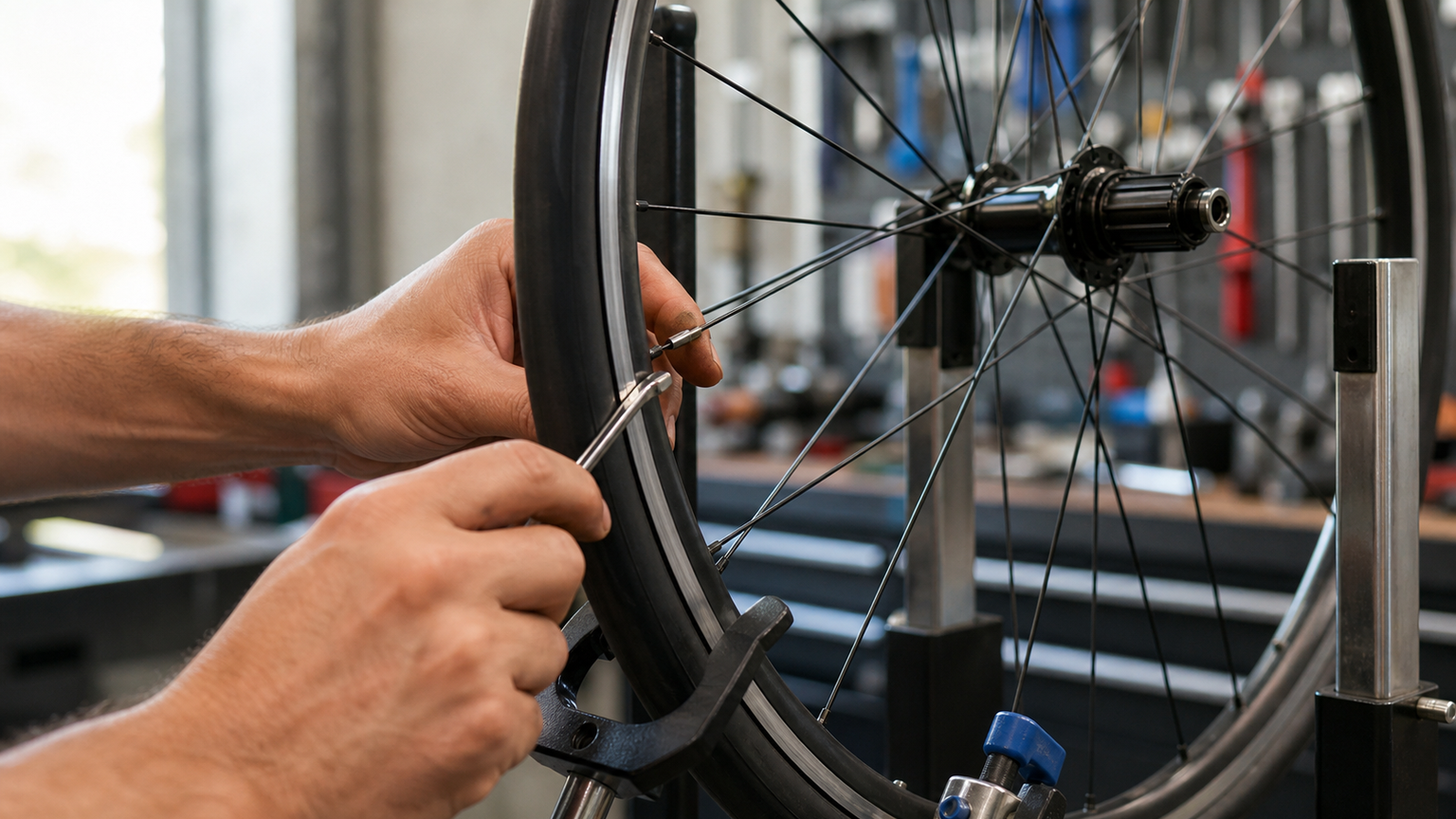
When rim wobble exceeds 2 mm, the rim will rub against the brake pads during braking, producing a “swish-swish” noise, and it also indicates that the overall strength of the wheelset has decreased. This article teaches you how to perform basic lateral wobble correction using a spoke wrench.
Tool Preparation
| Tool | Specifications |
|---|---|
| Spoke Wrench | Choose based on nipple size; common sizes are 3.23 mm, 3.30 mm, 3.45 mm |
| Work Stand | Allows the wheel to spin in a horizontal position for easy observation |
| Truing stand or visual reference | Use brake pads or a fixed rod as a reference point |
Spoke wrenches are available at bike shops or online retailers throughout Taiwan, priced around NT$150–500. The Park Tool SW-42 is a commonly used model in the industry. Be sure to choose the correct size — an ill-fitting wrench can slip and damage the spoke nipples.
Basic Principles of Spoke Tension
The position of the rim is determined by the resultant force of spoke tension:
- Loosening spokes on one side: The rim shifts toward the opposite side
- Tightening spokes on one side: The rim moves toward the same side
- Uneven tension between left and right sides: The rim shifts toward the side with greater tension
The basic rule of thumb when adjusting: Whichever way the rim is leaning, tighten the spokes on the opposite side while loosening the spokes on the same side (adjust alternately).
Wobble Correction Steps
Step 1: Locate the Wobble Point
- Mount the wheel on the work stand, using the brake pad or a thin line as a reference.
- Slowly spin the wheel by hand and observe where the rim approaches the reference point.
- Use chalk or paper tape to mark the start and end points of the wobble on the rim.
Step 2: Identify the Corresponding Spokes
At the point of greatest wobble, locate the 2–4 spokes directly over that area. Spokes alternate from both sides of the hub — one side is the left-side spokes, the other is the right-side spokes.
Step 3: Make Micro-Adjustments
- Find the opposite-side spokes from the center of the wobble: If the rim is leaning right, find the left-side spokes (spokes coming from the left hub flange).
- Turn the nipple clockwise (viewed from the rim side): Tighten to increase tension on the corresponding spokes, moving the rim to the left (opposite side). Adjust 1/4 turn (90°) at a time — do not make large adjustments.
- Spin the wheel again to re-check: Re-check the wobble after each adjustment, gradually reducing it.
- Compensate on the opposite side: If you tightened left-side spokes, slightly loosen the right-side spokes at the same location by the same amount to maintain overall tension balance.
Step 4: Check Roundness (Vertical Hop)
After correcting lateral wobble, switch to checking vertical hop. Vertical hop is usually caused by insufficient overall spoke tension or slack in a particular section. Tighten uniformly in low-tension areas (1/4 turn per spoke) rather than adjusting only locally.
Precautions
- Do not adjust more than 1/4 turn at a time: Excessive adjustment can deform the other side, making the wobble difficult to converge.
- Final tension should be even: Pluck each spoke with your fingers and listen to the pitch — spokes on the same side should have similar frequencies (you can use a phone app such as TensioApp to measure).
- Do not attempt to adjust carbon fiber wheelsets yourself: Carbon rims have stricter spoke tension specifications; it is recommended to have a certified technician handle them.
Practical Advice
- Many bicycle mechanic training courses in Taiwan (such as the mechanic certification classes offered by the Taiwan Cycling Association) include wheelset truing curriculum. If you want to learn more deeply, consider signing up for a 1–2 day basic course.
- If the wobble is caused by a broken spoke, replace the spoke before truing. Replacing a spoke requires a spoke threading tool, and in some cases the cassette must be removed — this is a more complex operation, so beginners are advised to leave it to a bike shop.
- After every long ride (such as a round-island tour or Wuling climb), it is recommended to check whether the wheelset has developed any wobble — early detection leads to early resolution.
Conclusion
Wheelset truing is a maintenance task requiring a high level of skill, but basic lateral wobble correction can be done at home once you understand the principles and have patience. Start with “being able to spot wobble and make small adjustments,” and as you gain experience, you’ll become increasingly confident in handling various wheelset issues — and you’ll also come to better appreciate a wheelset with perfectly balanced tension.
Related Reading
- Wheelset Balance Truing for Bicycles: DIY Spoke Tension Adjustment Techniques
- The Complete Guide to Home Wheelset Truing: Truing Roundness and Lateral Wobble Yourself
- The Complete Guide to Cable Tension and Barrel Adjusters: Mastering Precision Adjustment of Shifting and Braking
- Rim Truing Basics: Tools for Manual Wheel Truing and Basic Egg-Shape Correction Methods
Nepest NOVA 碳條輪組:輕量、空力、舒適一次滿足!/ 公路車 / CT Yeh
7 個月前
洗單車神器 吹水機! 實際洗車用用看 暴力洗鍊條大法 | 公路車 | CT Yeh
4 年前
鉅齒紋輪組!? ControlTech MEG-T50 EVO 碳纖維幅條輪組/ 功率對比實驗 / 公路車 / CT Yeh
2 年前
再一組! 全碳幅條 碟煞/無內胎輪組 開箱! 到底好騎嗎? UNAAS X40 | 公路車 | CT Yeh
4 年前
Vision Metron RS 37碳幅條輪組 (非SL)官網沒有的 低調開箱 / 這重量太銷魂了 / 公路車 / CT Yeh
6 個月前
碟煞公路車 銑面器 !? 原來銑完差這麼多! 降低蹭碟機率! | TIME 公路車 保養小記錄 | CT Yeh
3 年前
公路車 BB培林大升級! / 備戰海鷗繞圈賽 Canyon Aerod & TIME 一起改 / MIT大廠 CEMA對鎖式陶瓷培林BB & 導輪 / 公路車 / CT Yeh
2 年前
#公路車 #Fitting 靠人工智慧APP 幫你調整單車
6 年前