Introduction
Many swimmers spend a great deal of time training their shoulders and arms, yet forget the “engine” of the lower body—the hip flexors. The hip flexors (primarily comprising the Iliopsoas, Rectus Femoris, and Sartorius) are responsible for driving the thigh upward and forward, and are the main source of power during the “up-kick” phase of freestyle kicking.
However, modern lifestyles involve prolonged sitting while studying or using computers, which keeps the hip flexors in a shortened position for extended periods, leading to chronic tightness. This not only affects kicking mechanics but also causes anterior pelvic tilt and excessive lumbar lordosis, which in turn triggers the most common lower back pain issue among swimmers.
Effects of Tight Hip Flexors
On Kicking Mechanics:
- Tight hip flexors restrict hip extension (kicking the thigh backward), limiting the “down-kick” movement
- With anterior pelvic tilt, the lower back sinks, compromising the body’s overall streamlined position and significantly increasing drag
- The butterfly’s “dolphin kick” requires ample hip mobility; tight hip flexors will severely limit kick amplitude
On Posture and Health:
- Anterior pelvic tilt places asymmetric pressure on the lumbar intervertebral discs
- The glutes become “lengthened and inhibited,” functionally weakened, creating a vicious cycle
- Over time, this may lead to greater trochanteric bursitis and groin pain
Hip Flexor Stretching Routine
| Exercise | Hold Duration | Sets per Day | Target Muscles |
|---|---|---|---|
| Kneeling Hip Flexor Stretch (Lunge) | 45–60 sec/side | 2–3 | Iliopsoas |
| Prone Hip Extension | 30 sec/side | 2 | Rectus Femoris |
| Side-Lying Quadriceps Stretch | 45 sec/side | 2 | Rectus Femoris |
| 3D Lunge Stretch | 10 reps/direction/side | 1 | Full Hip Flexor Complex |
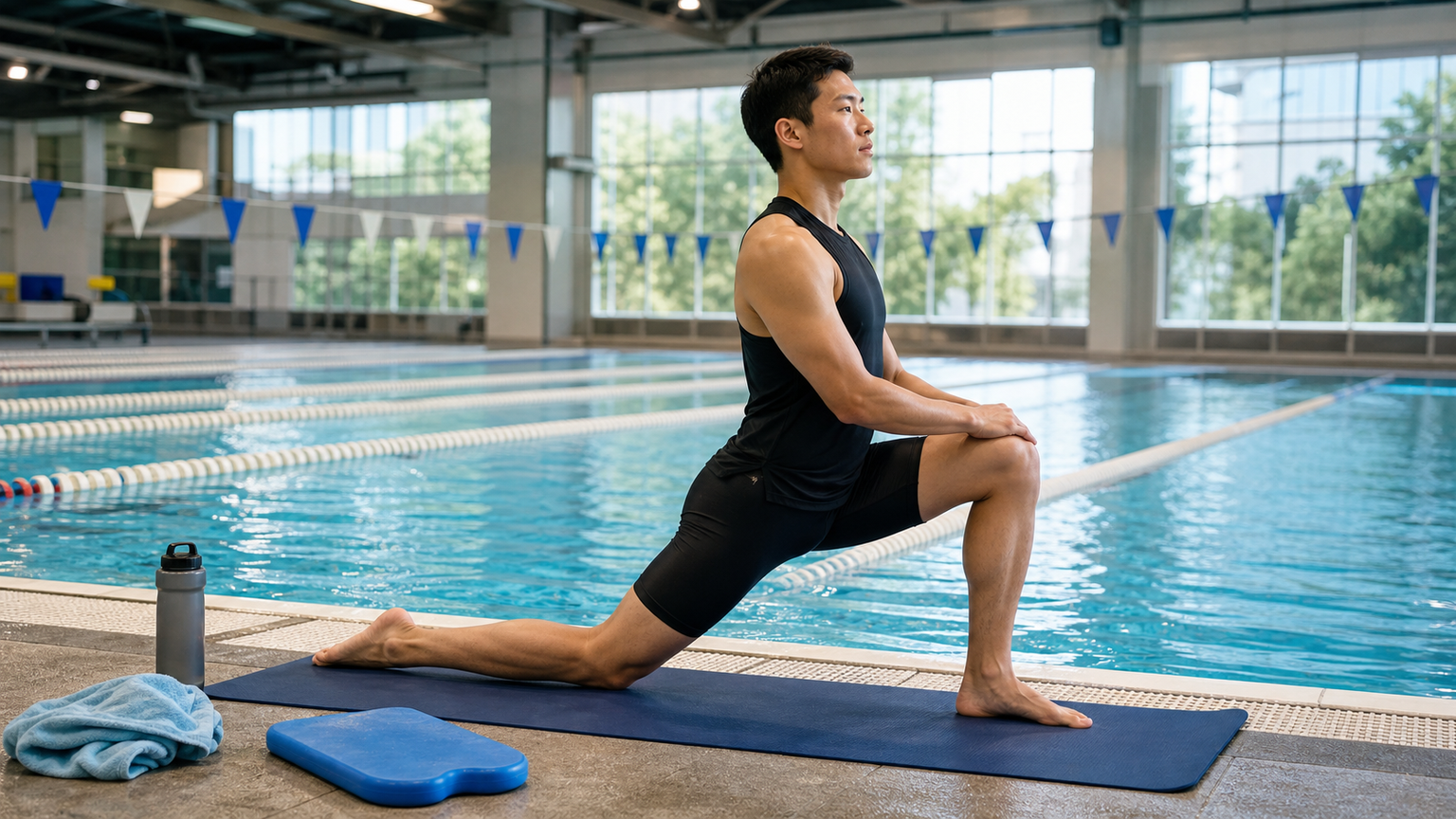
Kneeling Hip Flexor Stretch (Most Recommended)
Kneel on one knee with the front foot firmly planted and the rear knee on the ground. Perform a posterior pelvic tilt (squeeze the glutes and tuck the pelvis under), while gently shifting your body weight forward to feel a deep stretch in the front of the rear thigh and groin. Note: You must initiate the posterior pelvic tilt first to effectively stretch the deep iliopsoas; otherwise, you are merely compensating with lumbar hyperextension.
Hip Flexor Strengthening Routine
After stretching, strengthening is equally important. Weak hip flexors will cause your kick to lose control at high speeds or under fatigue.
| Exercise | Sets | Reps | Resistance | Notes |
|---|---|---|---|---|
| Supine Straight Leg Raise | 3 | 15/side | Bodyweight | Foundational iliopsoas strengthening |
| Hanging Knee Raise | 3 | 10–12 | Bodyweight | Iliopsoas + core |
| Banded Standing Hip Flexion | 3 | 12/side | Medium resistance band | Mimics kicking motion |
| Single-Leg Squat (Assisted Pistol Squat) | 2 | 6/side | Bodyweight or light assistance | Full-chain integration |
Banded Standing Hip Flexion
Attach a resistance band around the ankle, anchored behind you. From a standing position, lift the knee forward and upward until the hip flexes to approximately 90 degrees, then slowly return. The movement pattern of this exercise closely resembles freestyle kicking, making it the most transferable hip flexor strengthening exercise.
Glute Activation: The Antagonist Partner of the Hip Flexors
While strengthening the hip flexors, gluteus maximus activation training must not be overlooked. The gluteus maximus is the antagonist of the hip flexors, and the two must remain balanced. The following exercises can be added before or after hip flexor training:
- Glute Bridge: 3 sets × 15 reps
- Banded Clamshell: 3 sets × 20 reps/side
- Single-leg Glute Bridge: 3 sets × 10 reps/side
Practical Recommendations
- Perform 5 minutes of hip flexor stretching before every water session to improve body position in the water and reduce lower back strain.
- If you work or study at a computer for long periods, stand up and do a lunge stretch every hour to prevent chronic tightness from accumulating.
- Stretching and strengthening the hip flexors must go hand in hand; stretching alone without strengthening will allow the muscles to return to a tight state.
Conclusion
The hip flexors are a crucial yet often overlooked component for swimmers. Targeted stretching returns the pelvis to a neutral position, reducing drag; strengthening training makes the kick more powerful and enduring. Combining both allows you to truly “swim with your body” in the water.
Related Reading
- Hip Flexor Training for Runners: Key Muscles for Preventing Running Injuries
- Hip Flexor Training for Runners: The Relationship Between Leg Raise Strengthening and Stride Length
- Tight Hip Flexors While Running: Causes, Effects, and Complete Stretching Methods
- Stretching and Strengthening Combinations for Overly Tight Hip Flexors: Unlocking the Invisible Shackles of Sedentary Runners
一日北高/長距離團騎 常見問題補充篇 / 組團或跟團的眉角 / 壯車友容易被瘦車友慢性拉爆 / 原來屁股痛可能是這個原因...? / 風場配速法 / 公路車 / CT Yeh
2 年前
一起升級!海鷗盃LSD團練...JJSC Zone2招待 騎到手抖 / 公路車 / CT Yeh
2 天前
一日北高常見問題大集合 | 攻略 | 路線 | 訓練 | 補給 | 自行車 單車 | 一日雙城 | 雙塔 | TWB北高360 | 屁股痛
6 年前
[教學] Premiere 影片 手震 修正 教學 防抖 單眼 影像 GoPro 穩定 Video Stabilization
8 年前
2016/05/13 單車 冷水坑下滑
10 年前
CT 喇低賽) 武嶺牽車 才是王道 西進牽車四小時內秘訣 攝手位置 如何判斷 防抽筋小秘訣
7 年前
一日北高前的西濱集訓 | 跟著11小時軍團 | 300W踩不動的大逆風 | 輪車破風差幾瓦?
6 年前
西進武嶺 免費訓練分析服務 Intervals | 練不夠還是練過頭?你哪一種類型選手?AI模型告訴你! | 備戰神器 | 公路車 訓練 | CT Yeh
4 年前