Introduction
The 50m freestyle world record stands at just about 21 seconds—the entire race is one all-out explosive effort. Even for 400m swimmers, the explosive power from the starting block dive and every turn directly impacts the final result. Yet many swimming training programs overemphasize aerobic endurance while systematically neglecting power training.
Power is defined as “the ability to do work per unit of time” (Power = Force × Velocity). To improve swimming power, you must train both strength and speed on land, and the explosive chest press and squat jumps are the most direct training tools for this purpose.
Why Swimmers Need Power Training
- Block Starts: The starting dive (Track Start or Grab Start) requires instantaneous maximal lower-body explosive power, and the underwater dolphin kick after entry also demands powerful hip explosiveness.
- Turn Efficiency: During the flip turn in freestyle, leg explosive power at the moment of pushing off the wall directly determines your push-off velocity.
- Butterfly and Sprinting: Every butterfly stroke requires upper-body explosive power, and maintaining speed in the latter half of 50/100m sprints relies on neuromuscular efficiency, not sheer endurance.
Explosive Chest Press (Explosive Push-up & Med Ball Chest Press)
Clap Push-up
From a standard push-up position, push up as fast as possible, letting your hands leave the ground, clap in the air, and land back down. This is the foundational upper-body power exercise, effectively training the rapid contraction capacity of the pectoralis major, anterior deltoids, and triceps.
Medicine Ball Chest Pass
Stand facing a wall (or a partner), holding a medicine ball at your chest with both hands, and push it forward at maximum speed. The key is “release fast, no deceleration,” training your upper body’s impulse-generation capacity.
Squat Jump & Box Jump
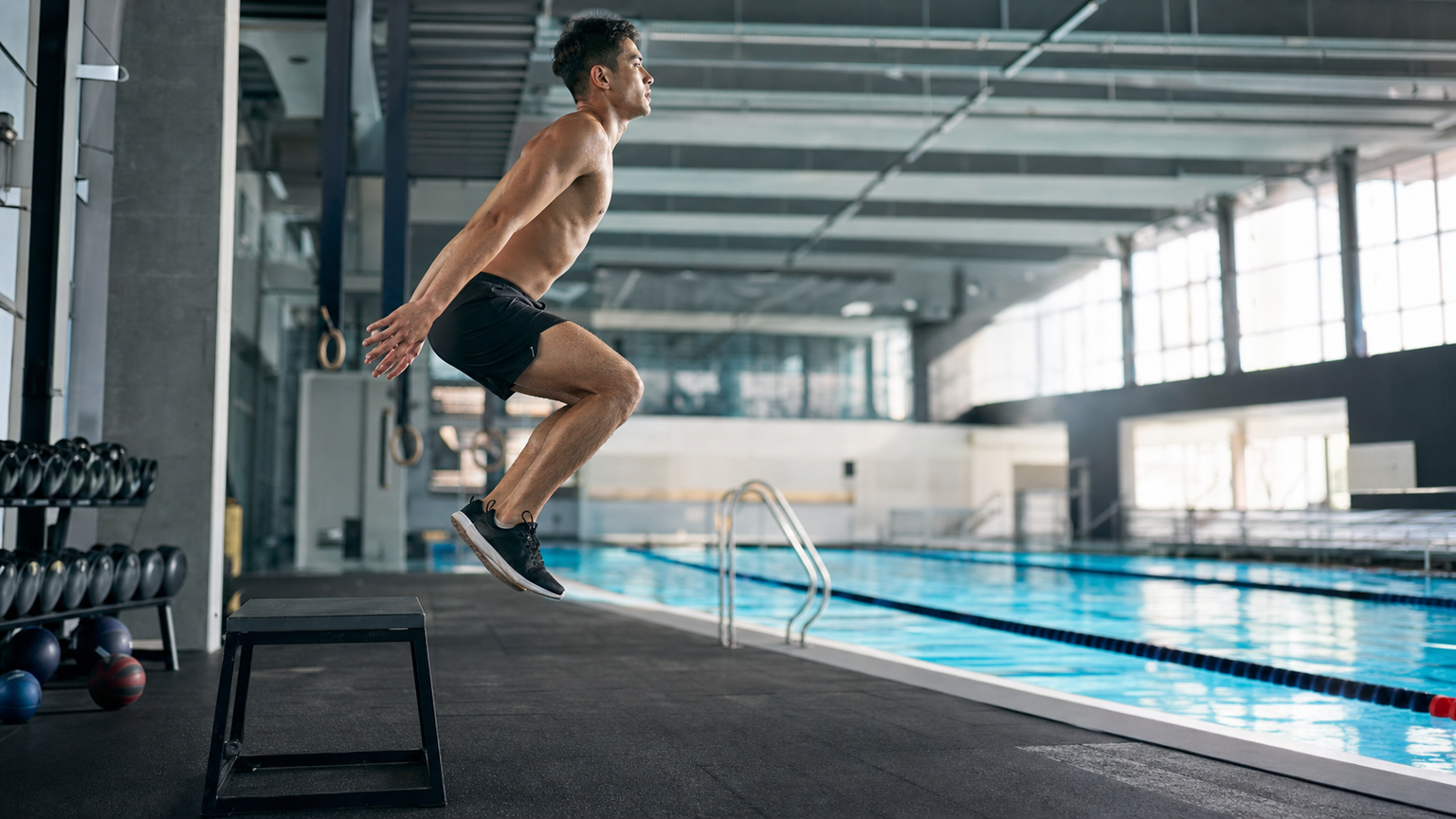
Countermovement Jump (CMJ)
Stand, squat down quickly to about 90 degrees, then immediately rebound upward, using your arms to assist the movement. CMJ is the most commonly used indicator for assessing lower-body explosive power and serves as a proxy for a swimmer’s start and turn ability.
Box Jump
Stand in front of a plyo box, perform a CMJ, and land softly on top of the box with both feet. The key is a quiet landing (bending the knees to absorb impact)—it’s not about how high you jump, but about training the neuromuscular pattern for rapid “take-off.”
| Exercise | Sets | Reps | Intensity | Rest | Notes |
|---|---|---|---|---|---|
| Clap Push-up | 4 | 5 | Max speed | 2 min | Max effort every rep |
| Medicine Ball Chest Pass | 3 | 6 | 3–5 kg ball | 90 sec | Speed first |
| Countermovement Jump | 4 | 5 | Bodyweight | 2 min | Max height |
| Box Jump | 3 | 5 | Appropriate box height | 2 min | Soft landing |
| High-Speed Jump Rope | 3 | 20 sec | Fastest speed | 60 sec | Ankle elasticity |
The Neuroscience of Power Training
The adaptations from power training are primarily neural (rather than muscular hypertrophy):
- Motor Unit Synchronization: More fast-twitch muscle fibers fire simultaneously
- Reduced Inhibition: The nervous system learns to “take the foot off the brake,” allowing maximal contraction
- Coordinated Antagonist Relaxation: Antagonists relax more quickly during pushing movements, reducing resistance
These neural adaptations require every session to be performed with “maximal intended velocity”—even with lighter external resistance, the intent of the movement must be as fast as possible.
Training Timing
Power training places high demands on the nervous system, so it must be done:
- After a thorough warm-up (when core temperature is elevated)
- Before fatigue sets in (with full rest between sets)
- Not on consecutive days (needs 48+ hours for neural recovery)
Practical Recommendations
- Power training twice a week is sufficient; higher frequency can actually cause regression due to neural fatigue.
- Young athletes should first build a maximal strength foundation in squats and push-ups (at least 6 months) before introducing power training.
- Schedule power training in the latter half of the 8 weeks before the season (using the first 4 weeks for maximal strength) for the best results.
Conclusion
Power is the “ceiling determiner” of swimming speed. Whether you’re a sprint specialist or a middle/long-distance swimmer, strengthening neuromuscular power will bring measurable improvements in your starts, turns, and sprint segments. Add squat jumps and explosive chest presses to your program—this is one of the most overlooked yet most effective components of dry-land training for swimming.
Related Reading
- Swimming’s Cross-Training Synergy: The Transfer of Dry-Land Power Training to Swimming Speed
- Explosive Swimming Starts: How Block Power Training Improves Start Performance
- Power Training for 50m Sprint Swimming: Neural Preparation for Maximum Velocity
- Dry-Land Power for Swimmers: A Complete Guide to Band Pull Simulations and Shoulder Power Training
戰略) Zwift Race 如何咬在第一集團 如何評估自己要開多少推力 (請開1.5倍速看)
7 年前
西進武嶺 免費訓練分析服務 Intervals | 練不夠還是練過頭?你哪一種類型選手?AI模型告訴你! | 備戰神器 | 公路車 訓練 | CT Yeh
4 年前
實景訓練台) 彰化經典百K 高強度喵團 90分鐘 跟著一起練功 2019 Indoor workout Changhua Classic 100 Taiwan
7 年前
一起升級!海鷗盃LSD團練...JJSC Zone2招待 騎到手抖 / 公路車 / CT Yeh
2 天前
西進武嶺 8000名單車友數據分析 PART1 | 從新手到高手數量/瓦數/推力比/FTP推力比/功率計使用率 大解析 | 公路車 | CTYeh
5 年前
FTL 與 SYB 車隊專訪 西進武嶺 實用攻略分享! 2小時 如何練?!你不知道的眉角!新手準備武嶺必看 EP1 | 實力派女車友 | 精華版 | 公路車 | CTYeh
4 年前
風櫃嘴 衝刺慢動作回放!
8 年前
CT 喇低賽) 武嶺牽車 才是王道 西進牽車四小時內秘訣 攝手位置 如何判斷 防抽筋小秘訣
7 年前