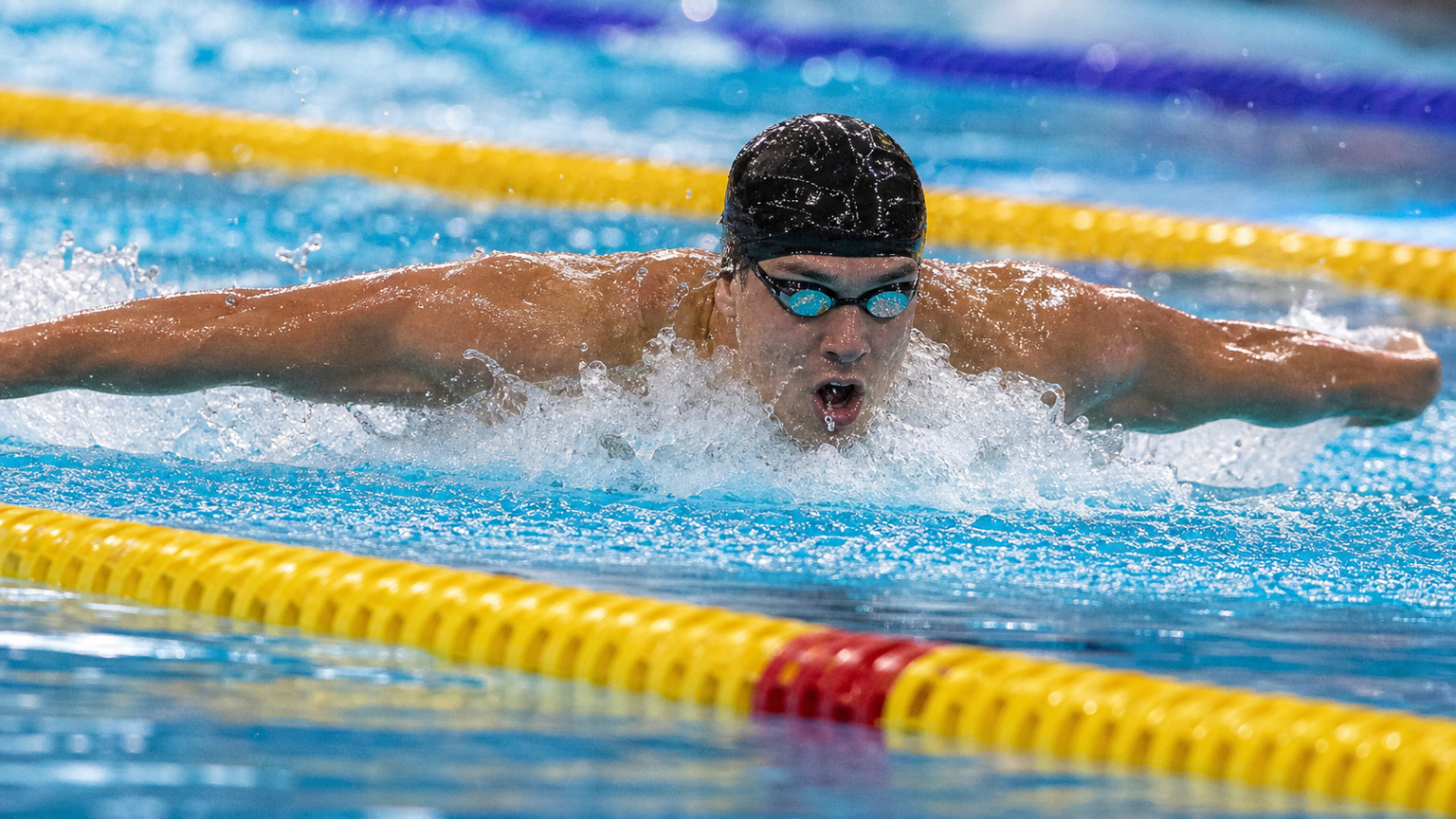
Introduction
Many coaches call the 200m butterfly “the hardest event in swimming.” Unlike the 100m, it cannot be won on raw explosive power alone, and unlike the 400m individual medley, it offers no change of stroke to break up the rhythm. Swimmers must hold technically demanding butterfly form across the full 200 meters while precisely managing their energy. Michael Phelps dominated this event across three Olympic Games, and his tactical approach remains the textbook standard today.
Four-Length Pacing Breakdown
The standard 200m butterfly race in a long-course (50m) pool consists of four lengths. Here is how the world’s top swimmers typically approach each segment:
| Segment | Distance | Tactical Focus | Typical Split (Elite Men) |
|---|---|---|---|
| First | 0–50m | Control the opening rhythm, avoid over-sprinting | ~26–27 seconds |
| Second | 50–100m | Maintain technique, begin building a rhythmic edge | ~29–30 seconds |
| Third | 100–150m | The most critical segment — keep the core stable | ~30–31 seconds |
| Fourth | 150–200m | Judge the moment to accelerate, sprint the final 15m | ~29–30 seconds |
The most common mistake is going out too fast on the first length. By the third length, lactate buildup causes the stroke to break down, and the final sprint comes too late to make up the deficit already lost.
Breathing Strategy: Phelps’s Secret
Breath control is one of the core tactical elements in butterfly. Phelps famously said that “breathing is borrowed time” — every breath slightly reduces stroke efficiency, so he deliberately reduced his breathing during the critical segments of the race:
- First length (0–50m): Breathe every two strokes (a 2:1 rhythm)
- Second and third lengths (50–150m): Maintain 2:1, or switch to 3:1 (breathing every three strokes)
- Final 15 meters: Full breath-hold sprint, no breathing at all
This approach requires exceptional breath-holding capacity and lung training as its foundation. Recreational swimmers should adapt it to their own condition rather than blindly copying it.
The Sun Yang Alternative
China’s Sun Yang, known for his distance-pacing prowess, took a front-loaded approach in the 200m butterfly — building a lead in the early segments and relying on technical stability to hold his position in the back half. This strategy suits swimmers with solid technique and a strong aerobic base, but carries the risk of having little room to respond if challenged hard in the closing segments.
Core Strength: Butterfly’s Hidden Engine
More than 60% of butterfly’s propulsive power comes from the undulating motion of the core and hips — the shoulders merely transmit that power. As a result, the common late-race fade in the 200m butterfly is rarely just arm fatigue; more often it is the core muscles giving out, causing the undulation to collapse.
To address this, Taiwanese swimmers commonly incorporate the following supplementary training:
- Breaststroke-kick-plus-butterfly-arm combination drills: to reinforce hip-driven awareness
- Land-based stability ball core training: 3 sessions per week, 20 minutes each
- Slow-tempo butterfly with in-water resistance cords: emphasizing core drive over arm effort
Differences in Turn Technique
The 200m butterfly includes three turns, and saving 0.1–0.3 seconds on each turn can be the margin over a competitor. Butterfly turns require both hands to touch the wall simultaneously, demanding tighter timing than a freestyle flip turn:
- Maintain a normal stroke tempo approaching the wall — don’t glide in too early
- Touch the wall with both hands while bending the knees, planting the feet quickly against the wall
- Hold the underwater dolphin-kick phase off the wall for at least 10–12 meters
Practical Tips
- Record split times for every segment in each training session to identify which length fades most and target it for extra work
- Incorporate “perceived-effort” sets into 200m butterfly training: swimming 200m at a subjective effort of 7/10 often mirrors race demands more closely than chasing a specific split time
- Breathing-rhythm training should start over short distances (e.g., 50m sets with 3:1 breathing) before gradually extending to 100m and 200m
- Compete in regional swim meets to build race-day composure — Taiwan’s counties and cities each hold annual swimming championships open for entry
Conclusion
The 200m butterfly sits at the intersection of technique, conditioning, and tactics. Phelps’s dominance shows that when physical ability is closely matched, tactical intelligence is often what decides who takes the gold. For Taiwanese swimming enthusiasts, understanding this tactical framework in depth can not only improve competitive results but also help sharpen the goals of every single training session in the pool.
Related Reading
- 200m Individual Medley Stroke-Transition Strategy: The Art of Order and Energy Distribution
- Preparing for Butterfly Events: Sprint Tactics for 50m and Split Strategy for 100m
- Managing Explosive Power in the 100m Butterfly: Balancing Early Conservation with a Late Sprint
- 200m Freestyle Split Strategy: Rhythm Control Across Four 50m Lengths
CT 喇低賽) 武嶺牽車 才是王道 西進牽車四小時內秘訣 攝手位置 如何判斷 防抽筋小秘訣
7 年前
西進武嶺 自製新版AI配速表產生器 x 賽前攻略 抱佛腳! 沒有功率計也可以產生配速表嗎?有什麼其他眉角賽前要注意的呢? | 西進武嶺 / 東進武嶺 KOM 攻略 | 公路車 | CT Yeh
4 年前
戀戀197 競賽組 | 50頁投影片心得報告 | 賽後檢討 攻略 #公路車
6 年前
戀戀197 血脈噴張 多視角剪輯版 最艱難的市民競賽組 M30 M35 參賽記錄 請開字幕 4K高畫質 #公路車
6 年前
教學) 如何做出專業 慢動作 影片 Slow Motion 120fps GoPro 7 ActionCam AX700 A99II
7 年前
戰略) Zwift Race 如何咬在第一集團 如何評估自己要開多少推力 (請開1.5倍速看)
7 年前
Live) 備戰2019彰化經典百K 賽前攻略 (已完賽請看新影片
7 年前
2026 輪霸西濱200K 挑戰VLOG / 第一集團 / 首次參加..經驗不足、膀胱不足 /死守6H內 / AI戰鬥力顯示系統 / 公路車 / CT Yeh
4 個月前