Introduction
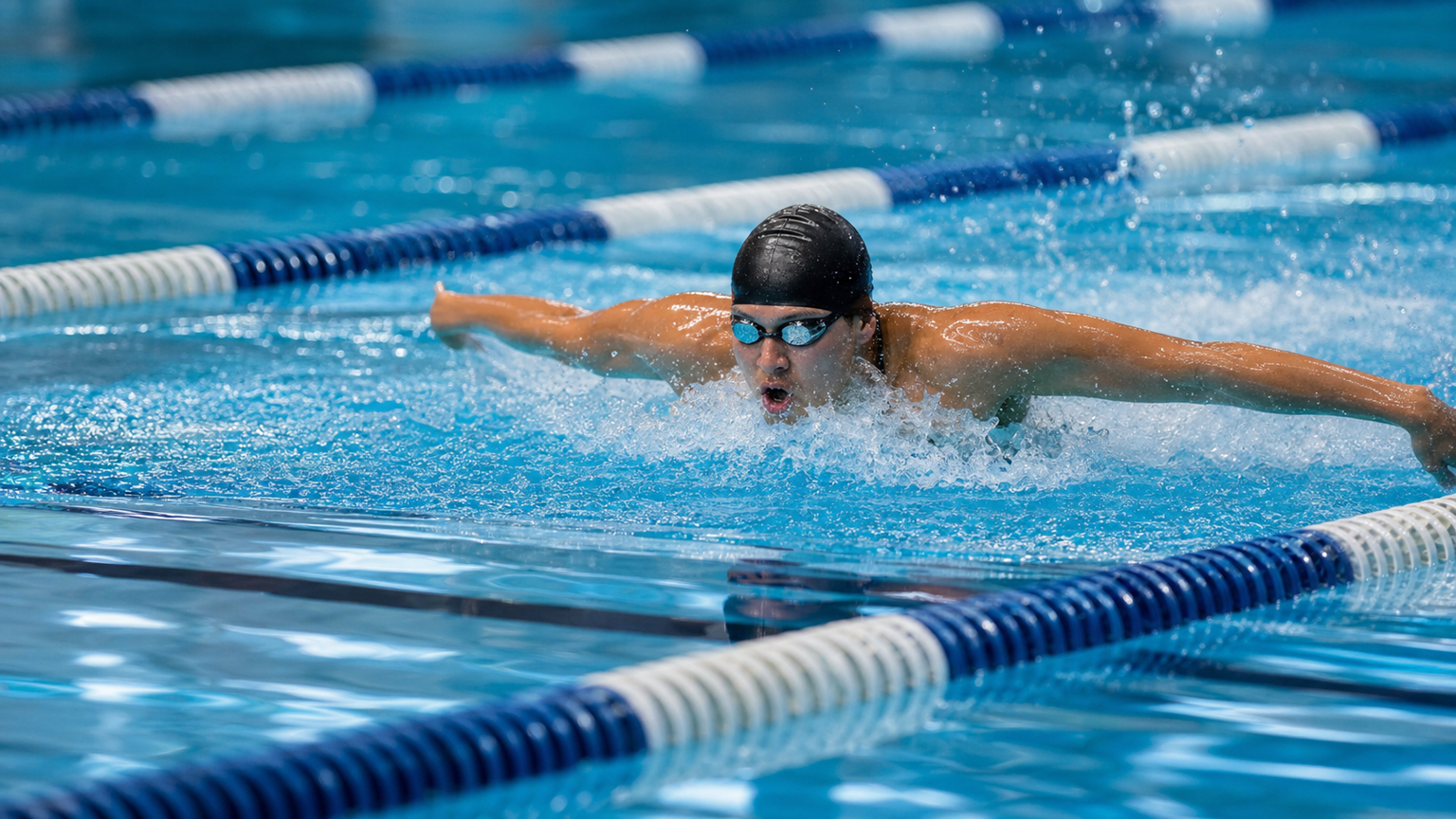
The 400m individual medley (400m IM) is the most comprehensive individual event in swimming, requiring athletes to swim 100m butterfly, 100m backstroke, 100m breaststroke, and 100m freestyle in sequence. This event tests not only technical proficiency in all four strokes, but also precise energy distribution and mental stability. American legends Michael Phelps and Ryan Lochte dominated this event for years, and their pacing philosophies remain training benchmarks to this day.
The Basic Framework of Four-Segment Pacing
The 400m IM cannot be measured by a single standard, as the energy system demands of the four strokes differ:
| Segment | Stroke | Energy System | Pacing Strategy |
|---|---|---|---|
| First | Butterfly 100m | High anaerobic demand | Controlled at 105–110% of personal best 100m butterfly time |
| Second | Backstroke 100m | Moderate intensity | Brief recovery, establish rhythm |
| Third | Breaststroke 100m | Aerobic + technique | Most critical segment, where technical breakdown begins |
| Fourth | Freestyle 100m | All-out sprint | Release all remaining energy |
The butterfly opening strategy is the most crucial. If the first segment is swum too fast (e.g., recklessly going all-out in butterfly), lactate will spike during the backstroke segment, breaststroke technique will inevitably collapse, and the final freestyle becomes little more than survival.
Phelps vs. Lochte: A Comparison of Pacing Philosophies
Phelps’ strongest stroke was butterfly, and his strategy was “build a lead in the early stages, defend the advantage in the latter stages”:
- Butterfly at approximately 95% intensity of his near-personal-best 100m butterfly
- Backstroke maintained steadily, without deliberately over-pacing
- Breaststroke was his weakness, prioritized for rhythm stability
- Final freestyle segment swum all-out, with a high success rate
Lochte’s strategy was markedly different, with backstroke as his strongest stroke:
- Butterfly conservatively at 90% intensity, conserving energy
- Backstroke segment swum at full effort to overtake—this was his biggest energy-gain segment
- Breaststroke technically sound, thanks to his stronger aerobic base
- Freestyle closed out with technical stability
The common thread between the two: never let the breaststroke segment become the breaking point.
The Breaststroke Segment: The Make-or-Break Point of the 400m IM
Breaststroke is the weakest stroke for most swimmers and the most common point of slowdown in the 400m IM. If the breaststroke kick technique breaks down under fatigue, propulsion per stroke drops significantly while energy expenditure does not necessarily decrease, creating a vicious cycle.
Improvement strategies:
- Practice breaststroke legs in a fatigued state in isolation: swim 200m freestyle, then immediately follow with 4×50m breaststroke legs
- Breaststroke turn technique: turn efficiency under fatigue is often a blind spot and requires specialized training
Rhythm Transitions Between Stroke Changes
Each stroke change has fixed wall-touch rules (butterfly-to-backstroke requires two hands, breaststroke also requires two hands, backstroke-to-freestyle allows a one-hand flip turn). Whether the transition is smooth affects overall time by 0.5–1 second.
Key transition points:
- Butterfly → Backstroke: After two-hand touch, turn quickly and begin backstroke kick immediately upon pushing off the wall—no delay
- Backstroke → Breaststroke: Must touch the wall with two hands in backstroke position; this is the most difficult transition to time
- Breaststroke → Freestyle: After two-hand touch, can immediately enter the flip turn—this is the most time-saving stroke change
The Current State of 400m IM Training in Taiwan
Several Taiwanese university swim teams list the 400m IM as a key training event, and it is also contested at the National Intercollegiate Athletic Games. The main challenges for Taiwanese athletes in the 400m IM come from the refinement of breaststroke technique and an insufficient long-distance aerobic endurance base.
Areas for improvement:
- Increase weekly long-distance aerobic training (each session including 2,000–3,000m of aerobic volume)
- Establish personal baseline times for all four strokes and calculate the gap between theoretical IM time and actual performance
- Participate in county and city swimming league meets across Taiwan to accumulate race pacing experience
Practical Recommendations
- Conduct at least two full 400m IM time trials per season, recording split times for all four segments
- Identify your weakest stroke and allocate an additional 20% of weekly training time to strengthen it
- Set a reasonable “target IM time”: the sum of personal bests in all four strokes plus 5–8 seconds
- Mental training is equally important: when fatigue sets in during the breaststroke segment, use breathing rhythm to stabilize your mindset
Conclusion
The 400m individual medley is the “triathlon” of swimming, demanding comprehensive technical and physical reserves. Understanding the pacing philosophies of the world’s top athletes and combining them with your own strengths and weaknesses to develop a personalized strategy is the key to Taiwanese athletes standing out at events such as the National Intercollegiate Athletic Games and the National Games.
Related Reading
- Race Strategy for Medley Events in Swimming: Stroke Order and Pacing Distribution
- Individual Medley (IM) Strategy: Energy Distribution Across the Four-Stroke Order
- 200m Individual Medley Four-Stroke Transition Strategy: The Art of Stroke-Order Advantage and Energy Distribution
- Energy Distribution in the Individual Medley (IM): Strength-and-Weakness Planning Across the Four-Stroke Order
2024桃園團體自由車邀請賽!4K環台賽等級拍攝 全賽事精華!/ 集團大摔車 / 60隊菁英好手衝線 / 公路車 CT Yeh
1 年前
西進武嶺 免費訓練分析服務 Intervals | 練不夠還是練過頭?你哪一種類型選手?AI模型告訴你! | 備戰神器 | 公路車 訓練 | CT Yeh
4 年前
Live) 備戰2019彰化經典百K 賽前攻略 (已完賽請看新影片
7 年前
西進武嶺 自製新版AI配速表產生器 x 賽前攻略 抱佛腳! 沒有功率計也可以產生配速表嗎?有什麼其他眉角賽前要注意的呢? | 西進武嶺 / 東進武嶺 KOM 攻略 | 公路車 | CT Yeh
4 年前
單車AI教練!全新 ChatGPT4o 幫你分析訓練成果!排武嶺課表,分析騎車姿勢! 太神了! / 公路車 / CT Yeh / feat. 緯緯
2 年前
2020 戀戀197 全程4K雙錄影 訓練台實境 市民競賽組 M30 M40 #公路車
6 年前
實景訓練台) 彰化經典百K 高強度喵團 90分鐘 跟著一起練功 2019 Indoor workout Changhua Classic 100 Taiwan
7 年前
#公路車 #西進武嶺 配速配瓦實驗 坡度分析 四小時內攻略 建大盃 NeverStop #西進武嶺攻略
6 年前