Introduction
The swimming relay is one of the most breathtaking events at the Olympics, World Championships, and Taiwan’s National Intercollegiate Athletic Games. Each swimmer’s individual technique certainly matters, but the timing and precision of the relay exchange often determine the medal-winning 0.03 seconds. A key reason the U.S. swim team has long dominated relays is their systematic training of exchange technique. This article breaks down the rules, science, and training methods behind relay exchanges.
The Rule Framework for Relay Exchanges
According to World Aquatics rules, the legal requirements for a relay exchange:
| Rule Point | Explanation |
|---|---|
| Start Timing | Before the incoming swimmer touches the wall, the next swimmer’s feet must remain on the starting block |
| Touch Requirement | The incoming swimmer must touch the wall with one hand (freestyle/backstroke) or both hands (butterfly/breaststroke) to complete their leg |
| Early Start | If the next swimmer leaves the block before the incoming swimmer touches the wall, the team is disqualified (DQ) |
| Determination Method | High-speed cameras + sensor systems, accurate to 0.001 seconds |
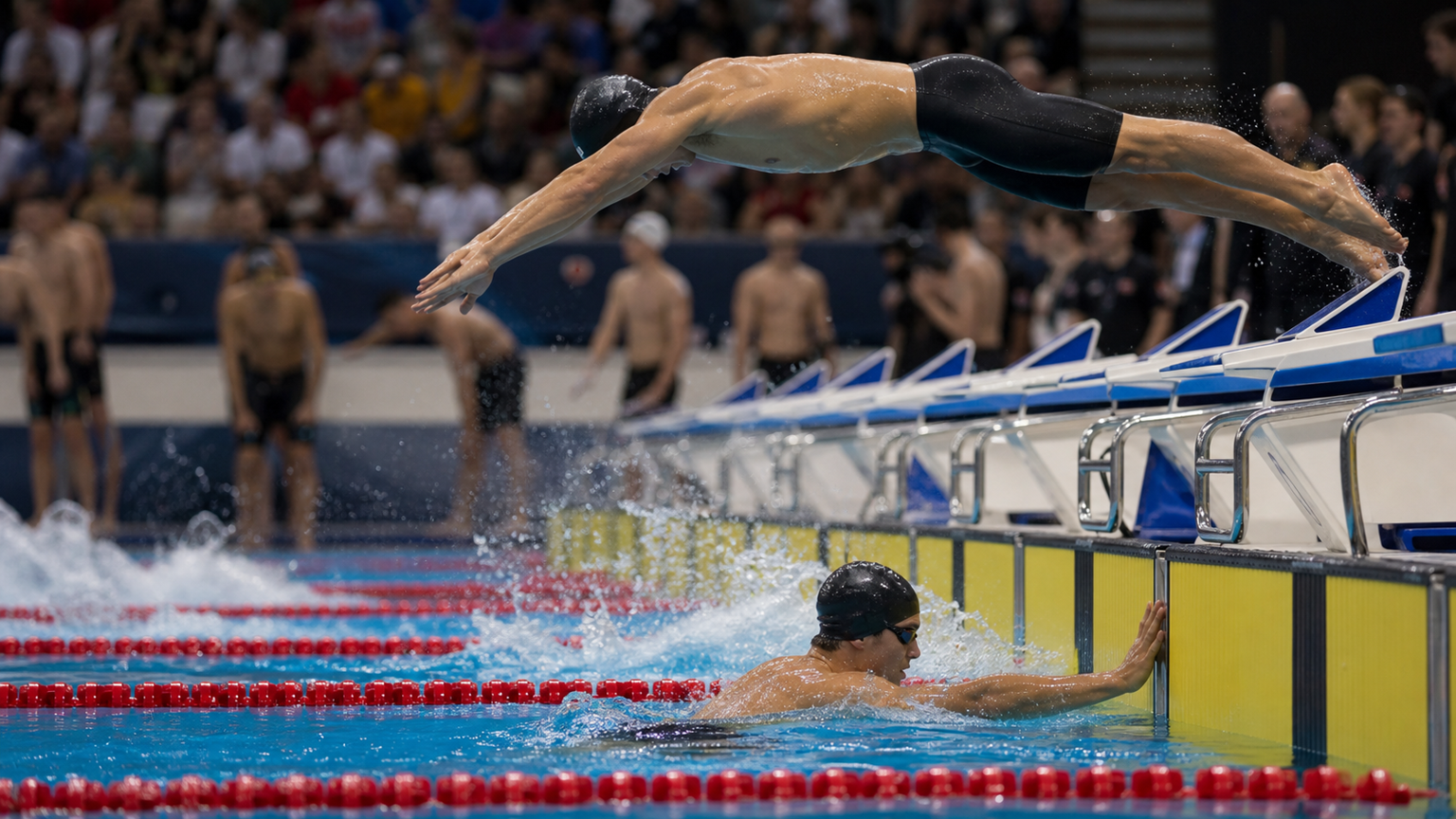
The ideal timing for a legal exchange: the next swimmer’s feet leave the block 0.00–0.03 seconds after the incoming swimmer touches the wall. The narrower this “window,” the better—but the feet must leave only after the touch.
The Science of the Exchange: The Limits of the “Early Dive”
Elite relay swimmers aim to have the next swimmer’s feet fully off the block but not yet in the water at the exact moment the incoming swimmer touches the wall—this allows them to use the rebound wave from the incoming swimmer’s touch as an extra boost.
The actual operational sequence:
- Observe the incoming swimmer’s approach to the wall: Predict the touch time based on the incoming swimmer’s stroke cycle
- Adopt the starting stance: Move into a crouched starting position early, shifting weight forward
- Trigger on the touch signal: Perceive the sound of the incoming swimmer’s touch (splash) or a visual cue, and launch the jump immediately
- Maximize starting speed: A relay start can be slightly higher than an individual start (thanks to the assist from the incoming swimmer’s wave)
Top relay swimmers control their reaction time plus exchange window to 0.04–0.07 seconds. Compared with the 0.65–0.70 seconds for an individual start, the “extra speed” gained on a relay start is substantial.
Leg Assignment Strategy
The order of the relay lineup is a core tactical consideration for coaches:
Typical 4×100m freestyle relay strategy:
- Leg 1: A technically consistent swimmer who establishes good water conditions from the start
- Leg 2: A fast but not necessarily the strongest swimmer, maintaining or extending the lead
- Leg 3: A mentally tough swimmer who handles the mid-race battles
- Leg 4 (anchor): The strongest or most explosive swimmer, sprinting under pressure
Coaches differ on how they arrange Legs 1 and 4, but “put the strongest on Leg 4” is the most common principle.
The Current State of Taiwan’s Relay Training
Taiwan’s relay teams have performed steadily at the National Intercollegiate Athletic Games and the National Games, but compared with Asia’s top teams (Japan, China), there is still room for improvement in the refinement of exchange technique. The main reasons:
- Insufficient joint practice time: Relay members often belong to different schools or clubs, limiting opportunities to train together
- Lack of systematic exchange training: Most training emphasizes individual swimming speed, with few relay exchange simulations
- Lack of video feedback: Top relay teams use high-speed cameras to analyze every exchange; adoption in Taiwan remains low
Training Methods to Improve Relay Exchanges
- Exchange rhythm drills: Groups of 4, performing 8–10 exchanges per session, recording the “exchange loss time” for each (ideal value < 0.04 seconds)
- Sound-triggered training: The incoming swimmer makes a sound upon touching the wall; the next swimmer starts on hearing it, training reaction time
- Video analysis: Use slow-motion recording (at least 120fps) to analyze the exact moment the feet leave the block on each exchange
- Exchange practice under fatigue: In real race scenarios, the incoming swimmer touches the wall only after giving maximum effort, leaving turbulent water; the next swimmer must make precise judgments under those conditions
Practical Recommendations
- Schedule at least 3 full-lineup joint practices before a relay race so swimmers become familiar with each other’s approach rhythm to the wall
- Study each incoming swimmer’s “last 3 strokes before the wall” characteristics to develop individualized starting timing
- If a team has a history of exchange disqualifications, adopt a more conservative strategy (increase the touch-confirmation time)—better to be 0.05 seconds slower than to commit a false start
- Watch footage of Japan’s relay teams; their exchange technique is currently one of the most refined models in Asia
Conclusion
Relay swimming is the perfect fusion of individual competition and team coordination. That 0.03-second exchange window is not just a test of reaction speed—it is an expression of trust and chemistry between teammates. If Taiwan’s swim teams can systematically improve their relay exchange technique, they will have greater room for breakthroughs in relay events at Asian competitions.
Related Reading
- Relay Exchange Technique in Swimming: Optimizing Reaction Time and Underwater Propulsion
- Relay Exchange Timing: The Precise 0.03-Second Judgment Before Touching the Wall
- Relay Leg Assignment Strategy: Order Arrangement and Exchange Technique
- Key Technical Points in Swimming Relays: Exchange Timing and Teammate Coordination
Zwift跨國線上追逐賽 第二站 台灣 TTR vs. 日本 JETT 第二場 (台灣追日本) | 數百位國內外公路車高手,同場較勁 | 多視角賽事直播
4 年前
CT 喇低賽) 武嶺牽車 才是王道 西進牽車四小時內秘訣 攝手位置 如何判斷 防抽筋小秘訣
7 年前
新屋團體繞圈賽 | 眾多菁英好手賽道奔馳 | 千瓦女子軍團 | 無敵交管狂獲好評 明年你一定不能錯過 | #公路車
5 年前
2025 海鷗團體繞圈賽 網路直播 超激烈裁判長視角 / EIPC 李廷威、Waypoint 等眾多高手競爭 / feat. 卡密兒主持 / 海鷗繞圈賽
9 個月前
2023桃園團體繞圈賽 / 海鷗繞圈賽 | 全程空拍數據版 | 公路車 | CT Yeh
2 年前
Live) 備戰2019彰化經典百K 賽前攻略 (已完賽請看新影片
7 年前
一起升級!海鷗盃LSD團練...JJSC Zone2招待 騎到手抖 / 公路車 / CT Yeh
2 天前
崇越盃武嶺冠軍高手 賽前JJSC 群峰會精華!對應大數據分析,會有落差嗎?/ feat. JJSC中部公路車約騎 /公路車 / CT Yeh
2 年前