Introduction
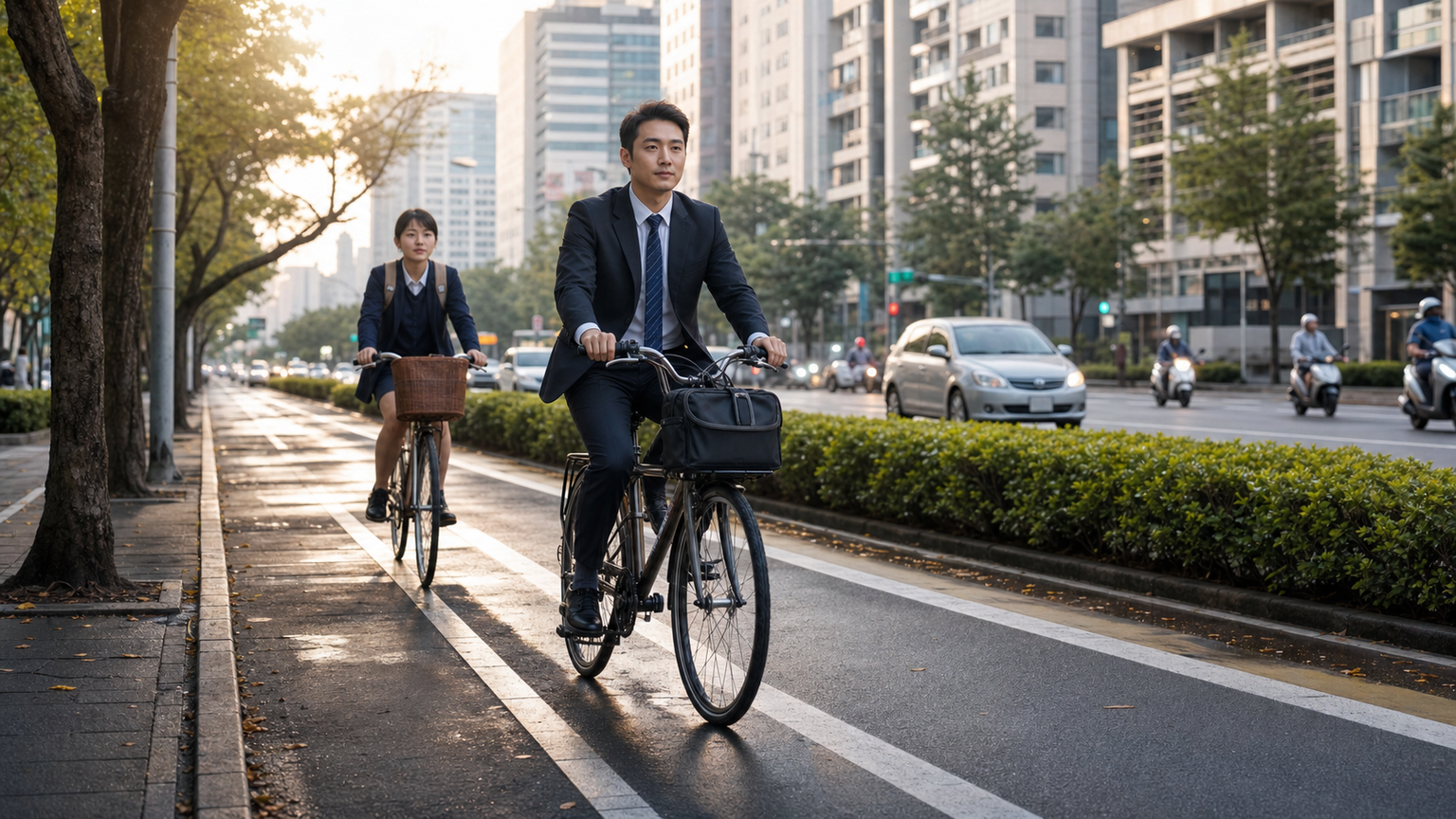
At 7:30 in the morning on Taipei’s Ren’ai Road bike lane, office workers in suits and students with backpacks ride side by side, tires humming over the freshly watered asphalt. This scene barely existed ten years ago; today, bike commuting has become a daily choice for many urban dwellers in Taiwan.
According to Ministry of Transportation statistics, Taiwan’s cycling rate in 2024 grew about 38% compared to 2019, with commuting purposes rising from 12% to 21% of all rides. This isn’t just a change in numbers—it’s a transformation in lifestyle attitude.
Why Are More and More People Choosing to Bike to Work?
Recalculating the Cost of Time
Many people assume cycling is slower than taking the MRT, but the reality is often the opposite. Take the route from Xinyi District to Da’an District in Taipei as an example:
| Mode of Transport | Average Time | Cost | Notes |
|---|---|---|---|
| Scooter | 15–25 min | Fuel approx. NT$10 | Parking hard to find |
| MRT | 20–35 min | NT$30–40 | Includes walking and transfers |
| Bicycle | 20–30 min | Zero cost | Door-to-door direct |
| Car | 25–50 min | Parking NT$80–150 | Traffic unpredictable |
The advantage of cycling lies in its “predictability”—unaffected by traffic jams and with no need to wait for scheduled departures, the door-to-door directness often makes the actual time shorter than expected.
The Added Value of Physical and Mental Health
A 30–40 minute daily commute by bike is equivalent to the daily moderate aerobic exercise recommended by the Ministry of Health and Welfare. Research shows that regular bike commuters:
- Have 15–20% better cardiovascular fitness than peers of the same age
- Face about a 22% lower risk of developing type 2 diabetes
- Show significantly lower psychological stress markers (cortisol) than public transit users
- Perform noticeably better at work during the first two hours after arrival
More importantly, bike commuting creates a “transition buffer zone”—a space to shift from home mode to work mode, giving the brain time to prepare.
The Current State of Commuter Cycling in Taiwan’s Cities
Rapid Progress in Infrastructure
In recent years, cities such as Taipei, New Taipei, Taichung, and Kaohsiung have greatly expanded their bike lane networks. Taipei currently has over 500 kilometers of bike lanes, with YouBike 2.0 stations surpassing 1,500. The waterfront bike paths along Liuchuan and Lüchuan in Taichung have turned commuting into an enjoyable experience.
Kaohsiung’s Love River bike path connects the city core and, combined with the light rail system, forms a “bike + public transit” hybrid commuting model that transportation planners regard as a benchmark case of urban transformation in Taiwan.
The Real Challenges Faced by Commuters
Of course, not everything is rosy. The realities facing Taiwan’s commuter cyclists include:
- Summer heat and humidity: Riding to the office between May and September leaves you drenched in sweat; without shower facilities at the company, this is a major obstacle
- Intermittent downpours: Taiwan’s afternoon thunderstorms often force last-minute cancellations of cycling plans
- Air quality: On days with high PM2.5 concentrations, riding with a mask is an unpleasant experience
- Parking security: The risk of theft for mid-to-high-end bikes parked outdoors
Overcoming these issues requires strategy: a spare lightweight rain jacket, a paid indoor parking spot near the office, air quality app alerts (head out only when AQI < 100), and keeping a spare set of office clothes.
Key Choices for Building a Commuter Bike
A commuter bike doesn’t need to be an expensive carbon-fiber race machine, but it shouldn’t be just any bike either.
Traits of an ideal commuter bike:
- Weight of 9–12 kg—light enough to carry easily without going overboard
- Tires 28c or wider, balancing comfort and puncture resistance
- Front and rear fenders (it rains often in Taiwan—this isn’t optional, it’s essential)
- Rack or pannier mounting points for carrying spare clothes
- Front and rear lights (many cities require lights even during the day)
- External gearing over internal—easier to maintain and cheaper
Taiwanese brands like Giant’s Escape series and Merida’s Crossway series are popular choices for urban commuting, priced between NT$15,000–30,000, offering excellent value for money.
Practical Advice
A first-month plan for new commuters:
- Week 1: Ride only on good-weather days to familiarize yourself with the route and timing
- Week 2: Plan an alternate route (avoiding steep climbs or traffic-heavy sections)
- Week 3: Sort out logistics (parking, changing clothes, breakfast supplies)
- Week 4: Try riding in the rain to test the actual effectiveness of your rain gear and waterproof bags
Gear checklist (within a NT$5,000 budget):
- Helmet (CNS certified): NT$1,500–3,000
- Front and rear light set: NT$500–1,000
- U-lock: NT$800–1,500
- Rain jacket (breathable): NT$1,000–2,000
- Backpack or pannier bags: NT$500–1,500
Conclusion
Bike commuting is not just a mode of transport—it’s a statement of life philosophy. With every pedal stroke, you choose a slower but more conscious rhythm of urban life; you measure the scale of the city with the power of your own body; you convert the time once wasted in traffic into an investment in your health.
Taipei’s Ren’ai Road, Taichung’s waterfront greenways, Kaohsiung’s Love River—on these routes, more and more people are writing their own city stories on two wheels every day. You could be one of them.
Related Reading
- The Daily Life of a Bike Commuter: How Taipei Office Workers Replace the MRT with Bicycles
- The Lifestyle Revolution of Bike Commuting: A Complete Guide to Riding to Work in Taiwan’s Cities
- Taiwan’s Cycling Environmental Awareness: An Urban Commuting Culture That Replaces Driving with Riding
- What Changed After a Year of Bike Commuting: A Real Record of Health, Wallet, and Quality of Life
高雄綠園道鐵路自行車道 / 外地人能輕鬆駕馭 還是整路崩潰? / 2025 全線開通 春節實地探索一次!(附GPS連結)/ 公路車 / CT Yeh
1 年前
2025 自行車錶排行榜 兩萬車友大數據 / Garmin Bryton 排名會大洗牌嗎? / 全新的碼表前身分析 /公路車 / CT Yeh
1 年前
單車 一日北高 ( 雙城 ) 肥宅雙人瘋狂行 紀錄片 REACTO
10 年前
2026 車錶排行榜!誰是最多車友正在使用?練家子最愛哪款?🏆 (2萬名車友數據) / 公路車 / CT Yeh
5 個月前
2023自行車展!與環台賽選手一同表演賽 / 全自動AI Fitting?/ TIME新車發表/神秘充電桌等 精華分享 VLOG | CT Yeh | 公路車
3 年前
靠單車減肥35公斤 心得分享與整理
7 年前
金門 ! 我騎過最棒的離島了 / 最後可以騎車上金門大橋的機會!?/ 公路車 / CT Yeh
1 年前
大武山後門26%歡樂陡坡!JJSC南台灣單車行Day2 / 被颱風追著跑 / 公路車 / CT Yeh
2 年前