Introduction
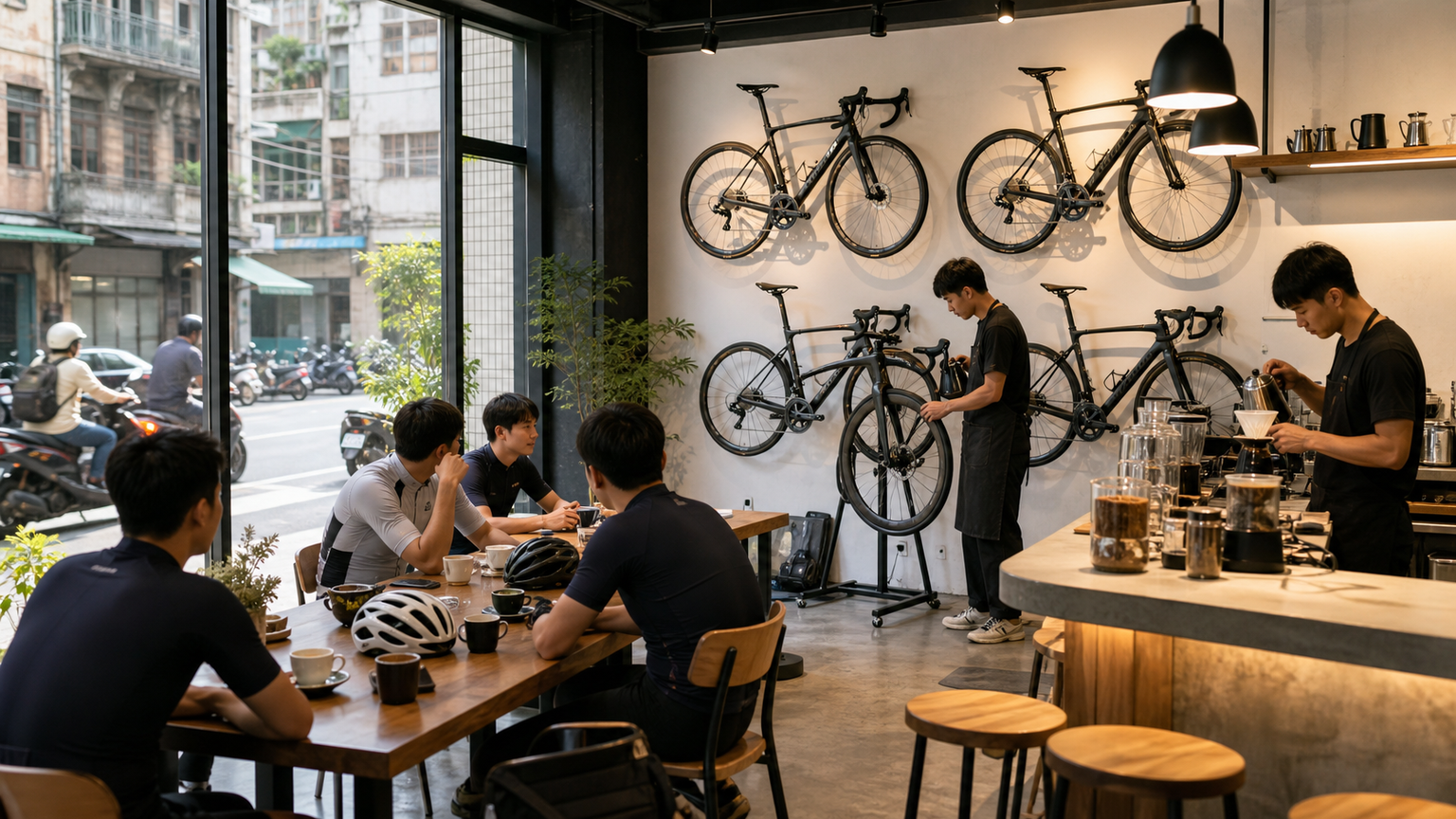
On Roosevelt Road in Taipei, a space that looks like a Nordic concept store makes many passersby stop in their tracks: behind the floor-to-ceiling windows, several top-tier road bikes hang neatly on white walls, a barista behind the counter is hand-pouring a single-origin Ethiopian coffee, and in the corner workstand, a mechanic is making final adjustments on a carbon fiber frame before completion. This is both a bike shop and a café, and even more so, a gathering place for the community.
This is the current face of Taiwan’s “bike café,” a unique cultural phenomenon that has grown from nothing to something, from the fringe to the mainstream, over the past decade.
The Era of Traditional Bike Shops
Before the 1990s, Taiwan’s “bicycle shops” were typical neighborhood service businesses—small storefronts crammed with spare parts, with an old master mechanic sitting at the door fixing grandma’s basket bike, occasionally greeting a customer who came in for a new inner tube. This model served practical needs; it had nothing to do with taste, and certainly no social function.
The turning point came between 2005 and 2008. With Giant and Merida’s achievements on the international racing scene, and the rise of local Taiwanese events like the KOM Challenge, a cohort of well-educated, affluent urban professionals threw themselves into road cycling with a passion. They didn’t just need a place to buy parts; they needed a “community.”
The Birth of the Bike Café
First Wave: Combining Coffee and Bike Repair
Around 2010–2014, Taipei saw the first batch of “bike shops that sold coffee.” The owners of these shops were usually hardcore cyclists themselves, well aware of how boring it was to wait for a repair. So they simply set up an espresso machine in the shop, making the waiting time for customers much more pleasant.
Merida brand stores in Taipei and several boutique bike shops in Taichung were the first to do this, and it quickly became a trend.
Second Wave: Design Consciousness and Curated Selections
After 2015, a group of entrepreneurs who had lived in Europe or Japan brought back more refined concepts. They combined their demands for quality coffee, their attention to spatial aesthetics, and their passion for bicycles, creating truly “hybrid experience spaces.”
| Old-School Bike Shop Traits | New-Generation Bike Café Traits |
|---|---|
| Cluttered parts displays | Curated, exhibition-style displays of select brands |
| Smell of machine oil | Aroma of coffee and leather |
| Mechanic fixes, customer waits | Open workstands, customers can learn |
| Buy and leave | Shared long tables, community gathering |
| Purely functional service | Experience + education + community |
Third Wave: Branding and Chain Expansion
After 2018, some bike cafés began consciously building their brands, launching their own merchandise (co-branded jerseys, reusable cups, curated goods), and even opening multiple branches. Taipei, Taichung, and Kaohsiung each developed several well-known “pilgrimage bike shops,” which became must-visit stops on the itineraries of cyclists from other counties visiting these Taiwanese cities.
The Community Function of Bike Cafés
The real value of these spaces isn’t just a cup of coffee or a repair service; it’s the community function they carry:
Regular Shop Rides: Departing from the shop’s doorstep on a fixed day each week, welcoming riders of all speeds, and ending back at the shop for coffee and shared stories. This is the most effective way to build a local riding community.
Technical Workshops: Inviting mechanics or veteran cyclists to explain bike fitting, tire changes, chain maintenance, and other technical knowledge, attracting newcomers and building foundational trust.
New Product Demo Rides: Partnering with brands to host demo days, giving cyclists hands-on riding experience before they make a purchase.
Women-Friendly Spaces: Many bike cafés place special emphasis on being welcoming to female riders, designing courses and events suitable for female beginners.
Types of Shops Worth Visiting in Taiwan
- Taipei East District Type: Curated boutique goods, Japanese-style aesthetics, perfect for a stop after shopping
- Taipei Xinyi Type: Close to bike paths, weekend shop rides draw big crowds
- Taichung Precision Engineering Type: Renowned for technical service, cyclists travel from other counties just to visit
- Kaohsiung Harbor Type: Blends harbor culture, a natural rest stop after riding along the sea views
- Yilan Countryside Type: A waypoint for touring cyclists, combining B&B-style lodging with bike shop services
Practical Tips
- Follow Instagram to find good shops: Most of Taiwan’s bike cafés are very active on IG, making it the fastest way to discover new places
- Join a shop ride to get to know the community: This lets you integrate into the local scene much faster than visiting alone
- Don’t just judge by the coffee: In a truly good bike shop, the quality of the mechanics is the core value
- Be patient at small shops: Good bike cafés usually don’t rush customers, but that also means they often have long lines
- Bring your questions with you: Good shop owners love answering all kinds of questions; this knowledge service is part of the brand
Conclusion
The rise of Taiwan’s bike cafés is a microcosm of the maturation of the entire cycling lifestyle culture. When cycling is no longer just a sport or a means of transportation, but becomes an expression of a way of life, people naturally need a space that can embody that lifestyle.
The transformation of bike shops from greasy repair garages into refined community hubs is not just a change in business model; it’s an entire generation of Taiwanese people finding a new way to connect with each other and define themselves. A cup of coffee, a bicycle—this is the contemporary interpretation of Taiwan’s bike shop culture.
Related Reading
- A Tour of Taiwan’s Bike Shop Culture: More Than Repairs, a Second Home for Cyclists
- Bike Café Culture: Riding Routes to Bike-Friendly Cafés Across Taiwan
- Coffee Ride Culture: The Union of Taiwan’s Cafés and Cycling Community
- Bike Coffee Culture: The New Trend of “Cyclist-Friendly Cafés” for Ride Refueling Across Taiwan
「悲情男車友」創作單曲 爆笑MV / 公路車 / CT Yeh / 4K劇情版
7 個月前
高雄綠園道鐵路自行車道 / 外地人能輕鬆駕馭 還是整路崩潰? / 2025 全線開通 春節實地探索一次!(附GPS連結)/ 公路車 / CT Yeh
1 年前
風櫃嘴 | 全台最多大砲的單車路線 | 尋寶網攝影師告訴你怎麼擺拍起來才好看 | 熱門攝影地點巡禮
6 年前
曜越單車旗艦館 開幕開箱! | 當電競魂注入單車! | 很多好料在裡面 | TIME TOMMASHINI MOOTS WAHOO GARMIN | 公路車 CT Yeh
4 年前
太平山單車員工旅遊 | 這樣玩CP值最高!| 公路車
5 年前
虎豹潭!日本老師來台一日約騎 台灣車友熱情招待私房路線 / CT Yeh
21 天前
#公路車 台北 #風櫃嘴 23:47 全台單車實境請訂閱鎖定
7 年前
JJSC南台灣單車走春三日行 DAY 1 / 強度 x 美食 x 節慶體驗 / 公路車 CT Yeh
5 個月前