Introduction
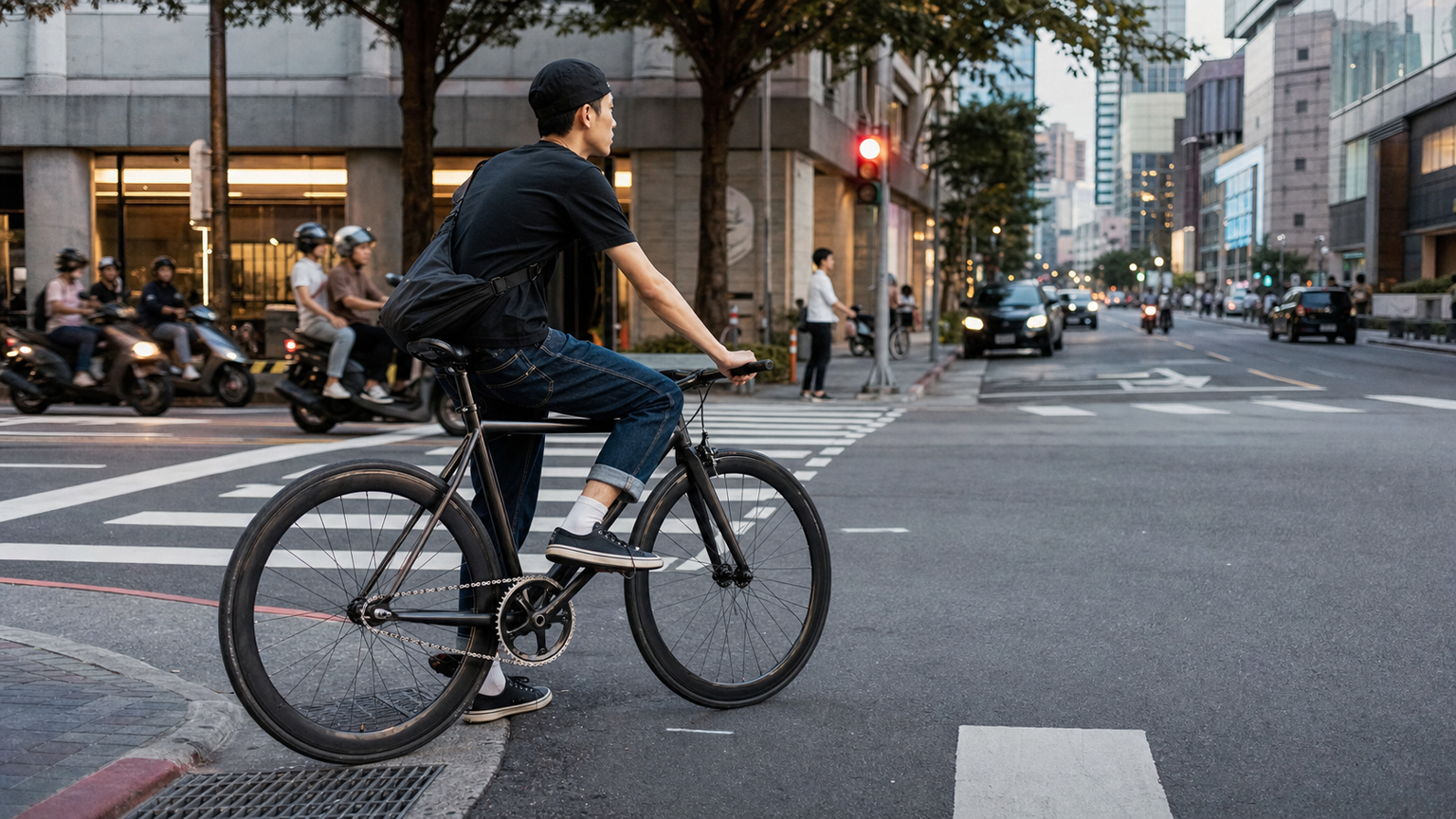
In the alleys of Taipei, you can occasionally spot a bicycle like this: so clean it almost looks like an icon—no shift levers, no extra cables, wheels often deep-section or full-disc, frames usually in a single saturated color, the rider wearing baggy pants or cropped jeans with canvas shoes, deftly pulling off a “Track Stand” before the red light, waiting quietly for it to turn green.
This is the world of Fixed Gear—a urban riding culture evolved from track racing bikes, carrying a strong anti-commercial, anti-mainstream ethos, yet forming an undeniable subcultural influence across global cities.
What is Fixed Gear?
The core concept of Fixed Gear is: the gear is directly fixed to the rear hub, so when the wheel turns, your feet must turn with it—there’s no freewheeling. This means:
- No coasting: If you stop pedaling, the bike slows down (your legs can act as a “brake”)
- Backpedaling possible: Pedaling backward slows the bike, and (with enough skill) even allows reversing in place
- Minimalist structure: No gear-shifting system, no freewheel mechanism—the entire drivetrain consists only of the essential chainring, chain, and rear cog
This design originally came from track cycling (Velodrome), where riders need precise speed control without relying on a freewheel mechanism.
The Origins of Fixed Gear Culture
In the 1980s–90s, New York City’s bike messenger culture was the starting point for Fixed Gear hitting the streets. Messengers discovered that track bikes offered several unique advantages in the city:
- Simple construction, low maintenance costs
- High drivetrain efficiency, immediate response to power input
- No freewheel on the rear, making precise speed control at busy intersections easier
The street aesthetic of messenger culture—worn-out backpacks, colorful waist packs, “Franken-bikes” assembled from discarded parts—gradually developed into a unique urban subculture, spreading through social media like Flickr and Tumblr in the 2000s to cities worldwide, including Taiwan.
Taiwan’s Fixed Gear Community
Taiwan’s Fixed Gear culture began to take shape around 2010, mainly concentrated in the two major cities of Taipei and Taichung.
Characteristics of Taiwan’s Fixed Gear Culture
A thriving DIY culture: Many Taiwanese Fixed Gear riders prefer to select their own parts and build their bikes rather than buying complete stock bikes. Part choices reflect personal aesthetics, giving each bike its own unique personality.
Deep-section wheel aesthetics: Deep-section rims (50mm and above) or even full-disc wheels are the most popular setup, visually clean and powerful while offering some aerodynamic advantage.
Trick culture: Some advanced riders are passionate about practicing various tricks, including:
- Track Stand: stationary balance
- Skid: locking the rear wheel to brake and leave skid marks
- No-hands steering (using body weight to control direction)
- Stunts like Wheelie / Endo
| Component | Entry-Level Choice | Advanced Choice | Price Gap |
|---|---|---|---|
| Frame | Taiwanese steel | Japanese Kalavinka / American Waterford | 3x or more |
| Wheelset | Standard aluminum rim | Deep-section carbon or full-disc | 5–10x |
| Chainring | Generic aluminum | Japanese Sugino / British Shimano Dura-Ace | 3–8x |
| Rear cog | Generic steel | Precision-machined aluminum alloy | 2–4x |
The Riding Philosophy of Fixed Gear
Part of the appeal of Fixed Gear culture comes from the way it forces a more direct connection between rider and machine:
Intuitive feedback: Every subtle movement of your feet is transmitted directly to the rear wheel, with no cushioning or delay. This immediacy makes the riding experience intensely “in the moment.”
Technical threshold: Beginners need time to adapt to the feeling of “the pedals moving your feet,” but once mastered, it produces a satisfying sense of “becoming one with the bike.”
Subtractive aesthetics: Removing all non-essential parts in pursuit of the purest functional form—this design philosophy echoes the aesthetics of minimalism.
Practical Advice
- Keep the brake when starting out: Many Fixed Gear bikes have a front brake installed; beginners are advised to keep it and only consider removing it once experienced
- Be conservative with gear ratio: Lower gear ratios (like 46/16 or 44/16) suit urban riding better than higher ratios, offering more agile acceleration
- Learn the Track Stand well: Being able to hold a stable standstill at red lights is the most basic skill for urban Fixed Gear riders; practice near a wall
- Check chain tension regularly: The chain on a Fixed Gear bike is more critical than on a geared bike; both slack and over-tightness pose safety risks
- Find Taiwan’s Fixed Gear community: Taipei has several Fixed Gear shop-ride communities—a great channel for learning tricks and exchanging information
Conclusion
Fixed Gear is not just a type of bicycle—it’s a declaration of a lifestyle attitude about the city, speed, and purity. In an increasingly complex modern life, it offers a conscious choice of “subtraction”—using the least machinery to feel the most direct joy of movement.
On Taipei’s streets and in Taichung’s alleys, whenever you spot that clean, characterful bike, take a second look—behind it is someone telling the city’s story on two wheels.
Related Reading
再快都跟的上!? 單車跟隨攝影機之王 HOVERAir X1 PROMAX 全面實測 / 唯一!8K畫質&自行車專用模式和跟蹤信標&前後避障 / DJI Neo 可參考/ 公路車 / CT Yeh
1 年前
再一組! 全碳幅條 碟煞/無內胎輪組 開箱! 到底好騎嗎? UNAAS X40 | 公路車 | CT Yeh
4 年前
下雨天就是要改車 #ceramicspeed #bike
1 年前
2023自行車展!與環台賽選手一同表演賽 / 全自動AI Fitting?/ TIME新車發表/神秘充電桌等 精華分享 VLOG | CT Yeh | 公路車
3 年前
「悲情男車友」創作單曲 爆笑MV / 公路車 / CT Yeh / 4K劇情版
7 個月前
CT 喇低賽) 單車 比賽總是沒照片? 攝影師的觀點大公開 姿勢就是力量! 請加速1.25倍收看
7 年前
#Canyon Aeroad 公路車 三年騎乘 #心得 | 出保方式 | 購買價格計算 | 同場加映累積三年大保養慘況
6 年前
高雄綠園道鐵路自行車道 / 外地人能輕鬆駕馭 還是整路崩潰? / 2025 全線開通 春節實地探索一次!(附GPS連結)/ 公路車 / CT Yeh
1 年前