Introduction
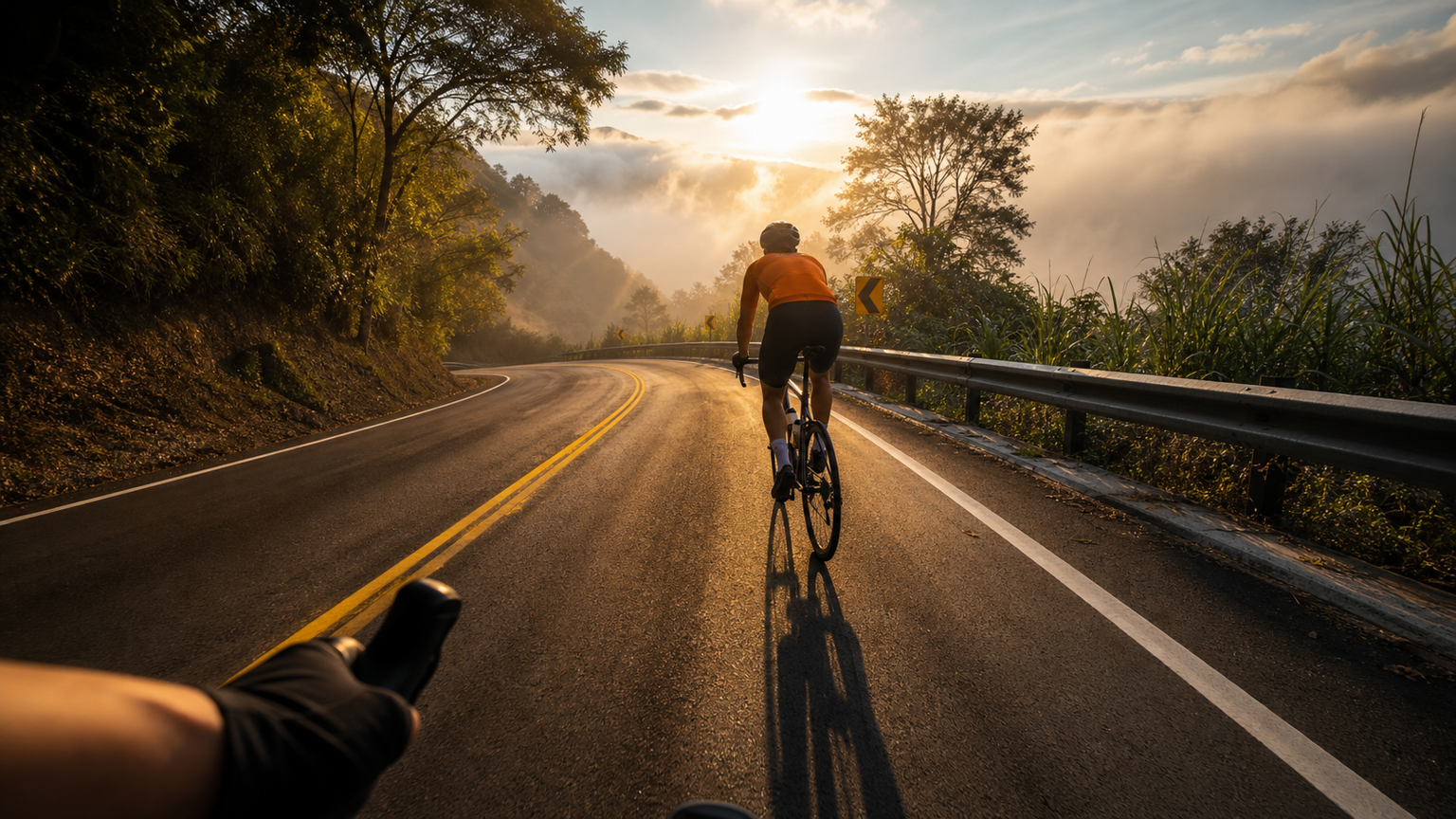
At 5:30 in the morning, the first light of day breaks through the clouds over Taipingshan Road. A golden beam cuts diagonally through the mist, striking the rider ahead. The rider wears an orange jersey and a dark helmet, and the bike’s shadow and the rider’s silhouette stretch long in the morning glow. This scene lasts only fifteen seconds before the angle of the light shifts and the magic disappears.
Being able to capture such a moment is what makes cycling photography so fascinating—and so challenging.
What Makes Cycling Photography Unique
Cycling photography differs from general landscape photography, presenting several core challenges:
- The photographer is also moving: You’re riding, and so is your subject. The relative speed between the two makes composition more complex
- Limited gear you can carry: You can’t bring a tripod or flash, and even the weight of your camera bag needs to be calculated
- The golden window is brief: Good light on mountain roads often lasts only a few minutes, so you must be in position early and react quickly
- Safety comes before shooting: You can’t neglect your attention on the road for the sake of a photo
Gear Selection: From Lightweight to Professional
Smartphones
For most people, phone photography is the most practical choice. The camera specs on modern flagship phones (iPhone 16 Pro Max, Samsung S25 Ultra) are already quite impressive, and they’re more than sufficient in bright daylight.
Tips for shooting from a bike with your phone:
- Use the volume button as the shutter—it’s more stable than tapping the screen
- Enable burst mode (press and hold the shutter) and pick the sharpest shot while moving
- Make good use of the ultra-wide lens (equivalent to 13–15mm), which is ideal for showcasing the sweeping vistas of mountain roads
- On Pro models, enable RAW format for significantly more editing flexibility
Action Cameras
Action cameras like GoPro and Insta360 are excellent tools for cycling photography, especially for capturing dynamic perspectives.
Mounting positions:
- Front of the helmet: a first-person perspective that shows what the rider sees
- Frame tubes (top tube/down tube): low-angle shots of the road and front wheel for a sense of speed
- Rear seatpost: captures fellow riders chasing from behind, great for group rides
- Extension pole (selfie stick): captures yourself framed against the background
Mirrorless Cameras
Riders seeking higher image quality can consider carrying a compact mirrorless camera. Lightweight models like the Sony ZV-E10 or Fujifilm X-T50, paired with a 23mm or 35mm prime lens, can keep the total weight under 500 grams.
It’s recommended to store the camera in a camera waist pack or top tube bag for easy access when stopped.
| Gear Type | Weight | Image Quality | Convenience | Best Use Case |
|---|---|---|---|---|
| Flagship phone | 200g | Excellent | Outstanding | Casual snapshots on daily rides |
| Action camera | 100–150g | Good | Outstanding | Dynamic angles, ride documentation |
| Compact mirrorless | 400–700g | Outstanding | Average | Dedicated photography rides |
| Full-frame DSLR | 1,000g and up | Best | Poor | Not recommended for bike rides |
Composition Techniques
Making the Most of Light
The golden hours (30 minutes after sunrise and 30 minutes before sunset) are the best times to shoot. Morning light on mountain roads is especially precious—the Tyndall effect (light beams piercing through mist) created by thin fog and side lighting is the most iconic sight in Taiwanese mountain-road photography.
The thin fog in high-mountain areas like Taipingshan, Wuling, and Lishan is a unique photographic resource; the sunset along the North Coast, paired with a rider’s silhouette, is also a classic composition.
Framing While in Motion
- Ultra-wide for enhanced perspective: Use a 10–16mm wide-angle lens at a low angle to capture winding mountain roads, emphasizing the depth of the road
- Backlit silhouettes: Position the rider in front of the light source to capture a crisp silhouette
- Road reflections: After rain, wet asphalt reflects the sky’s light, and combined with a rider, it becomes a striking visual element
- Tunnel exit composition: Shoot from inside a tunnel toward the opening—the strong contrast between light and shadow, with the rider emerging into the light, is dramatic
Taiwan’s Most Photogenic Riding Routes
- The Hehuanshan grasslands near Wuling: High-mountain meadows meeting the highway, grand and imposing
- The tree-lined section of Taipingshan Road: A light tunnel formed by the canopy
- The Jinzun section of Highway 11: A road along the cliffs of the Pacific
- Highway 61 (West Coast Expressway): Sunsets reflected over the industrial coastline, creating striking contrasts
- The rice-field routes from Jiaoxi to Luodong in Yilan: Changing with the seasons, a dialogue between greenery and mountains
Post-Processing Tips for Social Sharing
Shooting is only the first step; post-processing completes the work:
- Lightroom Mobile (the free version is sufficient): Adjust exposure, contrast, and tone
- Increase Clarity: Makes road textures and bike contours more defined
- Split toning: Push highlights toward warm tones (golden) and shadows toward cool tones (blue-green)—a common cinematic technique in mountain-road photography
- Preserve the natural haze: The mist on Taiwan’s mountain roads is a feature, so don’t over-sharpen
Practical Advice
- Research the sunrise direction in advance: Use the PhotoPills app to confirm the sunrise position and angle for your shooting date
- Spare batteries are essential: Cold environments (high mountains) drastically shorten battery life
- Never sacrifice safety for a photo: Absolutely no shooting on descents; stopping to shoot is better than shooting on impulse
- Join cycling photography communities: Groups like Cycling Taiwan Photography are great places to exchange inspiration
- Shooting fellow riders brings more life than shooting scenery alone: People in the frame provide a sense of scale and give the photo a story
Conclusion
Cycling photography gives riding another layer of meaning—not just passing through, but observing; not just moving, but documenting. Taiwan’s mountains and seas, its mist and light—every ride holds moments waiting to be captured.
Bring your camera, and let your next ride into the mountains also become a visual adventure.
Related Reading
- Cycling Photography Tips: How to Capture Beautiful Taiwanese Landscapes While Riding
- Instagram Cycling Photography: Framing and Gear Tips for Great Shots While Riding
- Cycling Photography for Beginners: Composition Tips for Capturing Scenery with Your Phone on Rides
- Cycling Photography: Techniques for Shooting While Riding and Taiwan’s Most Beautiful Routes
CT 喇低賽) 單車 比賽總是沒照片? 攝影師的觀點大公開 姿勢就是力量! 請加速1.25倍收看
7 年前
太平山單車員工旅遊 | 這樣玩CP值最高!| 公路車
5 年前
再快都跟的上!? 單車跟隨攝影機之王 HOVERAir X1 PROMAX 全面實測 / 唯一!8K畫質&自行車專用模式和跟蹤信標&前後避障 / DJI Neo 可參考/ 公路車 / CT Yeh
1 年前
西進武嶺最新路況場勘,台14到清境,還適合騎單車上去嗎?/ 居然有這優勢!?/請開啟字幕/當天現剪/公路車/CT Yeh
2 年前
新玉門關 單車挑戰賽 多視角主集團衝刺菁華版 4K #公路車
5 年前
DJI Osmo Action 6 / 單車運動拍攝實用技巧 公路車 CT Yeh
7 個月前
多機位拍片神器 DJI Action 2 拍出速度張力感 | 類空拍機視角 4陣列麥克風超強降風噪 實測! | 公路車 | CT Yeh
3 年前
實錄) 車隊中 攝影師 是如何用感情拍片的呢? 單車 移動攝影 攝影師的視角 米粉坡 手持 DJI OSMO POCKET Ft. Team Neko
7 年前