Introduction
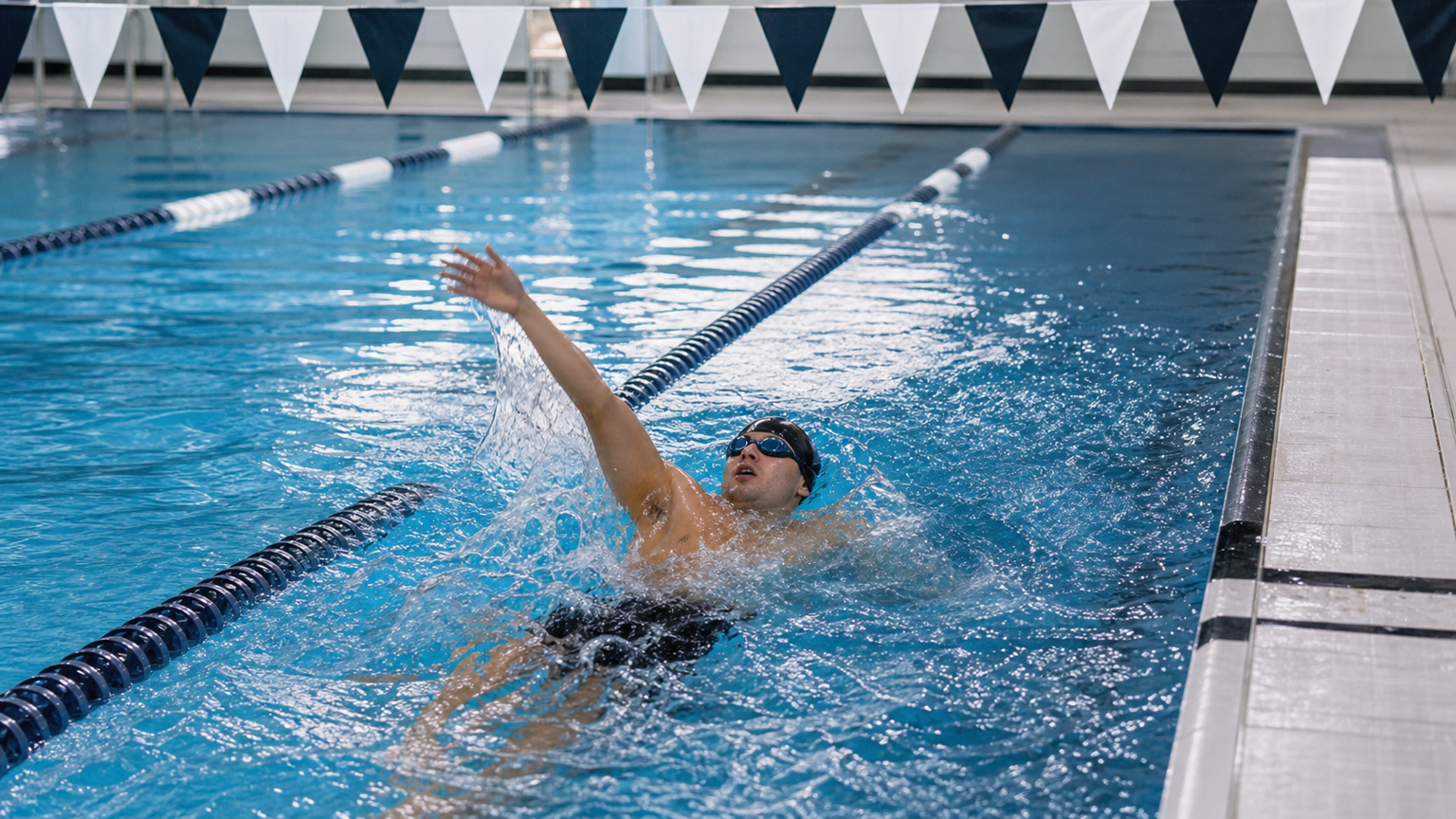
Backstroke is the only one of the four competitive swimming strokes performed on the back, so swimmers cannot see the wall directly as they approach it. They must rely on suspended backstroke flags as a distance reference. The flags hang 5 meters from each end wall. After passing under the flags, swimmers use their individual stroke length to calculate how many strokes they need to reach the wall, then decide when to initiate the flip turn. This skill requires repeated practice to build stable muscle memory. This article systematically covers the complete process from flag counting to flipping and planting on the wall.
Flag Counting System: Find Your Stroke Count
Because each swimmer differs in height, stroke length, and tempo, the number of strokes needed from the flags to the wall also varies. Beginners need to confirm their “post-flag stroke count” through repeated testing.
Testing method:
- Swim backstroke toward the wall at your normal speed and rhythm
- The moment you pass under the flags, start silently counting strokes (one-arm or two-arm counts both work, but stay consistent)
- Record the stroke count at the moment of touch, repeat 5–10 times, and take the average
- Test stroke counts at different speeds (fast swimming and slow swimming may differ)
| Swimmer type | Approx. single-arm strokes after flags | Notes |
|---|---|---|
| Youth/Beginner | 5–7 strokes | Shorter stroke length |
| Intermediate adult | 4–5 strokes | Medium stroke length |
| Advanced adult | 3–4 strokes | Longer stroke length |
It is recommended to record your baseline numbers in a training log and re-confirm them at the start of each training season, since fitness and stroke length change with training.
Flip Timing: When to Roll Over
Once your stroke count is confirmed, initiate the flip turn as you begin the pull of your final stroke. Specifically:
- After your last stroke (say, the right arm) enters the water, begin rolling to your right side
- Tuck your chin as you roll, quickly rotating your body from back to front
- During the rotation, whip your feet upward, ready to plant them on the wall
- Plant, push off, streamline, then surface after underwater dolphin kicks
Common mistakes:
- Flipping too early: your legs are nearly straight when your feet hit the wall, making the push-off weak
- Flipping too late: your feet miss the wall or your head hits first
- Incomplete rotation: you push off while still on your side, losing significant power
How to adjust timing: if your legs are too straight, you flipped too early—swim one more stroke before flipping next time; if you miss the wall, you flipped too late—start the flip one stroke earlier.
Rules Check: Body Position in the Backstroke Turn
World Aquatics rules state that backstroke swimmers may only rotate to a prone position after the last arm stroke has begun before touching the wall. In other words, swimmers may first roll to a prone position and then use a freestyle-style flip turn, as long as the rotation is completed continuously after the final arm pull begins. This makes the backstroke turn technically very similar to the freestyle turn, with the only difference being the body position before reaching the wall.
A compliant backstroke flip turn sequence:
- Count down your strokes after the flags
- On the final stroke, actively roll toward your dominant side (rotating from back to front)
- Once prone, immediately perform the freestyle flip to bring your feet to the wall
- Plant both feet, push off, streamline, and follow with underwater dolphin kicks
Practical Tips
- Count consistently in training: Whether it’s an easy swim or interval training, count your strokes after the flags every time you approach the wall, making counting an automatic habit.
- Test at different speeds separately: Stroke count may differ by one stroke between an easy 400m pace and an all-out 50m sprint, so record them separately.
- Practice flipping with your eyes closed: Under the supervision of a coach or a friend, practice feeling the flip timing with your eyes closed to enhance body awareness rather than relying on visual confirmation.
- Make full use of underwater dolphin kicks after the turn: Backstroke rules allow dolphin kicks after the turn. Practice 3–5 rhythmically stable dolphin kicks before surfacing—it’s faster than surfacing immediately.
Conclusion
The backstroke flip turn requires precise counting habits and body awareness, not special athletic talent. As long as you consciously practice counting in every training session and periodically test to confirm your stroke baseline, most swimmers can establish a stable turn rhythm within 2–4 weeks. This seemingly minor detail can accumulate into a significant time difference across multiple turns in a 200m backstroke race.
Related Reading
- Backstroke Race Strategy: Turn Counting, Turn Technique, and Sprinting
- Backstroke Technique Essentials: Rotation Axis and Stroke Efficiency Guide
- Core Backstroke Technique: The Triangular Relationship Between Body Roll, Straight-Arm Entry, and Steady Kicking
- Backstroke Stroke Rhythm and Shoulder Rotation: The Overlooked Efficiency Code
CT 喇低賽) 武嶺牽車 才是王道 西進牽車四小時內秘訣 攝手位置 如何判斷 防抽筋小秘訣
7 年前
下次拍照前要查清楚啦🤣 #cycling
7 個月前
西進武嶺 自製新版AI配速表產生器 x 賽前攻略 抱佛腳! 沒有功率計也可以產生配速表嗎?有什麼其他眉角賽前要注意的呢? | 西進武嶺 / 東進武嶺 KOM 攻略 | 公路車 | CT Yeh
4 年前
戰略) Zwift Race 如何咬在第一集團 如何評估自己要開多少推力 (請開1.5倍速看)
7 年前
如何把 GoPro 影片 翻轉 批次 轉正?
6 年前
抖肩舞 台灣x日本交流版 (台灣 vs 前橋) 赤城山登山賽 coincidance
8 年前
[教學] Premiere 影片 手震 修正 教學 防抖 單眼 影像 GoPro 穩定 Video Stabilization
8 年前
Insta 360 One 超級防手震技術實測
7 年前