Introduction
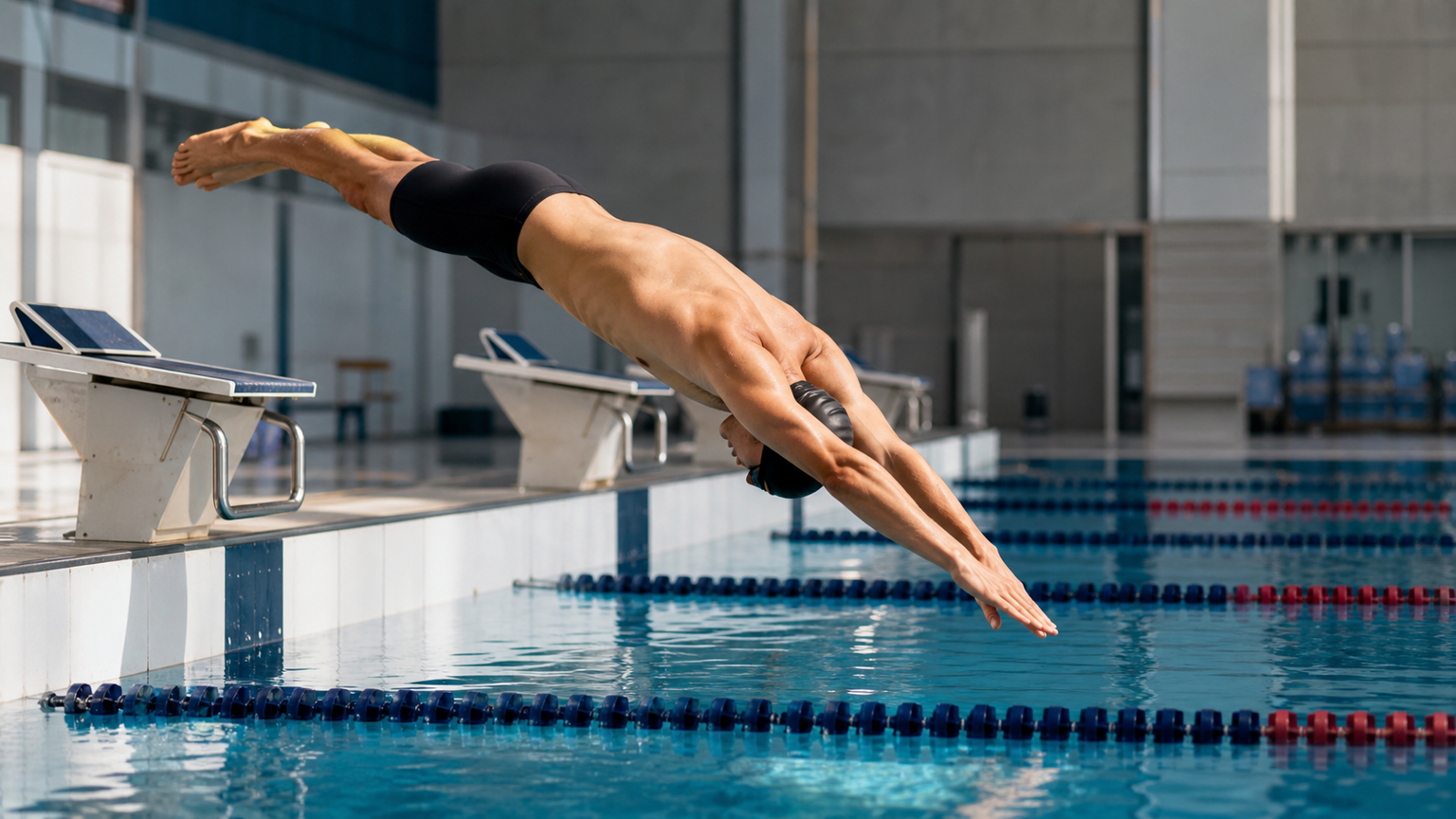
Many athletes focus on practicing explosive leg drive off the block, yet overlook that body position in the air and entry angle after takeoff are equally critical. An ideal start should allow the swimmer to enter the water with minimal resistance and achieve the longest underwater glide distance. An entry angle that is too steep (nearly vertical) drives the body straight into deep water, wasting momentum; an angle that is too shallow (nearly parallel to the surface) causes the stomach or legs to slap the water over a large area, generating enormous drag. This article analyzes the optimal start trajectory from a mechanical perspective and provides technical adjustments that can be applied immediately.
The Mechanics of the Optimal Start Angle
According to fluid dynamics and competitive swimming research, the ideal entry angle is approximately 30–40 degrees below the water surface (relative to the horizontal plane). This angle allows the swimmer to slice into the water with minimal frontal resistance while retaining sufficient horizontal velocity for the underwater glide.
The flight arc of the start is determined by the following factors:
- Takeoff angle: The direction of the body’s center of mass tilt at takeoff determines the flight trajectory
- Arm extension angle: The angle at which the hands point toward the water affects the entry point and entry angle
- Head position: Lowering the head (chin tucked to chest) makes the body arc steeper; lifting the head makes the trajectory flatter
Effects of different entry angles:
| Entry Angle | Underwater Depth | Drag | Suitable Scenario |
|---|---|---|---|
| < 25 degrees | Shallower | Large surface slap | Not recommended |
| 30–40 degrees | Moderate | Minimal | Standard competition |
| > 50 degrees | Too deep | Energy loss on turning | Not recommended |
Body Position: The Complete Arc from Takeoff to Entry
In a good start, the body should form a smooth arc in the air, with the toes, hips, hands, and fingertips all slicing into the same entry point (or very close to it) in sequence. This is known as “Entry Through the Same Hole.”
Complete movement sequence:
- After takeoff, extend the arms forward quickly, tuck the head between the arms, and keep the eyes focused on the entry point
- Keep the upper body streamlined, tighten the lower back, and avoid excessive arching of the waist
- Dorsiflex the ankles (pull the toes toward the shins) so the soles of the feet become the last part to slice into the water
- At the moment of entry, tighten the entire body simultaneously, with the palms tilted slightly upward to allow the body to continue gliding downward
- Immediately initiate underwater dolphin kicks after entry—do not let speed dissipate needlessly
Common Mistakes and Corrections
Mistake 1: Lifting the head at entry
This is usually caused by the swimmer trying to see the entry point or a nervous reaction. Lifting the head causes the hips to drop, resulting in a stomach slap. The correction is to keep the eyes looking at the water surface ahead of the block after takeoff, and only let the head follow naturally after the hands enter the water.
Mistake 2: Bending at the waist (banana-shaped entry)
Common among athletes with insufficient core strength. Arching the waist causes the stomach to enter the water first, generating enormous drag. The correction is to strengthen core training while deliberately pulling in the abdomen at takeoff so the body forms a straight line.
Mistake 3: Toes not pointed
If the toes spread or the ankles are relaxed after entry, the surface area of the legs slapping the water increases. The ankles should be locked tight while still in the air, allowing the top of the feet to be the final streamlined surface to enter.
Mistake 4: Hands separating after entry
At the moment of entry, the hands should remain stacked (or interlocked) to maintain a tapered cone shape, allowing the body to continue penetrating through the water. If the hands separate too early, drag increases sharply.
Practical Recommendations
- Use video analysis of entry trajectory: Have someone film from the side of the pool (above the water) and underwater (if conditions allow) to clearly see the flight arc and entry angle.
- Dry-land pillow drills: Stand beside a soft mat and practice the start jump movement, observing the hand entry angle and body arc.
- Underwater floating simulation: Practice streamlined gliding in the water to confirm whether the body position is truly in a straight line, helping you feel the drag differences after entry.
- Split timing: Measure the time and distance from the start signal until the head surfaces, objectively comparing the effectiveness of different start positions.
Conclusion
Start angle and entry technique are details within details, but in high-level competition, every 0.1–0.3 seconds saved on a start can change the final ranking. Through systematic analysis and deliberate practice, even amateur athletes can significantly improve start efficiency, gaining an advantage from the very beginning of every race.
Related Reading
- Swimming Start Entry Angle: Optimal Start Strategies for Different Distance Events
- Swimming Start Entry Angle Too Steep: Correcting Energy Loss from Splash
- Block Start vs. In-Water Start: Technical Choices and Competition Rules Explained
- The Science of Swimming Starts: Optimizing Takeoff Reaction Time and Entry Angle
CT 喇低賽) 武嶺牽車 才是王道 西進牽車四小時內秘訣 攝手位置 如何判斷 防抽筋小秘訣
7 年前
滑雪新手們慘摔學習全紀錄(請開字幕),滑雪好好玩 | Snowboard + Ski | 岩原 スキー場 | 滑雪APP使用 | GoPro Max
6 年前
戰略) Zwift Race 如何咬在第一集團 如何評估自己要開多少推力 (請開1.5倍速看)
7 年前
[教學] Premiere 影片 手震 修正 教學 防抖 單眼 影像 GoPro 穩定 Video Stabilization
8 年前
一日北高/長距離團騎 常見問題補充篇 / 組團或跟團的眉角 / 壯車友容易被瘦車友慢性拉爆 / 原來屁股痛可能是這個原因...? / 風場配速法 / 公路車 / CT Yeh
2 年前
單車 梅山36灣 坡度介紹 路段介紹 空拍 (相關遊記影片,請參考說明或我的頻道喔,歡迎訂閱)
6 年前
下次拍照前要查清楚啦🤣 #cycling
7 個月前
#PUSHBIKE 原來這麼好玩! 小朋友 滑步車 初體驗 超可愛
6 年前