Introduction
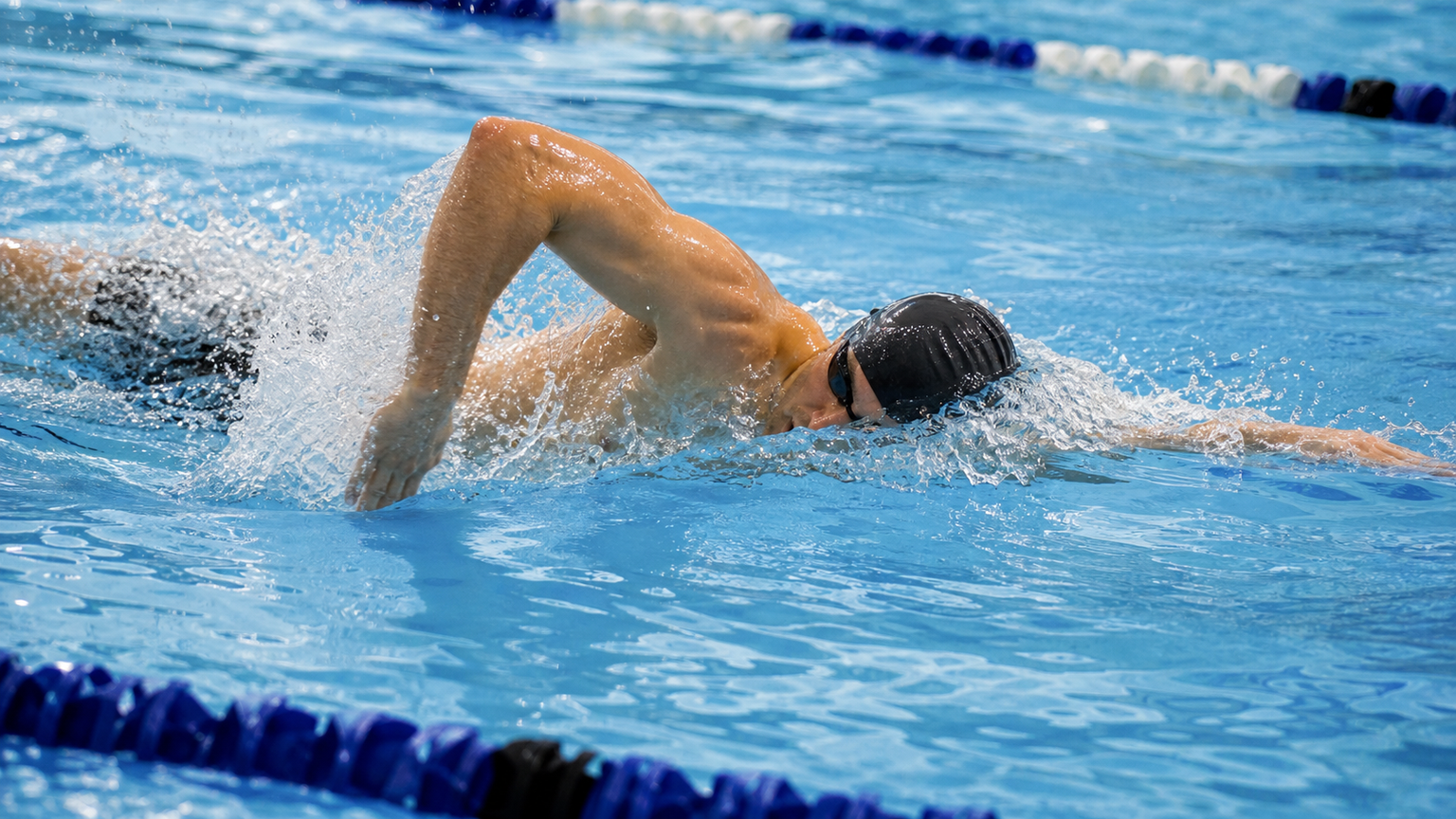
Among all the technical elements of freestyle, the High Elbow Catch (also known as Early Vertical Forearm, EVF) is regarded by most coaches as the single most critical technique. Its core concept is: after the hand enters the water and extends forward, the elbow stays high (near the water surface), allowing the forearm and hand to become perpendicular to the direction of travel as early as possible, thereby creating the maximum “pulling surface area.” In contrast, a dropped-elbow pulling style wastes most of the force pushing downward instead of backward, significantly reducing propulsion efficiency. This article will break down every phase of the high elbow catch in full detail.
Entry and Extension: Preparing for the Catch
The success of the high elbow catch is determined from the very moment the hand enters the water. A proper entry includes the following key points:
Entry Position: The hand should enter the water along the line of the shoulder, roughly directly in front of the same-side shoulder. Avoid entering too close to the body’s midline (cross-over entry), and avoid entering too far outward (wider than shoulder width).
Entry Angle: Enter with the thumb side first (slight outward rotation of the hand), allowing the arm to slice into the water with low resistance and reducing entry impact.
Extension (Catch-Up Concept): After entry, the arm continues to extend forward until nearly fully straight, while the shoulder stretches forward to increase the effective distance of each stroke.
The Catch: The Secret to Keeping the Elbow High
The catch is the core phase of the high elbow pull. After extension ends, instead of pulling the hand straight back, you should:
- Begin bending the elbow while keeping its height unchanged (or even rising)
- Rotate the forearm downward so the hand and forearm face the opposite direction of travel (i.e., backward) as quickly as possible
- Form a “vertical forearm” catching surface
This movement feels similar to “hanging the elbow high and pulling with the forearm.” Imagine the water as a wall—you push this wall with your forearm while the elbow stays still and the forearm rotates backward.
High Elbow vs. Low Elbow Comparison:
| Technique | Pulling Surface Area | Propulsion Efficiency | Shoulder Joint Stress |
|---|---|---|---|
| High Elbow Catch | Large (forearm + hand) | High | Moderate |
| Low Elbow Pull | Small (mainly the hand) | Low | Lower |
Pull and Push: Releasing Full Power
After completing the catch, you enter the pull and push phases:
Pull: The elbow remains bent at approximately 90 degrees. The forearm continues accelerating backward from its vertical position while the upper arm also begins pulling back, with the core rotating in coordination. The hand path is a slightly inward-curving S-shape (in reality, it is closer to a straight line; the S-shape is an outdated concept from earlier times).
Push: The arm continues pushing backward from the shoulder position until the hand passes the outside of the thigh, with the elbow straightening. This is the final acceleration phase of the stroke. Many swimmers end the push prematurely, wasting valuable power.
Exit: Exit the water with the pinky side first, relax the arm, and move it quickly above the water surface back to the entry position, completing one stroke cycle.
Practical Tips
- Practice the catch in front of a mirror: Stand before a mirror with your arm extended at shoulder height, then practice bending only the elbow while keeping its height unchanged, feeling the forearm rotating backward.
- Single-arm drill with a kickboard: Hold a kickboard with one hand and pull with only the other arm, focusing on feeling the resistance during the catch.
- Slow swimming: Swim freestyle at an extremely slow pace, deliberately feeling the direction of the forearm at every catch moment, confirming that the forearm faces backward during the catch.
- Avoid the “glide” habit: Gliding means pausing with the hand extended forward. Although it looks graceful, it disrupts continuous propulsion. Maintain a smooth stroke rhythm and minimize unnecessary pauses.
Conclusion
The high elbow catch is a technique that requires deliberate practice to build muscle memory, as it is not a natural movement pattern of the human body. It is recommended to include at least one technical set in every training session (e.g., 4×50 meters of slow technique swimming) to specifically feel and reinforce this movement. Once you master the high elbow catch, you will find that the same effort drives faster swimming speeds—a direct reflection of improved technical efficiency.
Related Reading
- Freestyle High Elbow Catch Fully Explained: The Mechanics from Entry to Push
- Freestyle High Elbow Pull: The Core Key to Feel for the Water
- The “High Elbow Entry” Technique in Freestyle Pulling: How Elbow Angle Affects Push Efficiency
- Freestyle Pulling Technique: A Modern Perspective on High Elbow Entry and the S-Shaped Pull
CT 喇低賽) 武嶺牽車 才是王道 西進牽車四小時內秘訣 攝手位置 如何判斷 防抽筋小秘訣
7 年前
西進武嶺 自製新版AI配速表產生器 x 賽前攻略 抱佛腳! 沒有功率計也可以產生配速表嗎?有什麼其他眉角賽前要注意的呢? | 西進武嶺 / 東進武嶺 KOM 攻略 | 公路車 | CT Yeh
4 年前
戰略) Zwift Race 如何咬在第一集團 如何評估自己要開多少推力 (請開1.5倍速看)
7 年前
單車高張力拍攝神器 Antigravity A1 全景空拍機! / CT Yeh
1 個月前
西進武嶺 免費訓練分析服務 Intervals | 練不夠還是練過頭?你哪一種類型選手?AI模型告訴你! | 備戰神器 | 公路車 訓練 | CT Yeh
4 年前
多機位拍片神器 DJI Action 2 拍出速度張力感 | 類空拍機視角 4陣列麥克風超強降風噪 實測! | 公路車 | CT Yeh
3 年前
DJI Osmo Action 6 / 單車運動拍攝實用技巧 公路車 CT Yeh
7 個月前
抖肩舞 台灣x日本交流版 (台灣 vs 前橋) 赤城山登山賽 coincidance
8 年前