Introduction
Butterfly is widely recognized as the most difficult swimming stroke. It demands not only powerful upper-body and core strength, but also precise arm-leg coordination timing. Butterfly propulsion comes from two sources: the pulling force of the arms and the dolphin kick of the legs. When the two are properly coordinated, the body forms a natural wave, and the swimmer feels “pushed along by the water.” When coordination breaks down, speed drops and energy expenditure rises sharply. This article systematically explains the core concepts and training methods of butterfly coordination.
The Two-Kick Rhythm of Butterfly: First Kick and Second Kick
Each full arm-stroke cycle in butterfly includes two dolphin kicks, occurring at different moments with different functions:
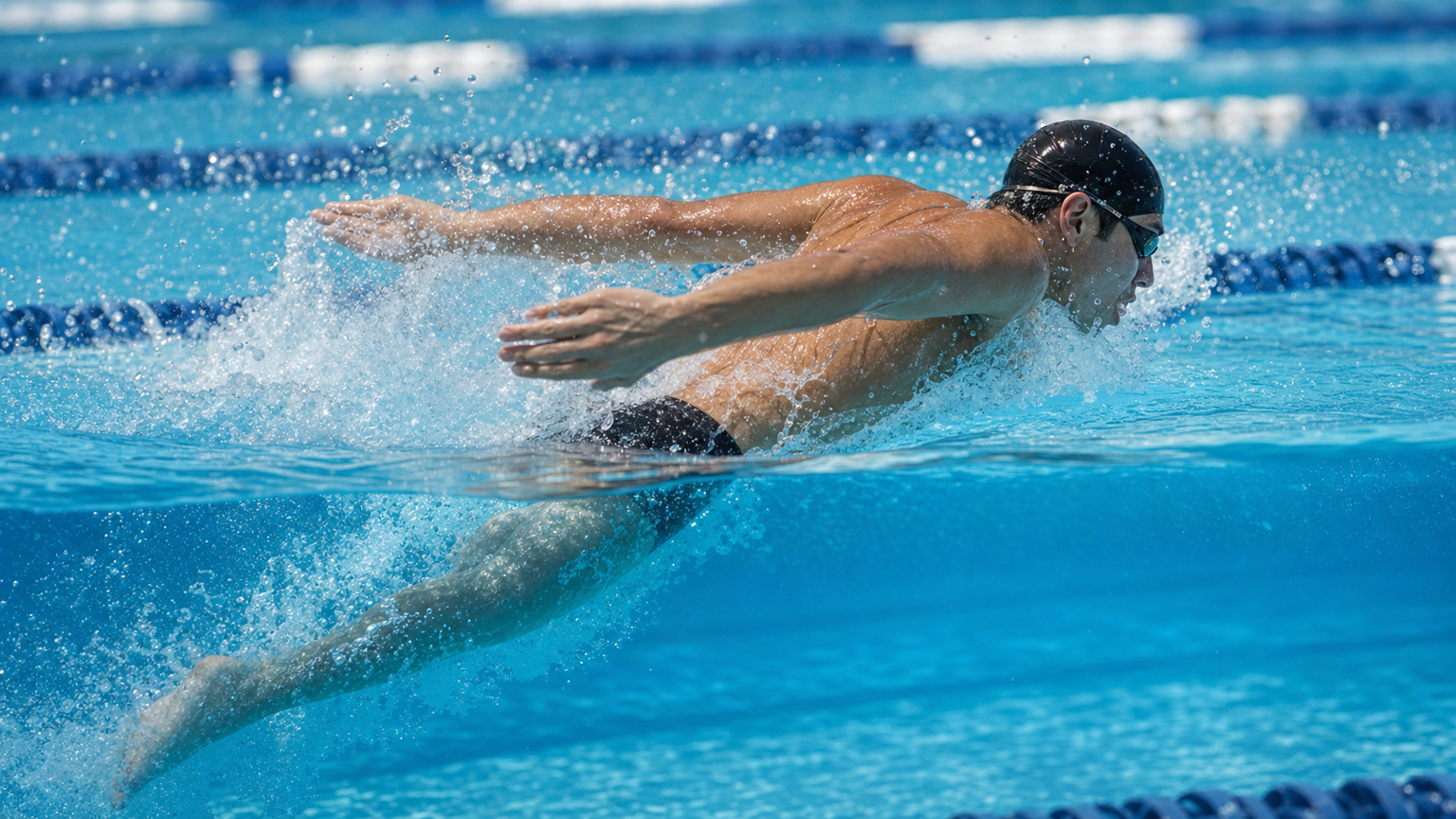
First Kick: Occurs as the arms enter the water and extend forward. At this point, both hands reach forward, the upper body tilts slightly downward, and the hips press down to drive the first kick. The main purpose of this kick is to help the body penetrate the water surface and maintain forward momentum.
Second Kick: Occurs during the pull and push phase after the catch (roughly when the palms reach beneath the chest). This kick is the primary propulsive kick, generating more power and, combined with the arm push, producing the greatest acceleration moment in butterfly.
| Kick Timing | Arm Position | Function | Power |
|---|---|---|---|
| First Kick | Entry and extension | Water penetration | Smaller |
| Second Kick | Push phase | Primary propulsion | Larger |
The Correct Feel of the Body Wave
The butterfly body wave is not a “hip twist” but a wave transmitted downward from the chest. The correct movement feel is: the chest presses down into the water, driving the hips up, then driving the legs down to kick; then the chest lifts, the hips sink, and the legs naturally rebound upward.
One drill that helps build this feel is the “vertical dolphin kick”:
- Stand vertically in deep water, performing only dolphin kicks while keeping the body at the surface
- Feel how the up-and-down motion of the hips drives the legs
- Confirm that the power comes from the hips and lower back, not just from the lower legs
Coordination Training Sequence
Build butterfly coordination by practicing in the following order:
Phase 1—Isolated Leg Training
- Flutter-board dolphin kick (prone, holding the board with both hands)
- Side dolphin kick (lying on your side, holding the board with one hand)
- Back dolphin kick (the clearest way to feel the hip-driven motion)
Phase 2—Basic Arm-Leg Coordination
- Single-arm butterfly: one arm pulls while the other rests at the side or extends forward, matching the leg kick rhythm
- 3-3-3 drill: right arm pulls 3 times, left arm pulls 3 times, both arms pull 3 times, repeat in a cycle
Phase 3—Full Butterfly Integration
- Swim butterfly at a slow pace, deliberately feeling the timing of the first and second kicks
- Gradually increase speed while maintaining coordination
Breathing and Rhythm Integration
In butterfly, breathing typically occurs at the end of the second kick, as the arms exit the water and recover forward—this is the natural moment for the head to lift. Common breathing frequencies are breathing every stroke (suitable for longer distances) or every two strokes (suitable for sprinting and faster tempos).
Practical Tips
- Start with slow, aerobic butterfly: Don’t go all-out from the beginning. Swimming slowly makes it easier to feel the coordination and allows you to cover longer distances.
- Use a pull buoy for assistance: First swim only butterfly kick to stabilize the leg rhythm, then add the arm motion.
- Film yourself for comparison: Shoot video of your butterfly from the side to confirm that your body forms a wave rather than bouncing up and down violently.
- Avoid “over-kicking”: Excessively large kicks cause deceleration. Aim for “effective, compact kicks” rather than a showy, wide-amplitude kick.
Conclusion
Butterfly coordination is not achieved overnight; it requires repeated breakdown drills and integration. It is recommended to include 200–400 meters of butterfly technique work in each session, prioritizing the feel of coordination over speed. Once the movement rhythm is truly internalized, butterfly becomes an enjoyable, rhythmic experience rather than a physical ordeal.
Related Reading
- Butterfly Wave Motion: Chest and Hip Rise-and-Fall Coordination Training
- Butterfly Dolphin Kick Wave Rhythm: Coordinated Chain Movement from the Lumbar Spine to the Ankles
- Butterfly Wave Motion: Hip-Driven and Arm-Synchronized Coordination Training
- Butterfly No Longer a Nightmare: A Scientific Breakdown of the Dolphin Wave, Two-Beat Kick, and Energy-Saving Rhythm
海豚島滑沙
11 年前
一起升級!海鷗盃LSD團練...JJSC Zone2招待 騎到手抖 / 公路車 / CT Yeh
1 天前
[教學] Premiere 影片 手震 修正 教學 防抖 單眼 影像 GoPro 穩定 Video Stabilization
8 年前
CT 喇低賽) 武嶺牽車 才是王道 西進牽車四小時內秘訣 攝手位置 如何判斷 防抽筋小秘訣
7 年前
抖肩舞 台灣x日本交流版 (台灣 vs 前橋) 赤城山登山賽 coincidance
8 年前
風櫃嘴 衝刺慢動作回放!
8 年前
西進武嶺 免費訓練分析服務 Intervals | 練不夠還是練過頭?你哪一種類型選手?AI模型告訴你! | 備戰神器 | 公路車 訓練 | CT Yeh
4 年前
2023桃園團體繞圈賽 / 海鷗繞圈賽 | 全程空拍數據版 | 公路車 | CT Yeh
2 年前