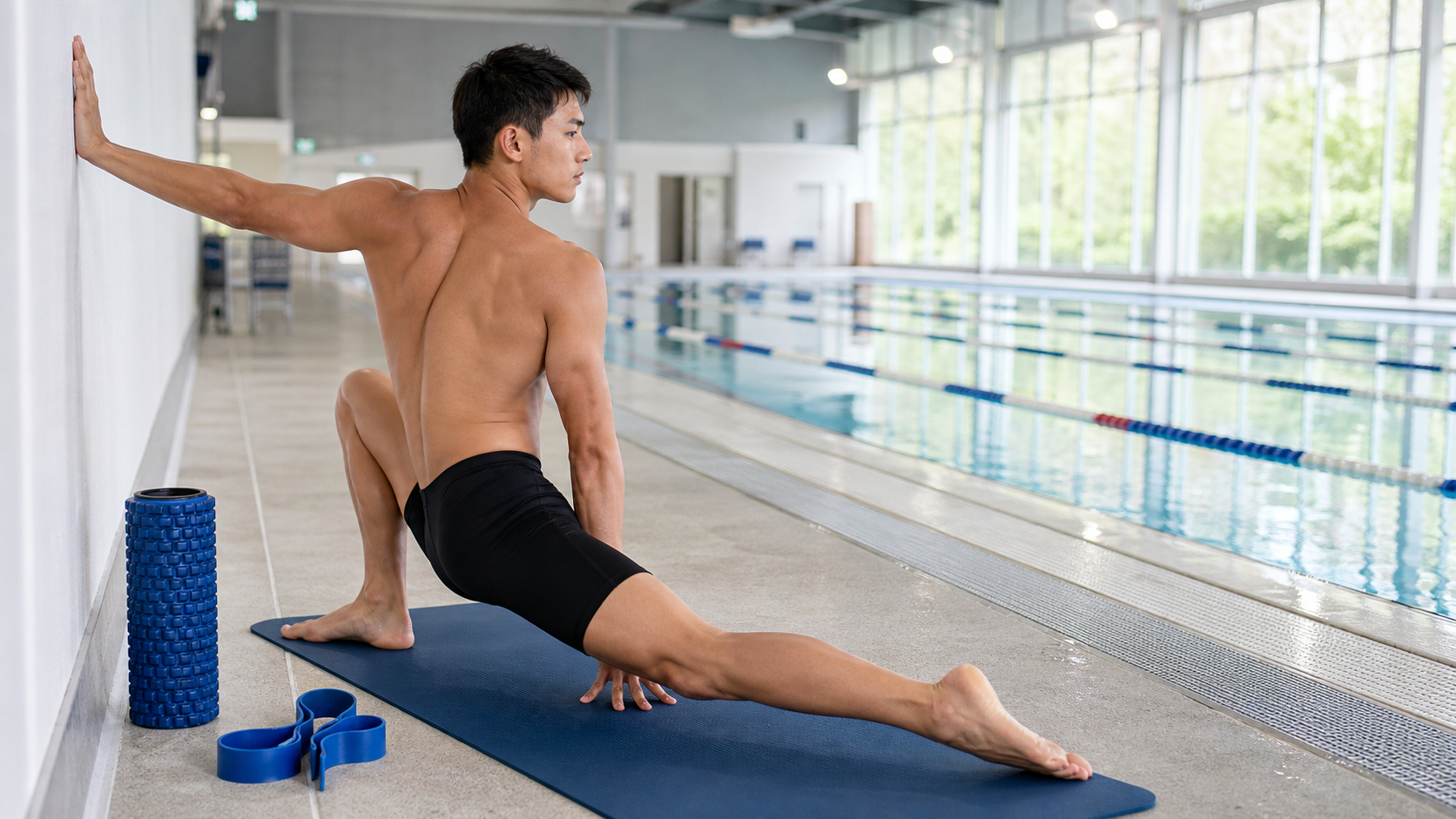
Introduction
Behind the fluid movements of elite swimmers lies a frequently overlooked foundation: excellent joint mobility. If the ankle joint cannot achieve sufficient plantar flexion (pointing the toes downward), kicking efficiency drops significantly; if thoracic spine mobility is restricted, the rotation for freestyle side-breathing will be compensated by the lower back, increasing injury risk; if shoulder flexibility is insufficient, maintaining the high-elbow position during the pull becomes difficult. The mobility of these three areas directly determines the ceiling of technical training.
Ankle Joint Plantar Flexion Mobility
Why It Matters
Freestyle kicking primarily relies on the top of the foot (not the sole) to push water, requiring the ankle to achieve full plantar flexion to approximately 150–160 degrees. If the ankle is stiff and the toes cannot be pointed, water resistance increases during kicking, propulsion decreases, and the entire lower body may even sink.
Assessment Method
- Sit on the floor with legs extended and ankles relaxed; observe whether the toes naturally drop beyond 90 degrees
- If the toe angle is close to vertical (90 degrees), ankle plantar flexion mobility is insufficient
Corrective Exercises
| Exercise | Method | Frequency |
|---|---|---|
| Kneeling Ankle Stretch | Kneel with feet extended, lean the body backward, and feel the stretch in the front of the ankle | Daily, 3×30 seconds |
| Ankle Circles | Seated, actively draw large circles with the ankle, 15 circles in each direction | Daily, before warm-up |
| Resistance Band-Assisted Plantar Flexion | Place a resistance band around the ankle to assist active plantar flexion and hold | 3×10, slow |
| Foam Rolling the Posterior Lower Leg | Roll for 60 seconds to relax the gastrocnemius and soleus muscles | Before and after each training session |
Shoulder Joint Mobility
Why It Matters
Swimming strokes require the shoulder joint to transition smoothly between flexion (arm reaching overhead), external rotation (high-elbow position), and internal rotation (pressing the water). Among these, external rotation and horizontal abduction mobility are especially critical: if external rotation is insufficient, the high-elbow catch cannot be achieved, reducing stroke efficiency; if internal rotation is excessive while external rotation is insufficient, it is a classic high-risk state for “swimmer’s shoulder.”
Key Stretching Exercises
- Cross-Body Stretch: Raise the arm horizontally across the chest, gently press the elbow with the opposite hand to stretch the posterior deltoid and rear rotator cuff, 30 seconds per side × 3 sets
- Sleeper Stretch: Lie on your side, bend the affected arm’s elbow to 90 degrees, and use the other hand to gently press the forearm toward the floor to stretch the posterior rotator cuff, 30 seconds per side × 3 sets (Note: avoid this exercise if there is acute pain)
- Doorway Chest Stretch: Place both hands on a doorframe, lean the body forward to open the chest and the front of the shoulder joint, hold for 30 seconds with deep breathing
- Arm Circles (both directions): For warm-up, to increase synovial fluid secretion, 10 circles in each direction
Thoracic Spine Mobility
Why It Matters
The rotation angle for freestyle side-breathing is approximately 45–60 degrees, which ideally should come from thoracic spine rotation rather than the lumbar spine. If thoracic spine mobility is insufficient (common in those who sit at a desk for long hours), the body will compensate by rotating from the lower back, causing excessive lateral bending of the lumbar spine. Over time, this leads to lower back pain and also makes the stroke less fluid.
Corrective Exercises
- Foam Roller Thoracic Extension: Place the roller horizontally under the mid-back, cross your arms over your chest, and slowly extend backward, working segment by segment along the thoracic spine, holding for 30 seconds at each position
- Quadruped Rotation: Start on all fours, place one hand behind your head, rotate the upper body to lead the elbow toward the ceiling, 10 reps per side × 3 sets
- Open Book: Lie on your side with knees bent, let the top arm follow the body’s rotation and reach backward, with deep breathing, 10 reps per side
- Cat-Cow + Side Bend: Add a side bend to the yoga Cat-Cow to further activate lateral thoracic spine mobility
Integrated Flexibility Routine (4–5 times per week, 15 minutes per session)
Recommended Timing: In the evening outside training hours, or during the cool-down phase after water training
- Foam Roller Thoracic Extension × 3 positions, 30 seconds each
- Open Book × 10 (each side)
- Doorway Chest Stretch × 30 seconds × 2
- Sleeper Stretch × 30 seconds (each side)
- Kneeling Ankle Stretch × 30 seconds × 3
- Ankle Circles × 15 (both directions, each foot)
Practical Advice
- Progress in flexibility training takes time; it typically requires 6–8 weeks of consistent training to see noticeable changes, so do not give up just because there is no short-term improvement
- Static stretching should be scheduled after training, not before warm-up; do dynamic movements (circles, active swings) before warm-up
- After flexibility improves, stability training should be performed simultaneously to avoid new instability issues caused by excessive joint laxity
- Athletes with a history of chronic ankle injuries should first consult a physical therapist to confirm a safe range of motion
Conclusion
Ankle plantar flexion, shoulder external rotation, and thoracic spine rotation—these three mobility indicators are the physiological prerequisites for swimming technique improvement. Investing 15 minutes daily in systematic flexibility training will open up greater possibilities for technical coaches’ guidance, allowing athletes to truly “execute” the coach’s movement instructions.
Related Reading
- Flexibility Training for Swimming: The Impact of Ankle and Shoulder Mobility on Kicking and Pulling
- Flexibility Routine for Swimmers: Systematic Training for Ankle, Shoulder, and Thoracic Spine
- The Relationship Between Flexibility Training and Swimming Speed for Swimmers
- Swimming Kick Power: A Guide to Lower Leg Flexibility Training
[教學] Premiere 影片 手震 修正 教學 防抖 單眼 影像 GoPro 穩定 Video Stabilization
8 年前
西進武嶺 免費訓練分析服務 Intervals | 練不夠還是練過頭?你哪一種類型選手?AI模型告訴你! | 備戰神器 | 公路車 訓練 | CT Yeh
4 年前
一起升級!海鷗盃LSD團練...JJSC Zone2招待 騎到手抖 / 公路車 / CT Yeh
1 天前
白沙屯媽祖進香在家走!UREVO 坡度自調走步機 / 可連接訓練遊戲APP MyWhoosh / 邊看直播邊走起來 / CT Yeh
11 個月前
訓練台體驗) 2019台北自行車展 三大家 訓練台體驗 Tacx Neo Flux 2 Xepdo Apx Wahoo Kickr
7 年前
[防寒衣體驗] 鐵人魂 三鐵 防寒衣試穿會 於松運 深水游泳池 鯨魚池
8 年前
抖肩舞 台灣x日本交流版 (台灣 vs 前橋) 赤城山登山賽 coincidance
8 年前
CT 喇低賽) 武嶺牽車 才是王道 西進牽車四小時內秘訣 攝手位置 如何判斷 防抽筋小秘訣
7 年前