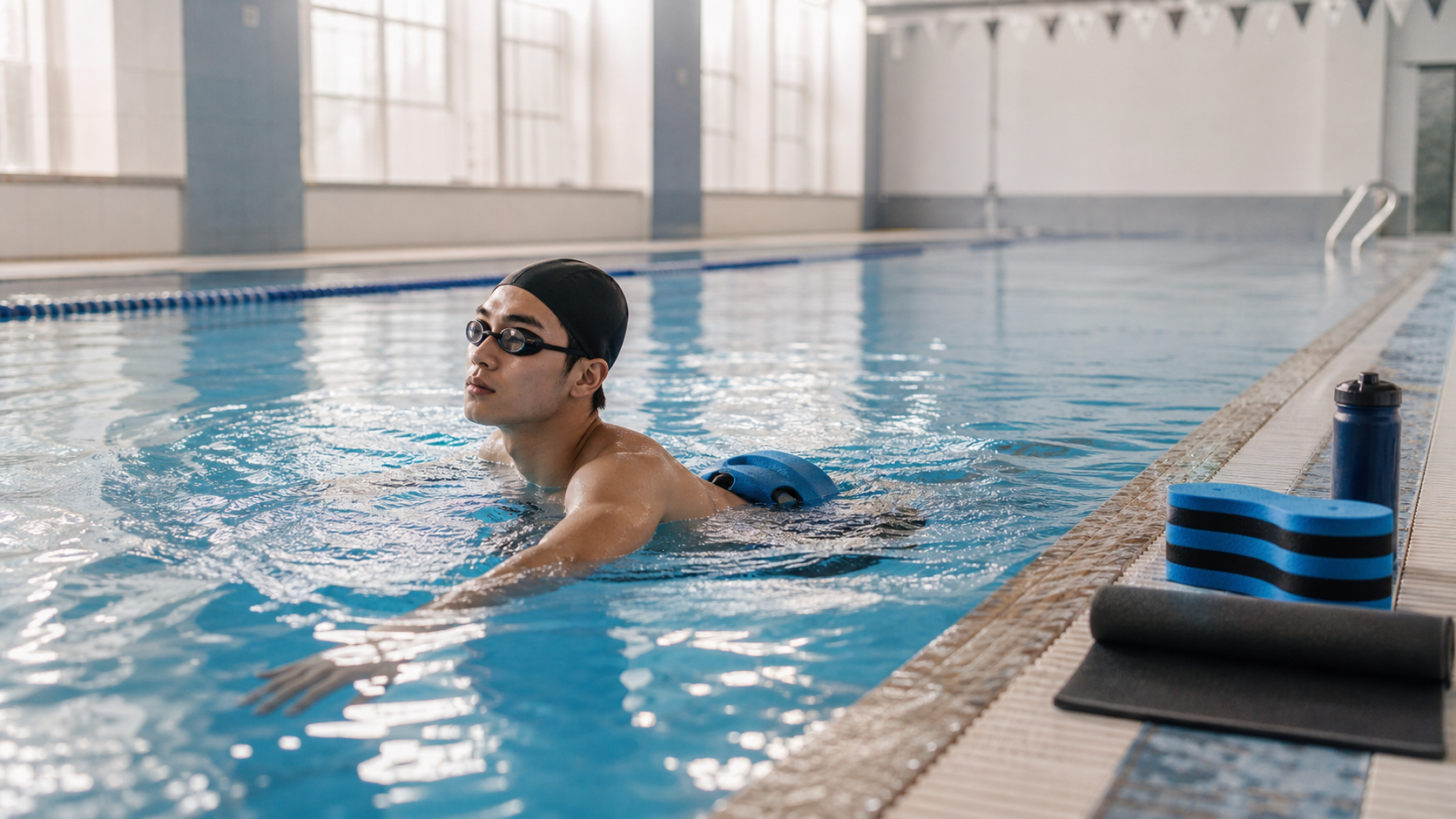
Introduction
“The more you train, the faster you improve” is a deeply ingrained myth among many athletes. However, the core principle of sports science is: adaptation occurs during recovery—the stress stimulus created by high-intensity training must be converted into performance gains through adequate recovery. Without sufficient recovery, athletes are merely accumulating fatigue, not surpassing their limits. Active Recovery is a deliberate but low-intensity activity designed to promote blood circulation and accelerate the clearance of metabolic waste, without adding new fatigue burden.
The Physiological Mechanisms of Recovery Training
- Promotes blood circulation: Low-intensity swimming keeps muscles contracting, driving venous blood return and accelerating the removal of lactate and metabolic waste
- Maintains neural activation: Complete rest causes the neuromuscular system to “shut down,” while active recovery maintains appropriate neural activation, benefiting performance in the next day’s high-intensity training
- Releases psychological stress: Easy swimming gets athletes “moving” without requiring effort, making it the optimal state for both physical and mental stress relief
- Maintains technical awareness: Even on recovery days, the sense of movement in the water (Water Feel) continues to be reinforced
Easy Swimming Techniques
Intensity Settings
Easy swimming should be performed under the following conditions:
- Heart rate < 120 bpm (or below 60% of maximum heart rate)
- Rating of Perceived Exertion (RPE) 2–4 (very easy, can converse comfortably)
- Pace approximately CSS + 20–30 seconds (per 100 meters)
Workout Design
| Purpose | Recommended Distance | Stroke Suggestion |
|---|---|---|
| Recovery the day after high-intensity training | 800–1200m | Freestyle or backstroke |
| Recovery day after high training volume | 1000–1500m | Mixed strokes, avoid butterfly |
| The day before a competition | 500–800m | Freestyle primarily, including short acceleration feel |
| Transition period after the season ends | 600–1000m | Casual, focus on enjoyment |
Key technical points for easy swimming: Using recovery swims to reinforce technical details (such as paying attention to catch position and kick rhythm) so that recovery days also serve technical refinement is the smartest way to utilize this time.
Aqua Jogging
Aqua jogging is an alternative option during injury recovery periods or phases of extremely high training volume. Athletes wear a buoyancy belt and simulate running motions in deep water, maintaining cardiovascular stimulus while completely eliminating ground impact.
Suitable Scenarios
- When lower-limb injuries (knees, ankles) prevent running
- When swimming volume is extremely high, replacing some land running with aqua jogging to reduce cumulative impact
- Active recovery for triathletes after high-volume weeks
Execution Method
- Preparation: Deep-water buoyancy belt (Aqua Jogger Belt), ensuring the head stays above water at all times
- Motion: Simulate land running, lift knees high, swing arms naturally, avoid touching the bottom with feet
- Intensity: Easy jogging for 20–30 minutes, maintaining heart rate at 110–125 bpm
- Note: The heart rate ceiling for aqua jogging is lower than on land; do not directly compare heart rates with land jogging
Post-Swim Relaxation Techniques
Static Stretching Sequence
While body temperature is still elevated after training (or after a warm shower) is the best time for static stretching, holding each movement for 30–45 seconds:
- Standing chest stretch: Clasp hands behind your back, lift the chest upward, relieving the chest muscles from the early phase of the pull
- Kneeling ankle stretch: Sit back on your heels and lean backward, releasing tension in the front of the ankles caused by kicking
- Side-lying shoulder stretch (Sleeper Stretch): Relax the infraspinatus, preventing cumulative rotator cuff tightness
- Supine twist: Let bent knees fall to one side, rotating the thoracic spine to release spinal tension after pulling
- Seated hamstring stretch: Extend legs straight and fold forward, relaxing the hamstrings after kicking
Foam Rolling Recovery
- Calves: Roll for 60 seconds to relieve gastrocnemius tightness after kicking
- Mid-thoracic spine: Place the roller horizontally and release back tension segment by segment after pulling
- Glutes (piriformis): Use the figure-four position to press and roll, particularly effective for athletes who frequently perform flip turns
Other Dimensions of Recovery
- Sleep: 7–9 hours per night; sleep is the most powerful of all recovery methods. If training volume is high, consider a 20-minute nap
- Hydration: Even though swimming takes place in water, you still sweat; replenish with electrolyte drinks after training
- Protein intake: Consume 20–25 grams of protein within 30 minutes after training to promote muscle repair
Practical Recommendations
- Clearly mark “recovery days” in your weekly schedule; do not change them to high-intensity training on a whim just because you “feel fine”
- Recovery swim pace should allow you to observe your own technique while swimming; if you are swimming too fast to think about your movements, you are going too fast
- Aqua jogging requires a buoyancy belt to be effective; attempting it without one is not recommended, as it easily compensates into a treading-water motion
- Establish a fixed 15-minute post-swim stretching routine; building a habit is more effective than occasionally doing long stretching sessions
Conclusion
Recovery training is an essential component of a high-intensity training program, not a luxury. Easy swimming maintains water feel, aqua jogging preserves cardiovascular fitness during injury recovery, and post-swim stretching prevents chronic injuries—the combination of these three forms the core of a swimmer’s recovery system. Learning to “slow down” is often the fastest way to break through training plateaus.
Related Reading
- Swimming Recovery Techniques: Low-Intensity Technical Swimming as Active Recovery Workout Design
- Swimming Recovery Workout Design: Distance, Intensity, and Technical Integration for Easy Swimming
- Recovery-Oriented Easy Swimming: The Correct Approach to Low-Intensity Make-Up Training
- Swimming as Recovery Training: How to Use Water-Based Exercise to Promote Physical Repair and Regeneration
[教學] Premiere 影片 手震 修正 教學 防抖 單眼 影像 GoPro 穩定 Video Stabilization
8 年前
西進武嶺 免費訓練分析服務 Intervals | 練不夠還是練過頭?你哪一種類型選手?AI模型告訴你! | 備戰神器 | 公路車 訓練 | CT Yeh
4 年前
滑雪新手們慘摔學習全紀錄(請開字幕),滑雪好好玩 | Snowboard + Ski | 岩原 スキー場 | 滑雪APP使用 | GoPro Max
6 年前
教學) 如何做出專業 慢動作 影片 Slow Motion 120fps GoPro 7 ActionCam AX700 A99II
7 年前
如何把 GoPro 影片 翻轉 批次 轉正?
6 年前
實景訓練台) 彰化經典百K 高強度喵團 90分鐘 跟著一起練功 2019 Indoor workout Changhua Classic 100 Taiwan
7 年前
#PUSHBIKE 原來這麼好玩! 小朋友 滑步車 初體驗 超可愛
6 年前
CT暗黑廚房) 車友必備 宇宙無敵鮮蚵湯 幫助訓練恢復 天然食補 好市多 超肥鮮蚵 破PR
7 年前