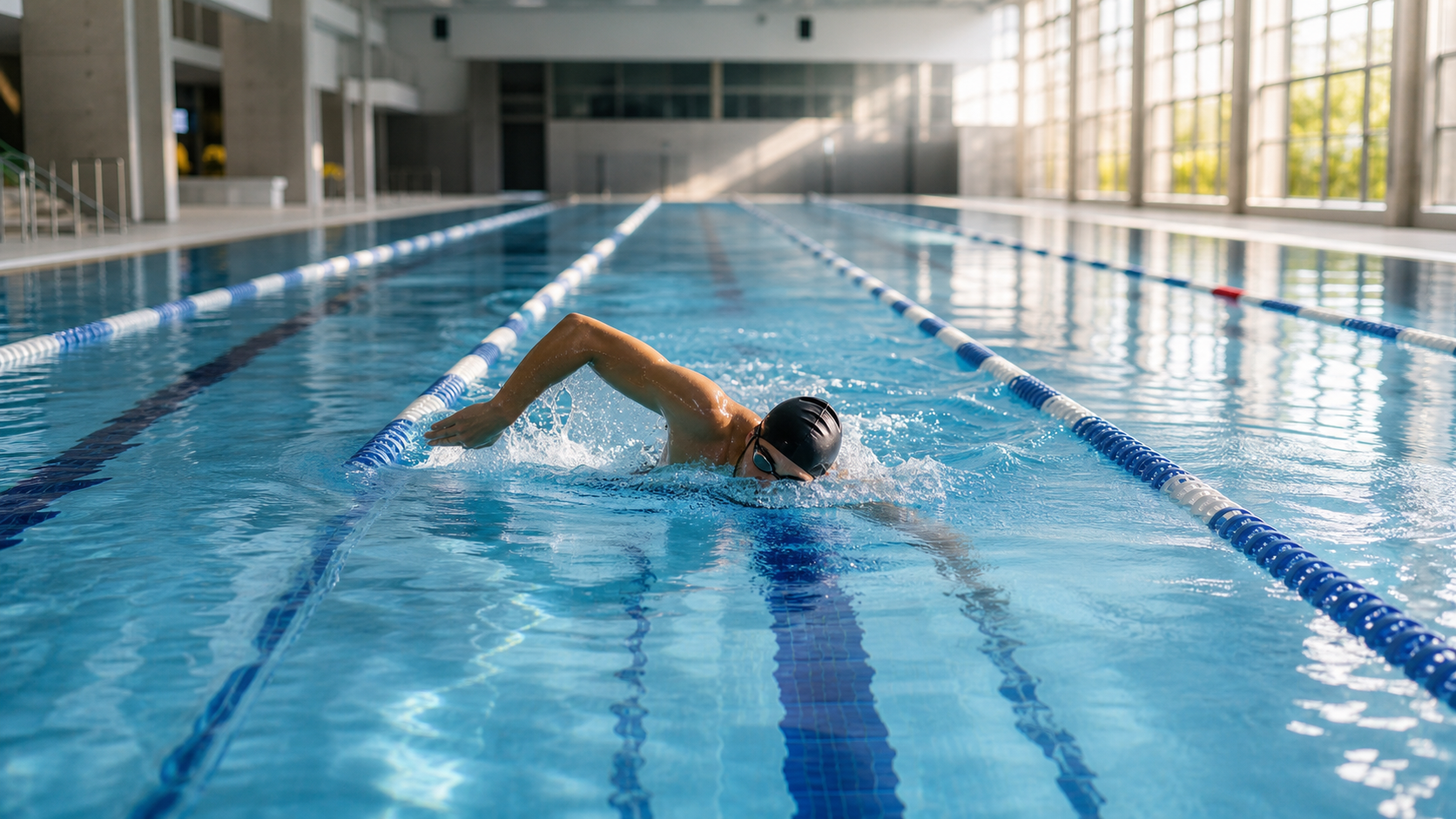
Introduction
In a 1500m freestyle race, many swimmers swim the first 400m too fast, then see their pace drop dramatically in the latter half, finishing with a time worse than their training capacity would suggest. Almost every swimmer has experienced this phenomenon, and the root cause lies in “poor pace perception”—not knowing how fast you’re swimming, nor how much energy you have left. Long-distance endurance training isn’t just about “swimming longer distances”; more importantly, it’s about “learning to manage speed throughout the long swim.”
Three Pacing Strategy Models
| Strategy | Definition | Best Suited For | Pros and Cons |
|---|---|---|---|
| Positive Split | Fast first half, slower second half | Sprints (50–100m) | Explosive start then hold on; not recommended for long distances |
| Even Split | Consistent speed throughout | Most distances | Most energy-efficient and predictable; requires high awareness |
| Negative Split | Second half faster than first half | 1500m and above | Strong finish feels great, but requires restraint early on |
Research shows that among elite performances over 400m, negative or even splits dominate nearly all records, while positive splits (starting too fast) often lead to a late-race collapse.
Why You Should Be Conservative Early in Long Distances
The energy management logic of long-distance swimming mirrors that of marathon running:
- Starting too fast → lactate exceeds clearance rate → forced slowdown later (usually costing far more time than the early speed gained)
- Starting conservatively → lactate stays at a steady state → explosive finishing speed remains for the latter half
A practical rule: for the first 25% of a long-distance race, pace should be 2–5% slower than your target average pace. In a 1500m race, the first 375m should be slightly slower than target pace, feeling “a bit conservative”—that’s the correct opening rhythm.
Methods for Training Pace Perception
1. Blind Pace Practice
Design training sets where you “don’t look at the clock”:
- Swim 100m without timing yourself; guess your time afterward
- Check the clock to confirm the actual time
- Repeat 5–6 times, gradually reducing the margin of error
The goal is to narrow the error from ±5 seconds to within ±2 seconds, indicating your pace perception has reached a practical level.
2. Split Timing Training
In long-distance workouts (e.g., 1500m), record split times every 200m or 300m:
- Second half ≥ 5 seconds faster per split than first half = started too slow; push the pace earlier
- Second half ≥ 5 seconds slower per split than first half = started too fast; be more conservative next time
- Difference between halves < 3 seconds = good pace control
3. Rhythm Stroke Rate Training
Pace perception isn’t just about time—it can also be built through stroke rate:
- Measure your stroke rate (strokes per minute) at your target pace
- Use this stroke rate as a pacing reference during training; when stroke rate drops, your pace is dropping too
- Use a stroke rate monitor (or the stroke rate function on your swim watch) for assistance
Sample Long-Distance Training Sets
Base Endurance Building (2x per week):
- Continuous 1500m swim, recording splits every 300m, at a pace that feels like “7 out of 10 effort”
- Goal: split time variation < 5 seconds
Negative Split Practice:
- Continuous 800m swim: first 400m at 5 seconds per 100m slower than target pace; second 400m accelerate to target pace or faster
- Feel the rhythm of holding back early and pushing late
Long-Distance Simulation Race (once per month):
- Timed swim over the full race distance (e.g., 1500m or 800m), with pre-planned split targets to test your pacing execution
Practical Tips
- After every long-distance session, record split times and analyze pace consistency to track long-term improvements in pacing stability
- In the simulation race one week before competition, strictly execute a negative split strategy to build muscle memory
- Beginners can start with 400m even-pace practice; once the error narrows, extend the distance
- Training partners in the pool can time each other, using external oversight to build more accurate pace perception
Conclusion
Pacing strategy in long-distance swimming is the combined expression of technique and capacity. Even or negative splits aren’t about “swimming slower”—they’re about managing energy with maximum precision so you still have sprinting room in the latter half. Through systematic blind pace practice and split recording, any swimmer can progressively build precise pace perception, allowing race performance to truly reflect training level.
Related Reading
- Long-Distance Swim Pace Training: Speed Management from 1500m to 5000m
- Pacing Strategies for Long-Distance Swimming (800m/1500m): Even Splits and Negative Splits
- Building Rhythm in Long-Distance Swimming: Split Strategies for 1500m Pacing
- Energy Distribution Across Splits in Swim Endurance Events (1500m, 5K, 10K)
西進武嶺 自製新版AI配速表產生器 x 賽前攻略 抱佛腳! 沒有功率計也可以產生配速表嗎?有什麼其他眉角賽前要注意的呢? | 西進武嶺 / 東進武嶺 KOM 攻略 | 公路車 | CT Yeh
4 年前
西進武嶺 免費訓練分析服務 Intervals | 練不夠還是練過頭?你哪一種類型選手?AI模型告訴你! | 備戰神器 | 公路車 訓練 | CT Yeh
4 年前
Live) 備戰2019彰化經典百K 賽前攻略 (已完賽請看新影片
7 年前
西進武嶺配速器 3.0更新 / NEW 免功率FTP估算! / 大數據xAI體能模型 / 如何模擬人止關前集團效應 / 配速儲存功能 / AI全台自行車賽事行事曆 / 公路車 / CT Yeh
1 年前
#公路車 #西進武嶺 配速配瓦實驗 坡度分析 四小時內攻略 建大盃 NeverStop #西進武嶺攻略
6 年前
西進武嶺各路段 前8000名 大數據分析 配速攻略/功率/心律/推力比/維持率/踏頻/踏瓦比/牽車率 大公開 | 建大盃 NeverStop 可參考 | 公路車 | CT Yeh
5 年前
戰略) Zwift Race 如何咬在第一集團 如何評估自己要開多少推力 (請開1.5倍速看)
7 年前
一日北高/長距離團騎 常見問題補充篇 / 組團或跟團的眉角 / 壯車友容易被瘦車友慢性拉爆 / 原來屁股痛可能是這個原因...? / 風場配速法 / 公路車 / CT Yeh
2 年前