Swimmers' Warm-Up and Cool-Down: Pre- and Post-Session Routines to Maximize Training Effectiveness
Introduction
“Not enough time, I’ll skip the warm-up.” Almost every swimmer has said this at some point. But skipping the warm-up doesn’t just increase the risk of injury—it directly lowers training quality. When muscle temperature is insufficient, nerve conduction velocity, muscle contraction efficiency, and joint range of motion all decline significantly, meaning you’re wasting precious training time in an inefficient state. The cool-down phase is equally important: active recovery after training accelerates lactate clearance and stores energy for the next session.
The Physiological Purpose of the Warm-Up
A good swimming warm-up should achieve the following physiological effects:
- Raise core body temperature: For every 1°C increase in muscle temperature, enzyme activity rises by approximately 13%, and contraction speed increases
- Increase joint fluid secretion: Reduces joint friction and improves range of motion in the shoulders, elbows, hips, and ankles
- Activate neuromuscular connections: “Wake up” the deep stabilizer muscles (core, rotator cuff) for more precise movement
- Cardiorespiratory preparation: Gradually increase cardiac output to avoid hypoxia from sudden high intensity
- Mental transition: Shift from daily life into a focused training mindset
Complete Warm-Up Protocol (25–35 Minutes)
Phase 1: Land-Based Dynamic Warm-Up (10 Minutes)
Before entering the pool, perform land-based dynamic activities:
| Exercise | Time/Reps | Purpose |
|---|---|---|
| Shoulder circles (both directions) | 15 each way | Shoulder joint activation |
| Arm cross-body swings | 20 reps | Chest muscle stretch |
| Torso rotations | 20 reps (each side) | Thoracic spine mobility |
| Squats (slow) | 10 reps | Hip and ankle joints |
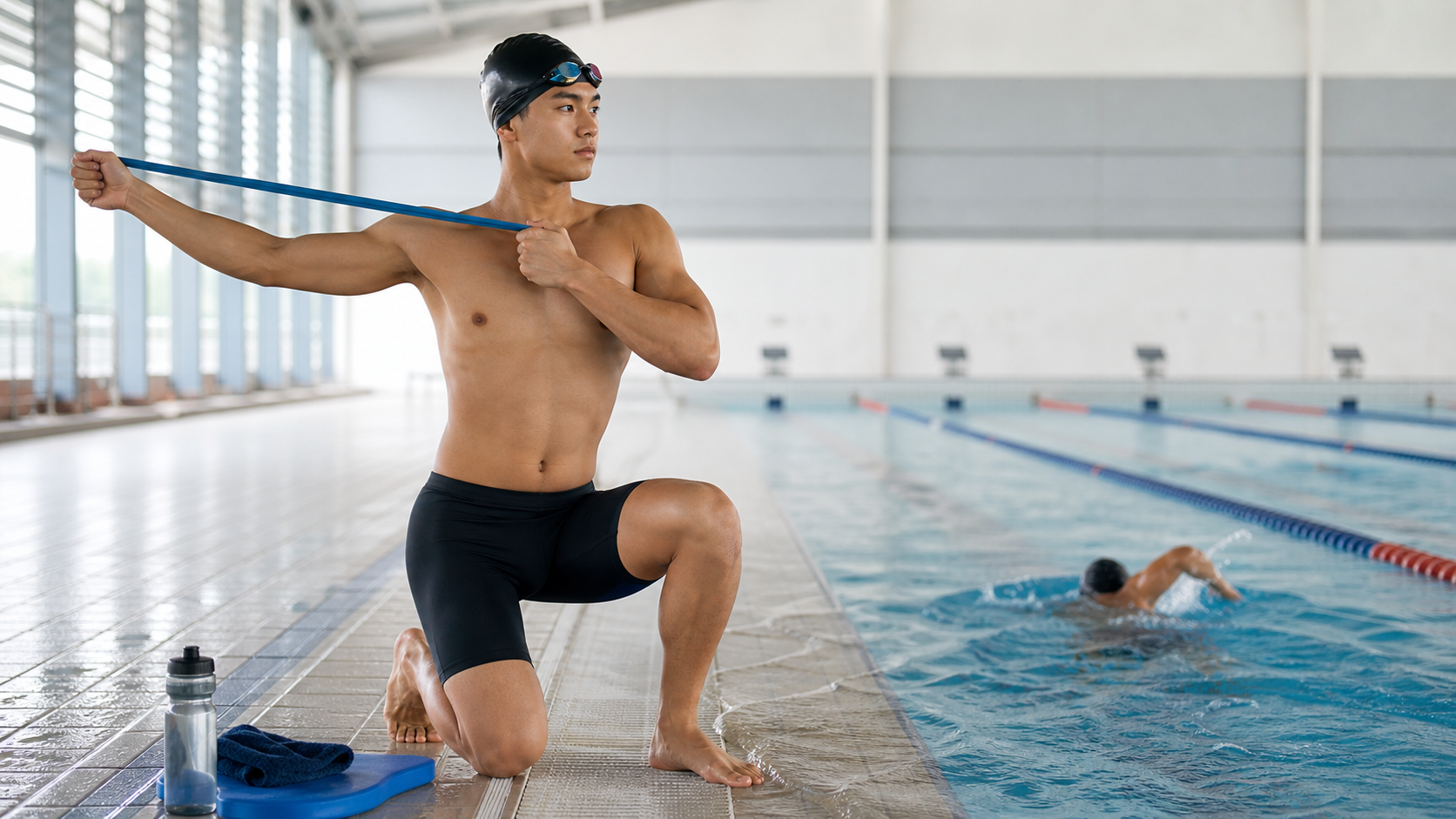
| Band external shoulder rotation | 15 reps (each side) | Rotator cuff activation |
| Jump rope or high knees in place | 60 seconds | Elevate heart rate |
Phase 2: Easy Swimming in the Water (8–10 Minutes)
Don’t rush to pick up speed after entering the water. First, get a feel for the water at a comfortable pace:
- 200m easy freestyle (CSS + 20 seconds or more), focusing on feel and body position
- 4 × 25m backstroke (relax the posterior shoulder, balancing the anterior load from training)
- 100m kicking drill (activate the kicking muscles and feel ankle relaxation)
Phase 3: Progressive Pacing (5–8 Minutes)
Gradually build up to near-training intensity:
- 4 × 50m progressive swim (accelerate every 25m: easy → moderate → fast → near training pace)
- 2 × 25m technical focus (e.g., focus on high-elbow catch, or maintain head position)
After completing the warm-up, the swimmer should feel “warm, heart rate slightly elevated, but not fatigued”—this is the optimal state for entering the main set.
Streamlined Warm-Up When Time Is Limited (15 Minutes)
If training time is limited, prioritize the following core elements:
- Land-based band external shoulder rotation × 15 (each side)—rotator cuff protection is most important and cannot be skipped
- 200m easy swim in the water—let the body adapt to the water temperature and establish water feel
- 4 × 25m progressive swim—gradually build up to training pace
The cost of skipping a longer land-based warm-up is that “it may take 2–3 laps before you’re fully in the zone.” Accept that the first few laps may have slightly poorer technique, and don’t rush to speed up out of frustration.
Post-Training Cool-Down (15–20 Minutes)
The goal of the cool-down phase is to bring the body back to rest in an orderly manner from high-intensity states and to initiate recovery mechanisms:
In-Water Cool-Down (10 Minutes)
- 300m easy mixed swim (alternating freestyle and backstroke, slow pace, focusing on breathing)
- 100m kick only (relax the arms and shoulders)
- 100m pull only (pull buoy between legs, relax the legs)
Note: The cool-down swim should be slower than the easy warm-up swim—it’s a “floating along” pace with no technical demands whatsoever.
Land-Based Static Stretching (8–10 Minutes)
Muscles are still warm after training, making this the best time for static stretching:
- Standing chest stretch (doorway or corner) × 30 seconds
- Cross-body shoulder stretch (each side) × 30 seconds
- Seated hamstring stretch × 30 seconds
- Supine knee twist (each side) × 30 seconds
- Ankle rotations (each foot, both directions) × 10 rotations
Common Mistakes
- Warming up too aggressively: Swimming the first 200m at near-training pace before the body is warm leads to poor technique quality and increases rotator cuff injury risk
- Skipping the cool-down entirely: Climbing out of the pool right after the last rep of the main set means lactate isn’t actively cleared, resulting in stronger residual fatigue the next day
- Doing static stretching in the warm-up: Static stretching reduces explosive power; it should be done after training, while the warm-up should use dynamic movements
Practical Recommendations
- Set a fixed warm-up sequence (the same every time), making it a mental ritual for “switching into training mode”
- Warm-ups before high-intensity sessions (speed work, lactate sets) should be longer than before easy swims to ensure full neuromuscular activation
- In cold weather or early-morning training, extend the land-based warm-up to 15 minutes, because lower ambient temperatures slow muscle warming
- Include the cool-down swim as a formal part of the workout plan, recording distance and time just as clearly as the main set
Conclusion
The warm-up and cool-down are not “accessories” to training—they are the framework that maximizes the effectiveness of every session. A 10-minute land-based warm-up plus a complete in-water activation allows every meter of the main set to be swum at its best; a 15-minute cool-down swim and stretching lays the best recovery foundation for tomorrow’s training. Building this habit is a necessary investment for a long, high-level training career.
Related Reading
- Swimmer’s Race Warm-Up Protocol: The Science of Pre-Race Volume and Intensity
- Swimming Warm-Up Protocol: Complete Land-Based Dynamic Warm-Up + 800m In-Pool Warm-Up
- Pre-Race Warm-Up Procedure: The Complete Process from Entering the Water to Stepping onto the Starting Block
- The Science of Pre-Race Warm-Up for Swimmers: Optimal Strategies for Water Temperature Adaptation and Neural Activation
FTL 與 SYB 車隊專訪 西進武嶺 實用攻略分享! 2小時 如何練?!你不知道的眉角!新手準備武嶺必看 EP1 | 實力派女車友 | 精華版 | 公路車 | CTYeh
4 年前
西進武嶺 免費訓練分析服務 Intervals | 練不夠還是練過頭?你哪一種類型選手?AI模型告訴你! | 備戰神器 | 公路車 訓練 | CT Yeh
4 年前
西進武嶺 自製新版AI配速表產生器 x 賽前攻略 抱佛腳! 沒有功率計也可以產生配速表嗎?有什麼其他眉角賽前要注意的呢? | 西進武嶺 / 東進武嶺 KOM 攻略 | 公路車 | CT Yeh
4 年前
滑雪新手們慘摔學習全紀錄(請開字幕),滑雪好好玩 | Snowboard + Ski | 岩原 スキー場 | 滑雪APP使用 | GoPro Max
6 年前
一日北高/長距離團騎 常見問題補充篇 / 組團或跟團的眉角 / 壯車友容易被瘦車友慢性拉爆 / 原來屁股痛可能是這個原因...? / 風場配速法 / 公路車 / CT Yeh
2 年前
[教學] Premiere 影片 手震 修正 教學 防抖 單眼 影像 GoPro 穩定 Video Stabilization
8 年前
CT 喇低賽) 武嶺牽車 才是王道 西進牽車四小時內秘訣 攝手位置 如何判斷 防抽筋小秘訣
7 年前
Live) 備戰2019彰化經典百K 賽前攻略 (已完賽請看新影片
7 年前