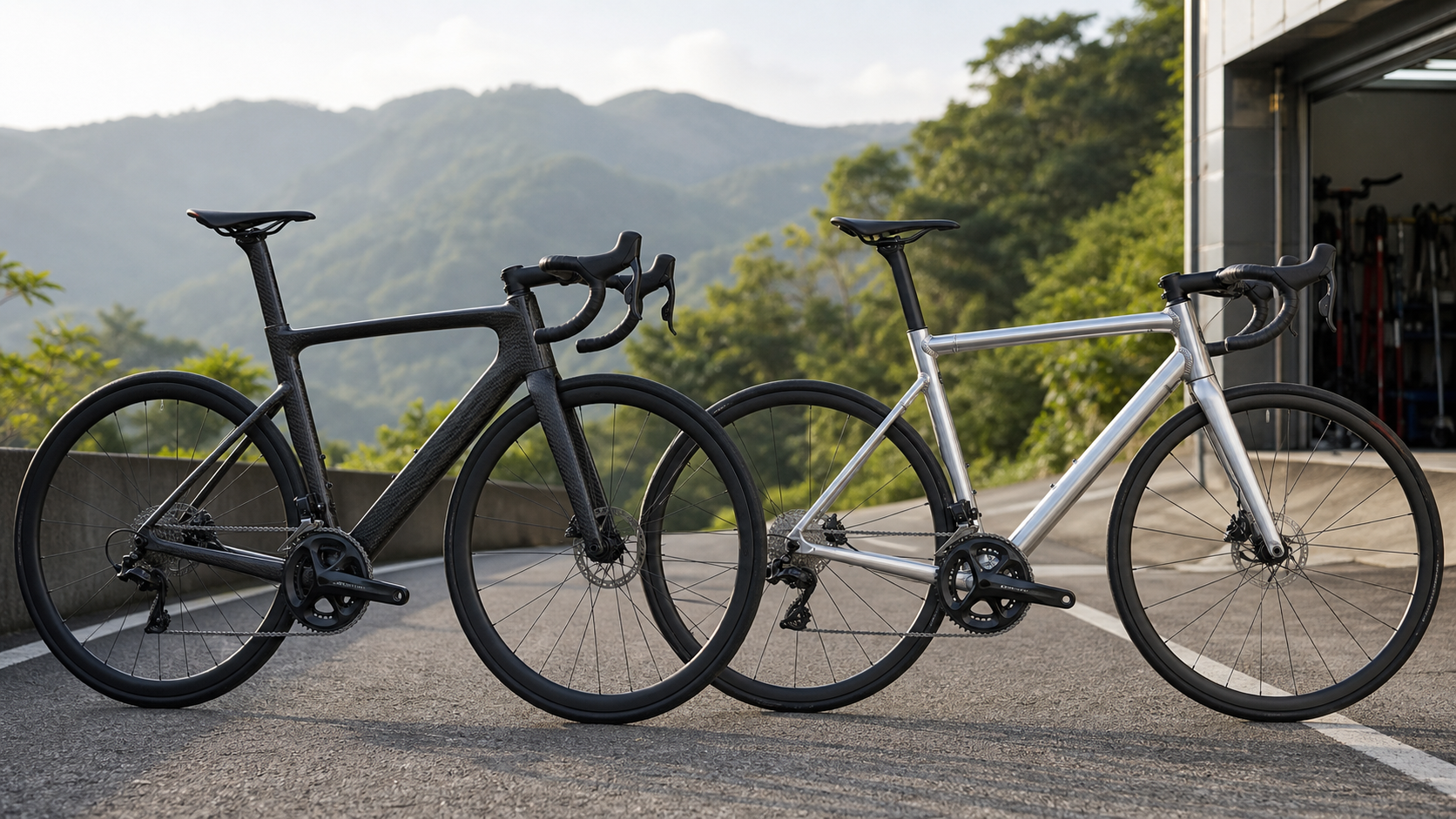
Introduction
“Save up for carbon” is almost every road cycling beginner’s first upgrade goal. Carbon fiber frames enjoy an almost mythical status in the cycling world, but the technological progress of aluminum alloy frames over the past decade should not be underestimated either. What exactly separates these two materials? Is the difference worth the extra cost? This article attempts to give an objective answer from a Taiwanese rider’s perspective.
Material Characteristics Comparison
| Characteristic | Carbon Fiber | Aluminum Alloy |
|---|---|---|
| Weight | 700–900g (frame) | 1,000–1,400g (frame) |
| Vibration Absorption | Excellent, layup direction can be tuned | Weaker, road feel transmitted directly |
| Stiffness | High, can be zone-tuned | Uniform stiffness, harder to fine-tune |
| Impact/Crash Resistance | More brittle, cracks hard to spot visually | Tougher, crash damage usually visible |
| Service Life | Typically 5–10 years (depending on usage intensity) | Can exceed 15 years |
| Repair Difficulty | High, requires professional carbon repair | Relatively easy, can be welded |
| Entry Price | Complete bike from around NT$100,000 | Complete bike from around NT$30,000 |
The Real Difference in Ride Feel
Vibration Absorption and Comfort
The most well-known advantage of carbon fiber frames is “filtering road vibration.” In high-quality carbon frames, engineers can use layup design to give specific directions greater compliance — for example, making the rear triangle more flexible vertically while keeping stiffness in the pedaling direction.
However, this advantage is less noticeable on Taiwan’s asphalt roads than on Europe’s cobblestone roads. Many riders who upgraded from aluminum to entry-level carbon report that the difference is smaller than expected — sometimes barely noticeable at all.
The Real Impact of Weight Difference
At the same spec level, a carbon frame is about 400–700g lighter than an aluminum one. For a complete bike, carbon models are typically 500g–1kg lighter than aluminum ones. This difference is genuinely noticeable when climbing: for a 70kg rider climbing on a 7kg vs. an 8kg bike, the power requirement differs by about 1.3%. For amateur riders, this translates to roughly a 30-second to 1-minute difference per hour of climbing.
Stiffness and Pedaling Efficiency
High-end carbon frames have extremely strong lateral stiffness around the bottom bracket (BB) and chainstays, delivering pedaling force more directly. But entry-level carbon frames (roughly under NT$100,000) often have stiffness inferior to quality aluminum bikes in the same price range — the stiffness of Giant’s ALUXX SLR aluminum or Cannondale’s CAAD13 can even surpass many cheap carbon bikes.
Special Considerations for Taiwan’s Road Conditions
Taiwan’s mountain roads have many potholes, and urban areas have manhole covers everywhere, so carbon frames face a higher chance of unexpected impacts than in Europe. Carbon fiber’s fatal weakness is “invisible damage” — a frame that looks perfectly fine on the outside may already have internal fiber cracks, and it can suddenly fail while riding, which is extremely dangerous.
It is recommended to have a professional bike shop perform an ultrasonic inspection on your carbon frame once a year, especially if the bike has a history of falls or collisions. Many bike shops in Taiwan offer this service for around NT$1,000–2,000.
Value Analysis: When Is Carbon Actually Worth It?
- Pursuing minimum weight for racing: In hill climbs or time trials, every gram matters
- More than 2 years of riding experience, committed long-term to road cycling: Avoid buying it and letting it sit unused
- Sufficient budget to spec Shimano 105 or above: Pairing carbon with low-end drivetrain components is a common case of misplaced priorities
- History of crashes or careless usage habits: Sticking with aluminum alloy to minimize potential loss is advisable
Practical Recommendations
- Budget under NT$100,000: High-spec aluminum (such as the Giant TCR Advanced SL Disc AL) is often better value than entry-level carbon
- Be extremely cautious with used carbon bikes: Ask the seller for proof of purchase and personally inspect every joint
- The “compliance” of aluminum frames is often overstated: Modern hydroformed aluminum frames offer comfort close to entry-level carbon
- Carbonize the fork first: If budget is limited, consider an aluminum frame paired with a carbon fork — this offers the most noticeable comfort improvement, and forks are relatively inexpensive
Conclusion
Carbon fiber frames are indeed better, but “how much better” depends on your riding intensity, road environment, and usage habits. For most weekend riders in Taiwan, a quality aluminum complete bike with Shimano 105 will bring more riding enjoyment than an entry-level carbon bike with Sora. Frame material is one part of performance, but not everything. Mastering the fundamentals first, then upgrading based on clear needs, is the most efficient way to invest.
Related Reading
- In-Depth Comparison of Bicycle Frame Materials: Aluminum vs. Carbon Fiber vs. Titanium — Ride Feel, Weight, and Long-Term Investment Analysis
- Carbon Fiber vs. Aluminum vs. Titanium Frames: The Complete 2025 Material Buying Guide
- Complete Frame Material Comparison: Carbon Fiber, Aluminum, Titanium, and Steel — Characteristics and Who They Suit
- Road Bike Frame Material Showdown: Carbon Fiber vs. Aluminum vs. Titanium Buying Decisions
Unaas X50 全碳纖幅條輪 數據實測對比PK | Lun Hyper 的高階版 | 板輪爬坡也可以很厲害? ! 武嶺2小時大師一起親測! CP值超高 | 公路車 | CT Yeh
4 年前
再一組! 全碳幅條 碟煞/無內胎輪組 開箱! 到底好騎嗎? UNAAS X40 | 公路車 | CT Yeh
4 年前
換車囉! TIME ADH 2023 全內線碟煞公路車 開箱實錄!/ Dyneema 碳纖維真的太猛了 / 曜越單車 / CT Yeh
3 年前
碟煞公路車 優缺點?換車一年半實際經驗分享 / 公路車 / CT Yeh
2 年前
鉅齒紋輪組!? ControlTech MEG-T50 EVO 碳纖維幅條輪組/ 功率對比實驗 / 公路車 / CT Yeh
2 年前
Nepest NOVA 碳條輪組:輕量、空力、舒適一次滿足!/ 公路車 / CT Yeh
7 個月前
Vision Metron RS 37碳幅條輪組 (非SL)官網沒有的 低調開箱 / 這重量太銷魂了 / 公路車 / CT Yeh
6 個月前
功率實測 Lun Hyper 2023 碳幅條輪組 D45 碟煞 | 公路車 | CT Yeh
3 年前