In-Depth Review of Cycling Helmets: MIPS Technology, Ventilation Design, and Mainstream Models in the Taiwan Market
Introduction
In the instant of a crash, your helmet is the only buffer between your skull and the ground. Among all cycling gear, the helmet is the one piece of equipment where you “cannot cut corners”—the difference between a NT$3,000 helmet and a NT$300 helmet in a real accident could come down to whether you suffer lasting aftereffects. Beyond reviewing mainstream models on the market, this article also takes a deep dive into technical details that are often overlooked.
MIPS Technology Explained
MIPS (Multi-directional Impact Protection System) is the most important technological innovation in cycling helmets over the past decade.
The Problem with Traditional Helmets
Traditional EPS (expanded polystyrene) helmets are well designed, but they are only engineered for linear impact forces. In real-world crashes, the head often strikes the ground at an oblique angle—this type of impact causes the skull to rotate relative to the brain, potentially leading to concussion or even cerebral hemorrhage.
How MIPS Works
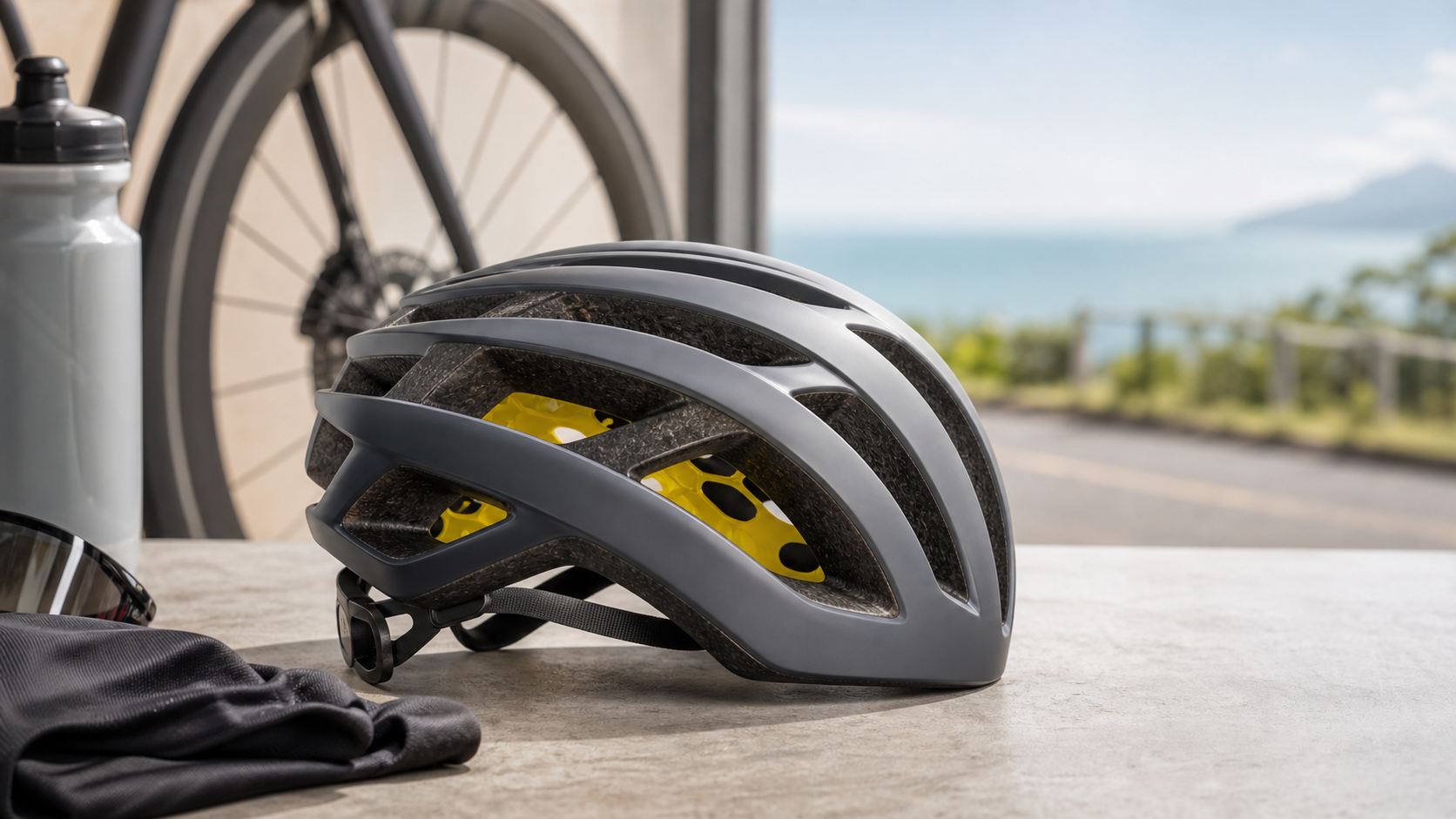
MIPS incorporates a low-friction “yellow sliding layer” inside the helmet shell, allowing the outer shell to slide approximately 10–15mm relative to the head during an angled impact. This tiny amount of movement can absorb up to 40% of rotational energy, significantly reducing the risk of brain injury.
Studies show that MIPS can reduce the risk of concussion by 10–20%. That may seem modest, but in a real accident, it could mean the difference between walking away with or without lasting aftereffects.
The Science of Ventilation Design
In Taiwan, the heat of summer riding is the biggest barrier to wearing a helmet, and ventilation design directly affects whether riders are willing to put one on.
Number and Size of Vents
- Entry-level models: 10–16 vents, suitable for low-speed commuting
- Mid-range racing models: 18–28 vents, suitable for general road riding
- High-end aerodynamic models: Fewer vents but more refined internal airflow channels, offering better heat dissipation at specific speeds
Internal Airflow Channel Design
Having vents alone is not enough—the interior of the helmet shell must have channels that guide airflow, drawing air in from the front, carrying heat away, and exhausting it out the rear. Cutaway testing shows that two different helmet designs with the same 24 vents can differ by more than 30% in actual heat dissipation efficiency.
Mainstream Model Reviews in the Taiwan Market
| Model | Price (NT$) | MIPS | Weight | Number of Vents | Best For |
|---|---|---|---|---|---|
| Giro Syntax MIPS | 5,500–6,500 | Yes | 260g | 25 | All-purpose, best value pick |
| Bell Z20 MIPS | 6,000–7,500 | Yes | 255g | 24 | Long-distance comfort, top seller in Taiwan |
| POC Ventral Air MIPS | 9,500–12,000 | Yes | 220g | 21+large openings | Racing, high-end |
| Specialized Propero 4 | 7,500–9,000 | Yes | 240g | 23 | Top choice for Specialized owners |
| Kask Protone Icon | 13,000–16,000 | Yes | 220g | 24 | Pro-level performance |
| OGK Kabuto Aero-R2 | 4,500–6,000 | Some models | 265g | 18 | Japanese brand, friendly to Asian head shapes |
| Lazer Sphere MIPS | 5,000–6,500 | Yes | 250g | 20 | Great entry-level MIPS option |
Special Note on Asian Head Shapes
Helmets from European and American brands are typically designed for round-oval (longer front-to-back) head shapes, which may not fit the rounder head shapes of many Asian riders. OGK Kabuto (a Japanese brand) and certain Giro models offer Asian Fit versions—be sure to confirm this when shopping, and trying the helmet on is always the most accurate way to judge.
Helmet Maintenance and Replacement Timing
Mandatory Replacement Triggers:
- After any significant impact: Once EPS foam is compressed, it cannot recover. The helmet may look fine on the outside but has already lost its protective function
- After more than 5 years: UV exposure and sweat cause EPS to gradually degrade; replacement every 3–5 years is recommended
- Cracks in plastic components: Cracks in the shell or buckle system are warning signs of structural failure
Daily Maintenance:
- Clean the foam padding with plain water or a mild detergent to prevent sweat buildup from breeding bacteria
- Store in a cool, shaded place, avoiding direct sunlight
- Do not hang your helmet from the handlebars (a drop to the ground can damage the structure)
Practical Advice
- Budget at least NT$3,000 or more, with MIPS as a priority: This is the minimum standard for head protection
- In Taiwan, choose a highly ventilated model: Without adequate ventilation, you will not want to wear it in summer—and protection only works if you actually wear it
- Always try before you buy; do not rely purely on online shopping: Head shapes vary too much, and buying blind risks a poor fit
- Avoid uncertified products: Choose helmets with CE, CPSC, or JCF certification
- Be cautious with painted stickers on the helmet: Some solvents can corrode the EPS structure
Conclusion
The helmet is the one piece of cycling gear where compromise is unacceptable. For NT$5,000–7,000, you can buy a quality helmet with MIPS, good ventilation, and an Asian-friendly fit—an investment that is absolutely worthwhile. Taiwan’s road conditions are complex, and the risk of crashing should not be taken lightly. Checking that your helmet strap is snug and the shell is secure without wobbling before every ride is a safety habit more important than any equipment upgrade.
Related Reading
- Cycling Helmet Buying Guide: The Trade-off Between MIPS Technology and Ventilation Design
- Bicycle Helmet Buying Guide: Three Key Considerations—MIPS, Aerodynamics, and Ventilation
- Helmet Technology Decoded: MIPS, WaveCel, and Modern Head Protection Systems
- Comprehensive Bicycle Helmet Review: The Balance Between Aerodynamics, Ventilation, and Weight
摔車後補裝備: 好市多新款單車安全帽& Specialized Romin 北高整路屁股都不痛的坐墊 | 一千元居然有MIPS | CT Yeh | 公路車
4 年前
#公路車 #Fitting 靠人工智慧APP 幫你調整單車
6 年前
再快都跟的上!? 單車跟隨攝影機之王 HOVERAir X1 PROMAX 全面實測 / 唯一!8K畫質&自行車專用模式和跟蹤信標&前後避障 / DJI Neo 可參考/ 公路車 / CT Yeh
1 年前
Insta 360 One 超級防手震技術實測
7 年前
DJI Osmo 360 全球首發!單車適合嗎?深度體驗報告/ 大疆第一台全景相機 Insta360 瑟瑟發抖? / 公路車 / CT Yeh
1 年前
Insta360/DJI做不到的!如何製作「騎士頭頂瓦數特效」單車影片?CycleDash 完整教學 / 超強批次影片數據疊加軟體
14 天前
車錶新黑馬? / 超狂續航 / 超好用錶冠 / 無敵準定位 / Dash圖表合成!?/ COROS DURA 評測!/ 公路車 / CT Yeh
2 年前
多到選擇障礙... 換個單車把帶想一個小時 / BTP / 編織&軟木特有材質超吸睛! / 公路車 / CT Yeh
1 年前