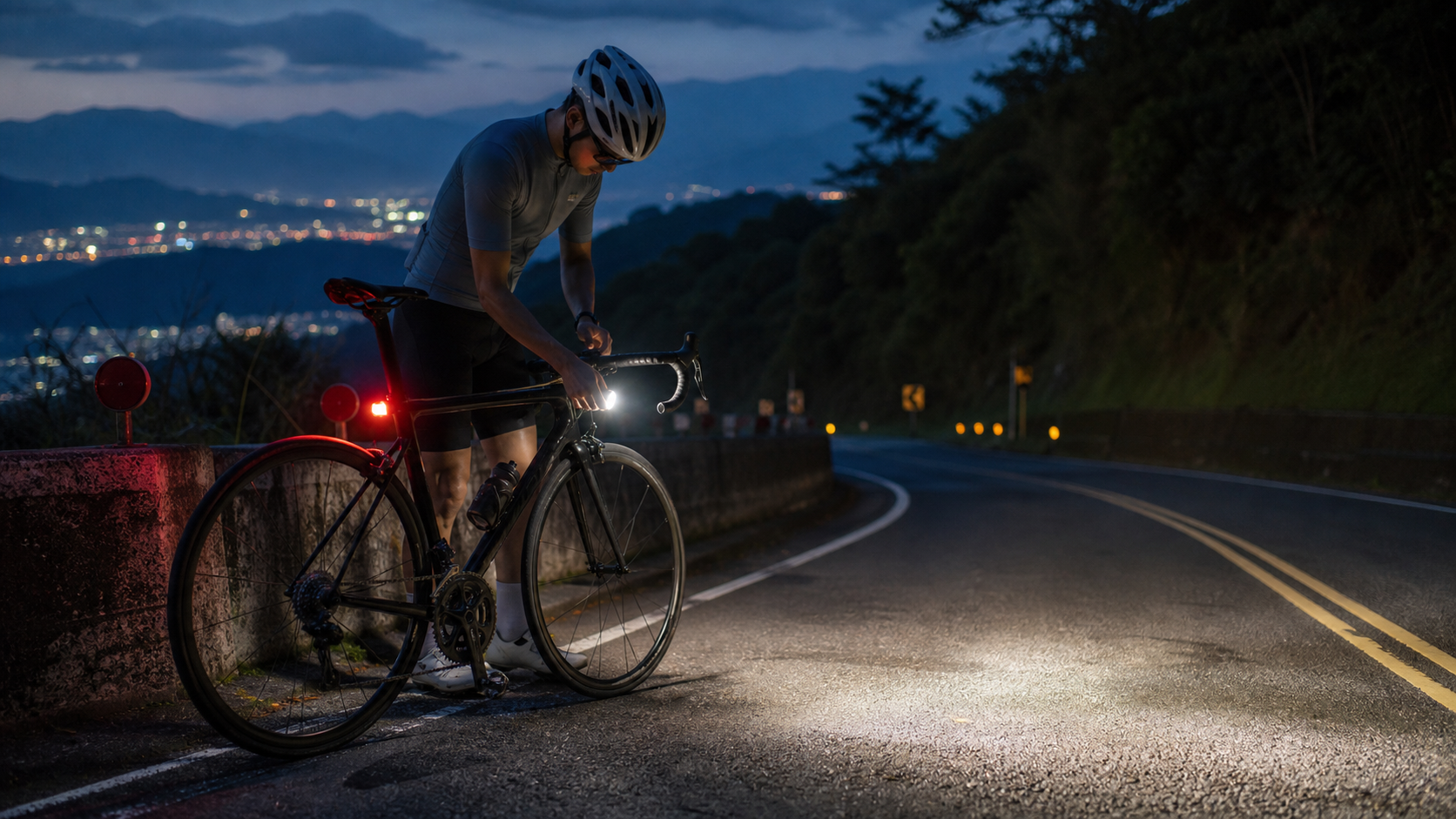
Introduction
Many Taiwanese riders treat lights as an “optional” accessory, or only think about buying them when riding at night. This attitude can lead to serious accidents in low-visibility road conditions. Taiwan’s regulations have clear requirements for bicycle lights, and a good light isn’t just about “letting others see you”—it’s about “letting you see the road clearly.” This article provides a complete analysis of light selection from three perspectives: regulations, technology, and practical needs.
Minimum Requirements Under Taiwan’s Regulations
According to Article 79 of the Road Traffic Safety Rules:
- Front light: White or yellow light, used at night or when visibility is poor
- Rear light/reflector: Red rear light or reflector, mandatory at night
- Taiwan-specific regulation: Under the Road Traffic Management and Penalty Act, riding at night without front and rear lights can result in a fine of NT$300
Minimum compliance standard: Front light visibility of at least 100 meters, rear light at least 50 meters.
Lumens ≠ A Good Light: Beam Pattern Is What Matters
Many beginners assume that higher lumens are always better—this is the most common misconception.
Lumens (lm): Represents total luminous flux, the “total amount” of light, but does not indicate throw distance or beam quality.
Beam pattern categories:
- Wide flood type: Light spreads broadly, suitable for low-speed urban riding, not glaring but with short throw distance
- Spot/throw type: Narrow beam with long reach, suitable for high-speed mountain night riding
- Hybrid type: Main beam + peripheral flood, balancing near and far visibility, the best choice for most riders
Key concept: A 1,000-lumen wide flood light may be less practical for mountain night riding than a 600-lumen spot-type light.
Light Recommendations by Riding Scenario
| Riding Scenario | Front Light Recommendation | Rear Light Recommendation | Reference Brands |
|---|---|---|---|
| Urban commuting at night | 400–800 lm, flood type | 30–100 lm, flashing mode | Cygolite Metro, Lezyne |
| Mountain night riding | 1,000–2,500 lm, spot type | 100–200 lm | Lupine Piko, Exposure Strada |
| Ultra-long distance at night | 2,000+ lm, external battery | 200+ lm | Lupine Wilma, Exposure Revo |
| Daytime visibility | 200–400 lm, daytime flashing | 30–50 lm, daytime flashing | Garmin Varia, Bontrager Flare |
| Super Taipei bike lane | 600–1,000 lm | 100 lm | Knog Blinder |
Special Needs of Taiwanese Riders
Beam pattern requirements for mountain descents
For night riding on Taiwan’s mountain roads, the most important features of a front light are “throw distance” and “cornering side illumination.” Some high-end lights (such as Lupine) feature a “cornering light” function that automatically illuminates the direction of the turn. On long descents like Wuling or Alishan, this feature has real safety significance.
Garmin Varia radar tail light
The Garmin Varia series is a special tail light combined with a radar system that detects vehicles approaching from behind and displays warnings on a bike computer. Given Taiwan’s heavy traffic and occasional startling overtakes, this product significantly improves the sense of psychological safety for solo night riders, priced at approximately NT$5,000–7,500.
Battery management strategies
- Built-in battery models: Lighter and more portable, suitable for short rides, convenient USB charging
- External battery models: Suitable for rides over 6 hours, batteries can be quickly swapped
- Recommended to carry a power bank: To prevent running out of power mid-ride
Mounts and Compatibility
- GoPro mount: Most high-end lights use the GoPro standard mount, compatible with computer mounts and camera mounts
- Proprietary mounts: Some budget lights use proprietary mounts that cannot be mixed and matched
- Handlebar diameter check: Standard 31.8mm or 35mm, confirm before purchasing
Practical Advice
- Front and rear lights are both essential: The front light lets you see the road; the rear light lets others see you
- At least 600 lm is needed for mountain roads: A cheap NT$200 light on mountain night rides is just psychological comfort
- Consider daytime use: “Being seen” matters during the day too; choose lights with a daytime flashing mode
- Don’t just compare lumens: Look at beam pattern diagrams and review videos to understand real illumination performance
- Check battery level before every ride: A dead light is the biggest human error in night riding safety
Conclusion
Lights are one of the core components of cycling safety equipment, yet they are often overlooked. In Taiwan, whether on early-morning mountain roads, at dusk in the city, or on long nighttime expeditions, investing in the right lights deserves serious consideration. Choosing the correct lumen output and beam pattern based on your riding environment, paired with a complete front-and-rear lighting setup, is the responsible way to ride for both yourself and others.
Related Reading
- Bicycle Light Selection: Lumens, Beam Patterns, and Taiwan Night Riding Needs
- Bicycle Light Selection: Front Light Lumen Output and Rear Light Visibility Standards
- Bicycle Light Selection: Front Light Lumen Requirements and Safety Considerations for Rear Light Flashing Modes
- Bicycle Light Buying Guide: Lumens, Beam Angle, and Regulatory Requirements
趣味單車配件:多功能智慧尾燈 / 有方向燈 可app編輯圖案!? / GRC x Lumii 聯名款 / 公路車 CT Yeh
9 個月前
再快都跟的上!? 單車跟隨攝影機之王 HOVERAir X1 PROMAX 全面實測 / 唯一!8K畫質&自行車專用模式和跟蹤信標&前後避障 / DJI Neo 可參考/ 公路車 / CT Yeh
1 年前
單車 一日北高 ( 雙城 ) 肥宅雙人瘋狂行 紀錄片 REACTO
10 年前
多到選擇障礙... 換個單車把帶想一個小時 / BTP / 編織&軟木特有材質超吸睛! / 公路車 / CT Yeh
1 年前
4K單車實境) 舊陽金P字道 第1P 仰德大道至小油坑 誤跟武嶺神人們 被拉爆爽飛天 Taiwan Cycling Climb Route Recommend
7 年前
雷達尾燈 雷不雷? 邁金L508 智慧雷達尾燈 情境考驗實測 | 同場加映 2千元等級的專業車錶 C406 Pro | 公路車 | CT Yeh
3 年前
碟煞公路車 銑面器 !? 原來銑完差這麼多! 降低蹭碟機率! | TIME 公路車 保養小記錄 | CT Yeh
3 年前
大家都在開箱的...單車用藍芽對講耳機真的有幫助嗎? SENA BiKom 20 長距離旅遊 & 海鷗繞圈賽 實際體驗心得 / 公路車 / CT Yeh
9 個月前