Introduction
Saddle selection is the most personal and often most overlooked aspect of road bike equipment. Many people experience saddle soreness after just 50 kilometers, yet fail to realize the root cause may lie in saddle choice rather than insufficient fitness. Saddle comfort depends on highly individual factors such as your sit bone width, riding position, and perineal anatomy. This article provides a scientific approach to saddle selection.
Sit Bone Width Measurement: The First Step in Saddle Selection
Saddle width must match sit bone width—this is the most fundamental principle of saddle selection. If the saddle is too narrow, your weight falls on soft tissue; if too wide, your center of gravity becomes unstable and your inner thighs rub against the saddle edges.
Measurement Method (Can Be Done at Home):
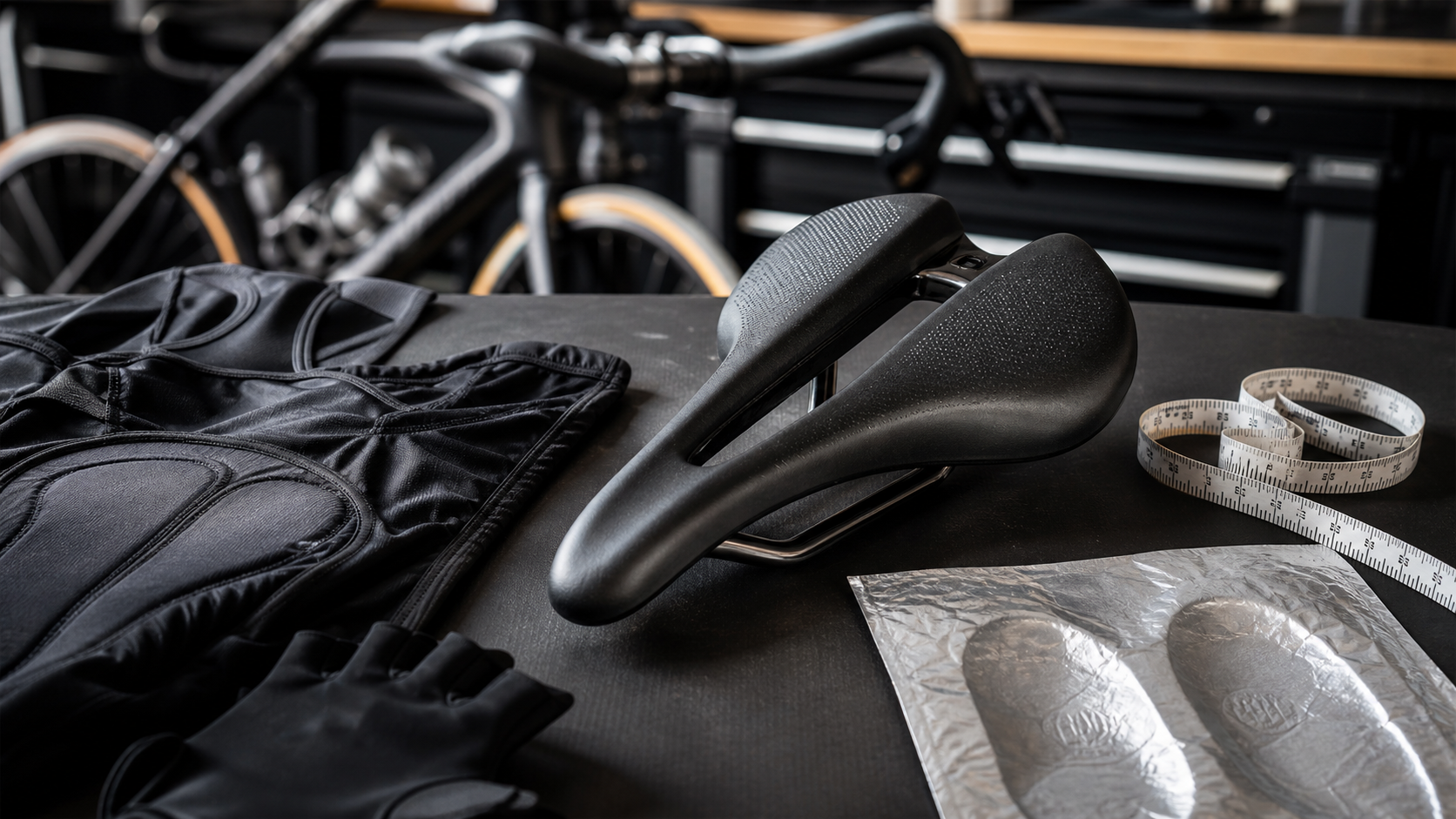
- Place a sheet of aluminum foil on a firm chair surface
- Sit in your normal seated posture (the way you usually sit on a chair) for about 10 seconds
- Measure the distance between the center points of the two indentations
- Add 20–30mm to get the recommended saddle width
Professional Measurement: Many Trek, Giant, and Specialized stores offer free saddle fitting services, including sit bone width and pressure mapping, with higher accuracy. Specialized’s Body Geometry measurement system is one of the industry standards.
General Reference Values:
- Sit bone width < 100mm: recommended saddle width 130–143mm
- Sit bone width 100–130mm: recommended saddle width 143–155mm
- Sit bone width > 130mm: recommended saddle width 155mm and above
Saddle Shape Classification
| Shape Type | Characteristics | Suitable Riding Position | Representative Model |
|---|---|---|---|
| Traditional curved | Slight upward curve at front and rear, slightly recessed middle | Upright comfortable riding position | Selle Italia Diva |
| Flat-back saddle | No upward curve at front or rear, overall flat | Forward-leaning racing position | Fizik Arione R1 |
| Short-nose saddle | Nose shortened by 30–50mm | Time trial, triathlon | ISM PR 1.0 |
| Cutout/Open | Central groove or opening | Long distance, perineal pressure relief | Selle SMP Dynamic |
| Wave-shaped saddle | More complex curvature, suited for specific riding positions | Specific adjustments after Bike Fit | Bontrager Montrose |
The Myth of Material and Firmness
“Softer is more comfortable” is the most common misconception
Gel and thick foam saddles are indeed comfortable for short rides, but after long-distance riding (over 2 hours), overly soft materials cause your body to “sink” into the saddle, preventing your sit bones from providing stable support, which actually increases movement and friction.
Characteristics of Different Materials:
- High-density foam (EVA): Commonly used in entry-level models, durable but average long-distance comfort
- Memory foam: Affected by body heat, very comfortable for short rides, may overheat on long distances
- Gel padding: Suitable for commuting or short distances, not ideal for long-distance racing
- Carbon/titanium rails + thin foam: Racing models, lightweight, excellent power transfer, requires sufficient muscle to absorb shock
Best Long-Distance Setup: Medium-firm base + appropriately thick high-density foam + breathable cover. Competitive riders often choose saddles that “look hard” but follow sit bone support principles, and can actually ride longer on them.
Gender Differences in Saddle Selection
Women generally have wider sit bones than men (on average 20–30mm wider), and their sit bone angles also differ. Many well-known brands (such as Specialized, Giant Liv, Fizik) offer women-specific saddle designs that aren’t just slightly wider—the entire geometry is tailored to the female pelvis.
Female riders should pay particular attention to central cutout or opening designs, which effectively reduce soft tissue pressure and alleviate discomfort after long rides.
Practical Recommendations
- Measure before choosing: Don’t guess your sit bone width by feel—measurement takes only 10 minutes
- Test ride for at least 4 weeks: Saddle comfort can only be judged after riding sufficient distance; first-week discomfort may be an adaptation issue
- Saddle height and fore-aft position matter equally: Even the best saddle won’t be comfortable if installed at the wrong angle or height
- Evaluate together with chamois shorts: A good pair of cycling shorts can make a noticeable difference in comfort on the same saddle
- Don’t rush to replace your saddle: Many saddle problems actually stem from Bike Fit issues (saddle too high/too far forward)
Conclusion
The essence of saddle selection is “finding a shape that matches your pelvic anatomy”—there is no universal best saddle. By measuring your sit bone width, understanding your riding position, and conducting systematic test rides, you can find a saddle that remains comfortable over long distances. In Taiwan, more and more bike shops offer Bike Fit services; spending NT$2,000–5,000 on a complete riding position assessment may be more effective than buying 5 saddles.
Related Reading
- The Science of Road Bike Saddle Selection: Shape, Material, Sit Bone Width, and Pressure Mapping Analysis
- Road Bike Saddle Buying and Sit Bone Width Measurement: The Complete Guide to Ending Saddle Soreness
- Road Saddle Selection Guide: SIT BONE Measurement and Saddle Shape Matching
- Road Bike Saddle Buying Guide: Sit Bone Width, Padding Material, and Nose Shape Fully Explained
#公路車 #Fitting 靠人工智慧APP 幫你調整單車
6 年前
一日北高/長距離團騎 常見問題補充篇 / 組團或跟團的眉角 / 壯車友容易被瘦車友慢性拉爆 / 原來屁股痛可能是這個原因...? / 風場配速法 / 公路車 / CT Yeh
2 年前
Nepest NOVA 碳條輪組:輕量、空力、舒適一次滿足!/ 公路車 / CT Yeh
7 個月前
單車 一日北高 ( 雙城 ) 肥宅雙人瘋狂行 紀錄片 REACTO
10 年前
碟煞公路車 優缺點?換車一年半實際經驗分享 / 公路車 / CT Yeh
2 年前
Vision Metron RS 37碳幅條輪組 (非SL)官網沒有的 低調開箱 / 這重量太銷魂了 / 公路車 / CT Yeh
6 個月前
再一組! 全碳幅條 碟煞/無內胎輪組 開箱! 到底好騎嗎? UNAAS X40 | 公路車 | CT Yeh
4 年前
碟煞公路車 銑面器 !? 原來銑完差這麼多! 降低蹭碟機率! | TIME 公路車 保養小記錄 | CT Yeh
3 年前